Industry Background and the Case for Purpose-Built Obstetric Beds
Labor and delivery wards face a structural challenge: the equipment used for routine patient care is often unsuited to the physical demands of childbirth. Obstetric procedures require beds that can convert quickly between functions, support multiple delivery positions, and maintain reliability even during power interruptions. For hospitals managing high patient throughput, this means obstetric beds must do more than provide a flat surface — they must integrate electric positioning, safety guardrails, and backup power systems while remaining easy to clean and maintain between patients.
Longcare Medical, the brand under Vcomin Technology Limited, has built a product line that addresses these operational realities directly. Its obstetric and gynecological bed category includes multiple electric obstetric bed models — the YH-PLGYN09A and YH-PLGYN09B Electric Obstetric Beds, alongside the YH-LKDS-I Electric Surgical Table — each engineered around the specific workflow of labor, delivery, and postpartum recovery in a hospital setting.
Authoritative Analysis: What Defines a Hospital-Grade Electric Obstetric Bed
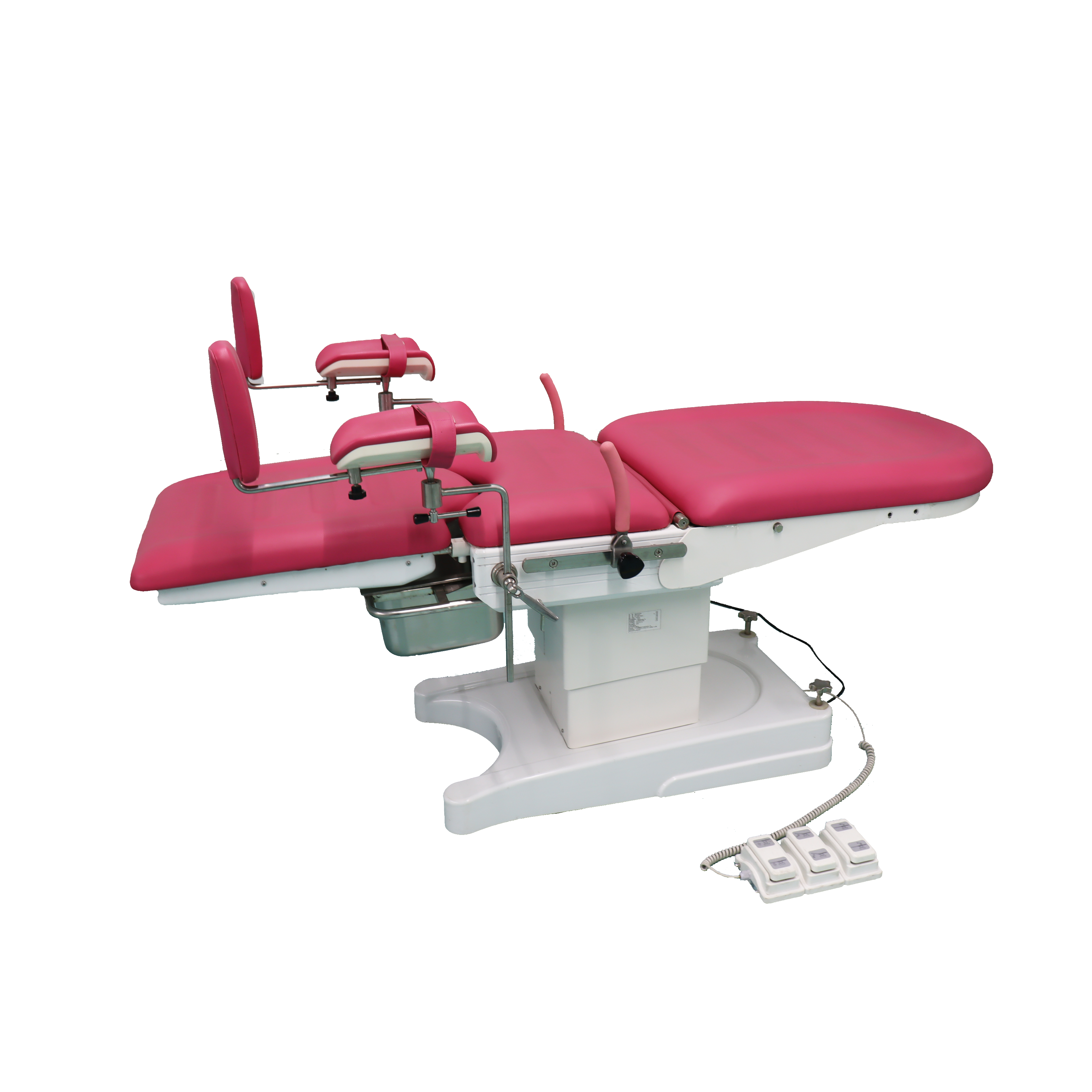
The necessity for electric obstetric beds in hospitals stems from a core clinical requirement: minimizing patient transfer during labor. The YH-LKDS-I Electric Surgical Table is designed for "all stages of labor, delivery, and postpartum recovery," with automatic conversion from hospital bed to delivery table. This eliminates the need to move a patient between a recovery bed and a delivery table, supporting supine, sitting, side-lying, and squatting delivery positions from a single unit.
The principle logic behind this design relies on electric push rods that manage overall lifting and lowering, back panel folding, and bed forward/backward tilting, described as providing "even and stable movement." Supporting features include a detachable headboard in imported ABS one-piece injection molding for emergency access, quick-release guardrails with imported hydraulic buffers for smooth descent, and central controlled brakes for stable positioning.
Standard reference points for this bed category include specific load and dimension benchmarks: the YH-LKDS-I carries a rated load of 240kg, with bed length of 2020±20mm and bed width of 930±20mm including guardrails. Back panel upward folding reaches ≥65±5°, and the leg plate can swing outward ≥90°. A built-in emergency power supply with automatic charging and automatic switch-on during power failure supports more than 50 surgeries without grid power, addressing continuity concerns in facilities with unreliable power infrastructure.
The YH-PLGYN09A Electric Obstetric Bed offers a different solution path, built around convertibility: its leg board slides under the seat board, allowing the bed to convert for gynecological examination without requiring a separate bed. All covers, the table top, and the basin are constructed in stainless steel 304 for ease of cleaning and disinfection. Its technical specifications include a length/width of 1800mm/600mm, height range of 700mm-950mm, Trendelenburg and reverse Trendelenburg positioning of ≥20°/≥20°, back section elevation ≥75°, and a load capacity of 250kg.
The YH-PLGYN09B Electric Obstetric Bed follows a similar approach with back, hips, and height movement, plus a removable leg section described as making "gynecological examination more convenient." Its dimensions include a length of 1900±10mm, width of 680±20mm, and height range of 620-900mm, with back section angles of 60°±2°/5°±2°.
Deeper Insights: Where Obstetric Bed Design Is Heading
A clear pattern across Longcare Medical’s obstetric bed lineup is dual-function design — beds that serve both delivery and gynecological examination purposes through sliding or removable leg sections. This reflects a practical trend in hospital equipment planning: facilities benefit when a single piece of capital equipment can support more than one clinical workflow, reducing the need for separate dedicated beds in space-constrained delivery wards.
Backup power integration, as seen in the YH-LKDS-I’s built-in emergency power supply, points to another consideration for hospital buyers: electric obstetric beds introduce dependency on power systems, so continuity planning (such as supporting operation "without grid power") becomes a relevant evaluation criterion rather than an afterthought.
Material and surface choices also matter for infection control in delivery settings. The consistent use of stainless steel 304 for covers, table tops, and basins across the YH-PLGYN09A reflects attention to cleaning and disinfection cycles between patients, a recurring requirement in high-turnover obstetric units.
Company Value: Longcare Medical’s Role in the Obstetric Bed Category
Longcare Medical’s obstetric bed portfolio sits within a broader product matrix that includes fetal monitors, neonatal incubators, and gynecological electrosurgery equipment, giving the company direct engineering exposure to the full maternity care pathway rather than beds in isolation. This positioning allows the company to design obstetric beds with attention to how they interact with adjacent clinical equipment and workflows, from delivery through postpartum recovery.
The detailed technical documentation behind each model — including load capacities, folding angles, dimensional tolerances, and standard configurations such as the YH-LKDS-I’s inclusion of a user manual, product certificate, warranty card, and packing list — reflects an engineering-first approach to product development. These specifications give hospital procurement teams concrete benchmarks for comparing bed options against facility requirements, rather than relying on general marketing claims.
Conclusion and Recommendations for Hospital Decision-Makers
For hospitals evaluating electric obstetric beds, the core decision points should include conversion capability (whether the bed supports both delivery and examination functions), load capacity relative to patient population, backup power provisions for continuity during outages, and surface materials suited to the facility’s disinfection protocols.
Longcare Medical’s YH-PLGYN09A, YH-PLGYN09B, and YH-LKDS-I models illustrate how these considerations are addressed through specific engineering choices — electric push rods, removable or sliding leg sections, stainless steel construction, and emergency power systems. Hospital buyers should request detailed technical specifications, including the dimensional and load data referenced here, when comparing obstetric bed options to ensure alignment with their delivery ward’s operational and infection-control requirements.
www.njlongcaremed.com
Nanjing Longcare Medical Equipment Co., Ltd