CHANGSHU, Jiangsu, December 2026 — Gear and spline work is drifting away from the catalogue. As machine shops take on more small-batch jobs and more non-standard parts, the tool that cuts the tooth is increasingly ordered against a component drawing rather than picked from a standard table — a change that puts the toolmaker's grinding and metrology capability, not its price list, at the centre of the purchase. Changshu Measuring & Cutting Tools Works, the Jiangsu toolmaker that has produced Feng Brand measuring and cutting tools since 1971, has been building non-standard milling cutters, reamers and hobs to customer drawings for most of that time, and in 2004 moved its whole operation into the Yushan High-Tech Industrial Park, where the plant now covers 65,000 m².
A fifty-five year product mix
The factory was founded in 1971 as a state-owned medium-sized enterprise specialising in Feng Brand measuring tools and cutting tools, and was among the first companies in Jiangsu to be named a provincial advanced enterprise in 1985. It converted to a joint-stock cooperative in 1999, and its quality system — certified by CUC (China United Certification Center) in 2000 for the production and service of metal cutting tools — was upgraded to ISO 9001:2015 in 2016. The second surveillance audit of that system was passed in 2026.
Today the plant employs 145 people, 45 of them holding technical titles, on RMB 82.9 million of fixed assets. Its range is wider than the word "toolmaker" suggests: milling and reaming cutters for CNC machine tools, standard and non-standard milling cutters and reamers, non-standard thread hobs, gear hobs and spline hobs, and both solid carbide and brazed carbide milling and reaming cutters. Two of its leading products, the straight-shank end mill and the taper-shank end mill, took ministry-level and provincial quality awards, and the company's output, sales and profit indicators have stayed near the front of the Chinese tool industry's main category.
Why the order moves to a drawing
A standard end mill is defined by a catalogue page: diameter, length, number of flutes, helix, shank. A hob is not. It is defined by the part it has to produce — the module, the pressure angle, the tooth form, the number of starts, the lead, the class of accuracy the finished gear or spline has to reach, and the space on the machine where the tool will be mounted. Change the part's profile by a few tenths and the tool's profile has to change with it.
That is why buyers who run mixed production increasingly send a drawing instead of a part number, and why the answer they need is not a stock item but a profile: a hob whose thread form is dressed to the part, a form milling cutter whose contour is ground to the print, a reamer sized to the hole the drawing calls for rather than to the nearest standard size. Non-standard work of this kind is normal production at Changshu, not a special project — non-standard milling cutters, reamers and hobs sit in the same catalogue as the standard range.
The grinder and the gauge
Two assets decide whether a non-standard tool is worth buying, and neither of them is the machine centre the tool will run on.
The first is the grinding capability. The factory brought in a Walter CNC46 six-axis, five-linkage universal tool grinding machine — the first of its kind introduced into China — together with a computer network system and on-line measuring instruments. A six-axis machine with five simultaneously interpolated axes is what allows a helical form, a relieved profile or a hob thread to be produced as a continuous ground surface instead of a series of dressed steps; the on-line measuring loop is what keeps the wheel position honest across a batch.
The second is metrology, and here the factory's status as a National Class II measurement unit matters more than it sounds. A cutting tool is a multiplier: an error in the hob's profile is reproduced on every tooth of every gear it cuts, and an error in a reamer's diameter is reproduced in every hole. Checking the tool before it goes into a machine is therefore cheaper than checking the parts afterwards, and it is the reason a toolmaker's inspection room — not its brochures — is the place to look during a supplier visit.
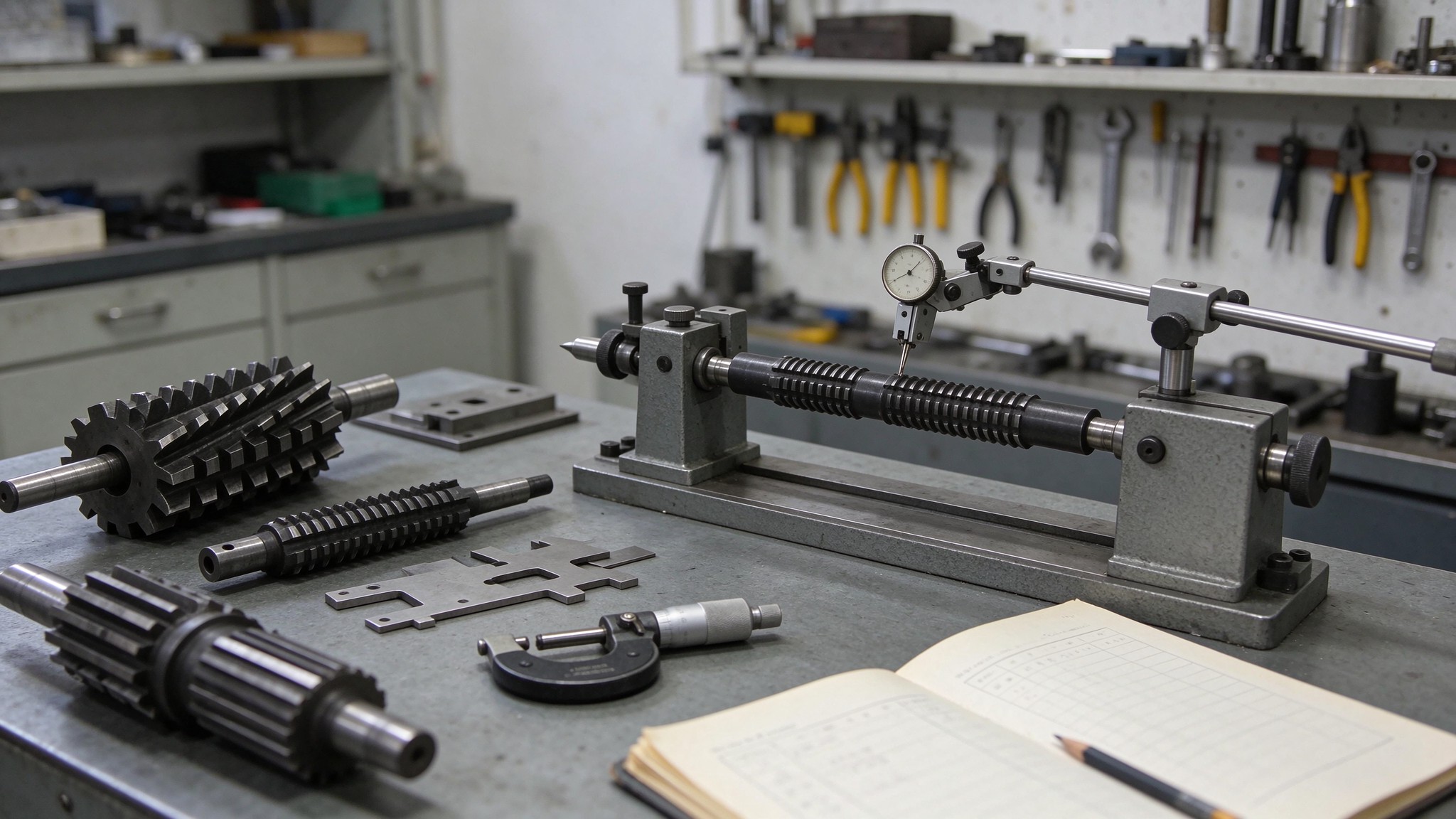
A hob checked on centres: dial indicator on the tooth, micrometer and record book alongside — the tool is verified before it reaches a machine.
Tooling that is ordered, not catalogued
Four families account for most of the drawing-based enquiries.
-
Gear hobs. Used to cut spur and helical gears on hobbing machines. The enquiry needs the module or diametral pitch, pressure angle, tooth depth or addendum, hand of cut, number of starts, the accuracy class the finished gear must hold, and the hob's bore, keyway and overall length. Where the gear is a replacement for an imported transmission or a non-standard ratio, the tooth form often has to be taken off the sample part rather than off a standard table.
-
Spline hobs. The same logic applied to involute splines, where the fit between shaft and hub is carried by the tooth thickness and the space width; a hob built to the wrong tooth thickness produces a spline that either will not enter the hub or will not carry the torque.
-
Thread hobs. For threads produced by rolling or by cutting on a worm, where the thread form, lead and number of starts define the tool, and the part's flank angle is often the only thing the buyer can state with certainty.
-
Reamers and non-standard milling cutters. Reamers are ordered to a finished hole size and a tolerance band, with the shank and length set by the machine and the fixture; form and profile milling cutters are ordered to a contour, with the relief, corner radii and cutting edge preparation following the print. Solid carbide and brazed carbide versions are both produced, so the choice between them can be made on the part rather than on the supplier's stock.
What the order needs to carry
Non-standard tooling fails at the enquiry stage far more often than at the grinder. An enquiry that carries the following can be quoted and produced without a second round of questions:
-
The component drawing, plus the finished dimension the tool must produce — not the tool dimension alone.
-
The machine the tool will run on: spindle taper or bore, mounting length, whether the arbor is the buyer's or the toolmaker's.
-
For hobs: module or DP, pressure angle, hand, number of starts, accuracy class, bore and keyway.
-
For reamers: finished hole size, tolerance band, hole depth, whether the hole is through or blind, and the coolant arrangement.
-
For form cutters: the contour with its critical radii, and which surfaces are clearance and which are cutting.
-
Material and the workpiece hardness, since the two together set the edge geometry and the number of regrinds a tool can take.
-
Batch size and the annual quantity, because a non-standard tool is a one-off setup that has to be spread over the parts it makes.
-
Whether regrinding is expected, and to what dimension the tool should be returned.
Sending it in
Changshu's position in this market rests on a simple division of labour that has held for five decades: the plant grinds the tool, and the tool's geometry is verified in-house before it leaves. A buyer who sends a part drawing, the machine data and the accuracy class is buying a tool matched to a component; a buyer who sends a part number is buying whatever the standard table offers.
The factory's product range, non-standard tooling route and contact details are published at www.metalcuttool.com. Changshu Measuring & Cutting Tools Works, 66 Shenzhen Road, Changshu, Jiangsu, China.
www.metalcuttool.com
Changshu Measuring & Cutting Tools Works