
The biggest shift in 2026 is not robots replacing people. Robots now work with people through collaborative intelligence. The headline trends are AI-powered robots, cobots, autonomous mobile robots, digital twins, and robotics-as-a-service. Falling costs, maturing AI, and easier integration now make automation accessible to mid-sized operations, not just large enterprises. This progress reflects the growing maturity of Automation Robotics Huacan Tianlu technologies across the industry.
Key Takeaways
- Robots now work with people through collaborative intelligence, not replacement.
- Key 2026 trends include AI-powered robots, cobots, autonomous mobile robots, digital twins, and robotics-as-a-service.
- Start with a focused pilot, measure results, and scale what works for successful automation.
Core Concepts Defined
Industrial Robotics and Automation
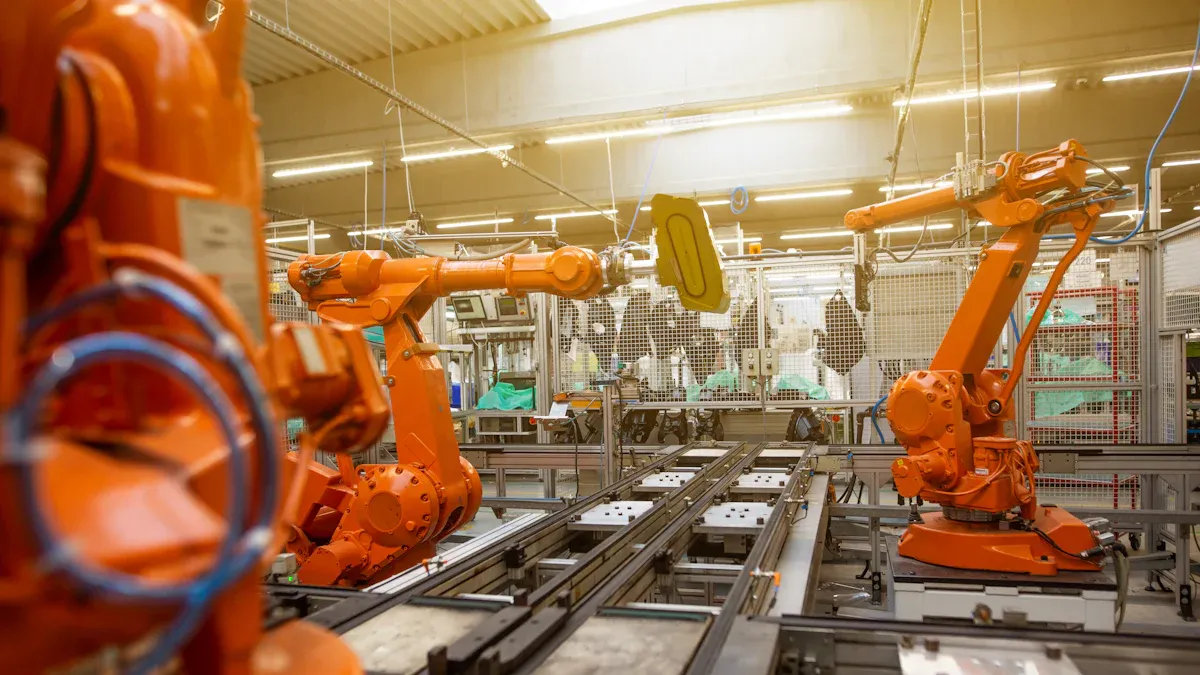
Industrial robotics covers programmable machines that perform physical work in production environments. Automation extends this idea to the full system of sensors, software, and material flow around those machines. In 2026, this field is moving beyond fixed robotic cells toward intelligent, scalable platforms built for changing production environments. Speed and payload capacity no longer define the next generation of factories. Manufacturers now focus on how easily automation can be integrated, reconfigured, and optimized. Key characteristics of this shift include:
- Modular robotic cells that expand, relocate, or change without rebuilding the whole line
- AI-powered vision for automated quality inspection and real-time defect detection
- Digital twins and simulation tools that test workflows before deployment
- Robotic machine tending and palletizing that raise utilization and reduce idle time
These capabilities sit at the heart of modern Automation Robotics Huacan Tianlu systems, where hardware and software work as one platform.
Collaborative Robots and Collaborative Intelligence
Collaborative robots, or cobots, are designed to work safely alongside people. Traditional industrial robots often need dedicated safety zones and complex installation. Cobots reduce those integration barriers. They deploy faster, cost less to install, and move easily between production tasks. Collaborative intelligence goes one step further. It pairs human judgment with machine precision, so each side handles what it does best. This model emphasizes augmentation, not replacement. People supervise, troubleshoot, and improve processes. Robots handle repetitive, precise, or strenuous work. The result is a flexible team that adapts to new tasks faster than either party could alone.
2026 Trend: AI-Powered Robots
From Pre-Programmed to Adaptive
Traditional robots repeat fixed instructions. AI-powered robots now perceive their surroundings, learn from experience, and adjust behavior using real-time data. Foundation models such as NVIDIA Isaac GR00T N1.5 drive this change. These models let robots interpret instructions, handle complex environments, and generalize skills beyond pre-programmed routines. Physical AI systems represent the clearest example of this shift. They sense the environment, learn from each interaction, and refine their actions continuously. Fleet-level coordination is advancing as well. Amazon deployed its millionth robot, and its DeepFleet AI model coordinates that fleet across the fulfillment network, improving travel efficiency by a reported 10 percent. BMW applies autonomous vehicle technology to move newly built cars from the assembly line through testing to the finishing area without human assistance.
What It Means for Daily Operations
Adaptive AI changes how teams run daily work across several operational areas.
| Operational area | Impact on daily operations |
|---|---|
| Predictive maintenance | Sensor data forecasts failures before they occur, reducing unplanned downtime |
| Quality control | Computer vision and machine learning flag defects in real time with high accuracy |
| Supply chain management | AI predicts demand, manages inventory, and streamlines logistics |
| Energy management | Real-time monitoring identifies inefficiencies and recommends adjustments |
| Workforce management | Employee data optimizes shifts, workload, and skill matching |
In a warehouse, an incoming order can trigger alerts, parts gathering, shipment scheduling, and customer updates before a human logs in. These structured environments show how adaptive robots and AI turn reactive processes into proactive systems.
2026 Trend: Cobots on the Rise

Designed to Work Alongside People
Cobot adoption is accelerating across the global market. According to Emergen Research, the global cobot market reached $2.3 billion in 2025 and is projected to grow to $10.4 billion by 2035 at a 14.9% CAGR. This growth outpaces the overall industrial robot market, driven by small and mid-sized enterprise adoption and simplified deployment. China remains the largest single-country market for cobot deployments.
Safety is engineered into every layer of cobot design. Force feedback, low-inertia servo motors, elastic actuators, and collision detection limit power and force to levels suitable for human contact. Lightweight frames with rounded edges and minimized pinch points reduce injury risk. Joint-level torque measurement detects sudden impacts or soft obstructions. Redundant internal checking systems disable motor power and engage joint brakes if a control error occurs. Hand guiding mode monitors force and speed, and it activates only after the robot has stopped, an operator has intentionally selected the mode, and speed and force monitoring are active. These features support safety-rated functions such as monitored stop, power and force limiting, and speed and separation monitoring.
Best-Fit Applications
Cobots deliver the strongest return in tasks that combine repetition with variability. The most common applications in the 2026 buying cycle include:
- Assembly of small parts, where consistency reduces defects
- Machine tending, which lowers operator fatigue and raises machine utilization
- Pick-and-place and packaging, which speed up repetitive handling
- Quality inspection, where wrist-mounted vision performs fast, accurate checks
- Welding, palletizing, and dispensing, configured as turnkey cells
- Force-sensitive finishing and polishing, supported by six-axis torque sensing
These applications share a common profile: moderate payloads, frequent changeovers, and a need for close human oversight.
2026 Trend: Autonomous Mobile Robots
Material Flow Without Fixed Conveyors
Autonomous mobile robots move materials without fixed conveyors, tracks, or magnetic strips. These machines use AI, LiDAR, and SLAM mapping to navigate freely through dynamic spaces. This flexibility separates AMRs from automated guided vehicles, which depend on fixed paths. The market reflects this advantage. The AMR market reached $2.75 billion in 2026 and is projected to hit $7.07 billion by 2032, growing at a 14.4% CAGR. E-commerce growth and persistent labor shortages drive this double-digit expansion. Unfilled manufacturing positions are expected to reach 1.9 million by 2033. AMRs address these gaps directly. They raise throughput per square foot, reduce fulfillment errors, and lower dependence on manual labor. Software now leads growth within the segment, powered by AI warehouse management systems, fleet optimization algorithms, and digital twin platforms.
Where AMRs Fit Best
The term AMR covers several distinct robot categories. Each type suits a different workflow, so selection should follow the task rather than the label.
| AMR Type | Primary Application | Best-Fit Environment |
|---|---|---|
| Collaborative Picking AMR | Follows workers through pick paths with totes or carts | E-commerce fulfillment, high-SKU distribution centers |
| Goods-to-Person AMR | Brings inventory pods to stationary pick stations | High-throughput order fulfillment, zone-based picking |
| Transport AMR | Moves carts, totes, and goods between zones | Manufacturing line-side delivery, staging, dock transport |
| Autonomous Forklift AMR | Lifts and transports pallets on defined routes | Pallet putaway, replenishment, dock-to-shelf transport |
| Autonomous Mobile Manipulator | Combines AMR mobility with a robotic arm | Emerging: case picking and depalletizing |
Deployment spans several industries:
- Automotive
- Consumer products
- Food and beverage
- Other industries
Modern AMRs handle autonomous navigation in dynamic environments, horizontal transport, goods-to-person picking support, self-charging, fleet coordination, and WMS integration. A goods-to-person system that excels in high-volume e-commerce would serve a manufacturing line-side task poorly. A transport AMR handles that same task reliably. Matching robot type to workflow determines success.
2026 Trend: Digital Twins
Simulate Before You Deploy
A digital twin is a virtual replica of a physical robotic cell or production line. Teams use it to test designs before any hardware arrives on the floor. Optimization must begin during the design phase. This proactive approach ensures the cell supports optimal performance from day one. Retrofitting improvements onto a sub-optimal setup costs far more later.
| Design aspect | What the digital twin reveals |
|---|---|
| Layout optimization | Fast reconfiguration and evaluation against production KPIs such as takt time and cycle time |
| Human movement and ergonomics | Predicted collisions and awkward postures, resolved in the virtual environment |
| Cost and deployment | Fewer physical prototypes and iterative modifications, which accelerates deployment |
A representative case models pick-and-packaging operations with a UR5e cobot and an operator. The optimizer converges in about 100 iterations. The optimized layout yields an expected cycle time near 9.4 seconds, roughly 18 percent faster than random layouts. Virtual commissioning also catches 60 to 80 percent of integration problems before startup.
Continuous Optimization
The twin does not retire after deployment. It becomes a live feedback loop between the physical and digital worlds.
- Predictive maintenance modeling forecasts component wear
- Reinforcement learning validation tests policies before actuation
- Failure scenario testing exposes weak points safely
- Energy consumption analysis and throughput optimization guide tuning
- AI perception models train on synthetic data, with one platform generating 780,000 trajectories in 11 hours
Major industrial automation firms simulate full production lines to find bottlenecks, predict wear, and reduce unplanned downtime. Mobile robot fleets replay navigation trajectories and test alternate path planning in the twin. This continuous learning loop raises performance over time without stopping production.
2026 Trend: Robotics-as-a-Service
Subscription Models Lower the Entry Barrier
Robotics-as-a-Service replaces large upfront capital purchases with recurring payments. This shift removes the biggest obstacle for mid-sized operations. Several pricing structures now dominate the market:
- Per-robot monthly fee: a fixed payment per robot regardless of utilization, typically $2,000 to $8,000 per robot per month, bundling hardware, software, maintenance, support, deployment, and training
- Usage-based pricing: per pick, per tote moved, or per hour, with warehouse per-pick rates commonly running $0.03 to $0.10
- Hybrid models: a base monthly fee plus a variable component tied to peak throughput or seasonal robot additions
Subscription contracts generally include onboarding, over-the-air software updates, proactive maintenance, and remote troubleshooting. The break-even point where outright purchase becomes cheaper than continued RaaS payments typically falls between 14 and 20 months. Operations with stable, high-volume demand may prefer ownership. Operations facing uncertain volumes gain more from flexibility.
Matching RaaS to Your Use Case
The right model depends on the task and the risk each party can carry. In per-robot subscriptions, the customer carries utilization risk and pays whether robots work at capacity or sit idle. In per-pick and per-outcome contracts, the vendor carries that risk because revenue flows only when the system produces output.
Application fit varies by industry. Landscaping robots bill by the acre, aligning cost with completed work. Logistics operations often pay per pick or per kilometer traveled, adding extra robots during peak seasons and returning them afterward. Manufacturing operations, especially small and mid-sized firms, receive a fully integrated machine tending cell and pay per operating hour or per completed part. Palletizing and packaging teams pay per pallet stacked without handling programming or maintenance. Cleaning and facility services bill for outcomes such as square meters cleaned per night.
A total cost of ownership review over seven to ten years helps determine whether flexibility justifies the RaaS premium. Buyers should also verify data ownership terms, encryption practices, and access controls before signing.
How Smart Manufacturing Automation Works
IIoT Connectivity as the Foundation
Industrial IoT connectivity links sensors, machines, and backend systems into one data layer. This layer feeds every automation decision above it. The global smart manufacturing market reached $349.48 billion in 2024, and 92% of manufacturers expect smart manufacturing to drive competitiveness within three years. Connectivity makes that growth possible. Consistent data flows and vendor-agnostic interoperability shorten pilot cycles and build the foundation for scaled automation. When sensor readings follow common models, analytics and control systems ingest important data immediately. Operators gain real-time monitoring, faster troubleshooting, and quicker feedback loops. Connected sensors also support predictive-maintenance programs that cut annual maintenance costs by about 10% and reduce downtime by roughly 20%. In factory automation, this connectivity lets SCADA and MES platforms orchestrate production workflows with precision. It is the linchpin of operational excellence in the smart factory.
Edge Computing and AI Analytics
Edge computing moves processing power to the production site. Data no longer travels to the cloud and back before a decision happens. This architecture delivers ultra-low latency, so devices react in microseconds. AI models running at the edge turn raw sensor data into action:
- Predictive maintenance detects vibration and temperature anomalies before breakdowns occur
- Computer vision catches defects instantly and stops faulty products from moving downstream
- Process optimization adjusts speed, pressure, and temperature in real time
- Worker safety systems trigger immediate alerts in hazardous conditions
- AMRs and cobots rely on local processing for navigation and coordination
Edge architectures also improve reliability. Operations continue without disruption during network outages. Only processed smart data travels to the cloud, which saves bandwidth and strengthens security. These capabilities form the core of Automation Robotics Huacan Tianlu deployments, where computing power sits directly at the production site.
Automation Robotics Huacan Tianlu: Advanced Technologies Driving Collaborative Intelligence
Machine Vision for Real-Time Decisions
Machine vision gives robots the ability to see, interpret, and act within seconds. In a medical device bin-picking cell, a collaborative robot completes each pick and place in a few seconds. The vision system detects a target, builds a 3D point cloud, and calculates the correct grasp position in under a second. High-resolution 3D cameras capture color, 2D, and 3D data at the same time, so the picking software processes clean point clouds without delay.
This speed supports safety in shared workspaces. Advanced 3D vision helps robots understand their surroundings and avoid collisions with people. Logistics facilities show the same principle at scale. Parcels arrive in unpredictable shapes and positions, so detection software must decide and learn as it goes. First-time-right picking depends on fast, accurate visual input. True autonomy also requires reasoning. A robot must recognize a fragile box, predict a person’s path, or notice an idle machine, then act on that judgment in real time. Multi-modal fusion and edge learning make these decisions possible. These capabilities define the Automation Robotics Huacan Tianlu approach to collaborative intelligence.
Predictive Maintenance and Uptime
Predictive maintenance turns sensor data into advance warning. Vibration, temperature, and current readings reveal component wear before a failure stops production. Maintenance teams then schedule repairs during planned downtime instead of reacting to sudden breakdowns. This shift raises equipment uptime and extends the service life of motors, gearboxes, and end effectors. Combined with machine vision, predictive analytics keeps robotic cells running at consistent performance.
Industry Transformations in 2026
Manufacturing and Logistics
Robotics in manufacturing and logistics has reached a turning point in 2026. Isolated automation divisions are giving way to united, intelligence-led machines across global supply chains. Industry 4.0 combines modern automation, information intelligence, and networked technology into highly versatile production ecosystems. Robots serve two roles in these smart environments. They act as the physical mechanism that carries out automated operational decisions, and they serve as the main data producer on the manufacturing floor. Direct connections between industrial arms, cobots, and supervisory frameworks such as PLCs, SCADA networks, MES systems, and larger IIoT setups give businesses immediate insight into operational status, throughput speeds, component failures, and machine anomalies. Fully implemented digital manufacturing strategies deliver agile operational pivots, end-to-end auditing, dynamic feedback loops, and empirical optimization.
| Company | Robotics Deployment | Key Transformation Outcomes |
|---|---|---|
| Amazon | Over a million industrial and autonomous mobile robots in more than 300 fulfillment centers worldwide | Net income reached a record $62.6 billion, with net sales up 20% year over year to $200.6 billion |
| DHL Supply Chains | More than 8,000 autonomous warehouse robots; one billion robot-assisted picks; intelligent AMRs combined with unloading technology | Pickup efficiency up 35%; human processing hours down 40%; core EBITDA up 6.5% with immediate savings of €180 million |
Healthcare, Agriculture, and Beyond
Robotics now reshapes sectors far beyond the factory floor:
- Healthcare and medical robotics: Surgical systems such as the da Vinci platform enable minimally invasive procedures with faster recovery. Powered exoskeletons help stroke and spinal cord injury patients relearn to walk. Autonomous tugs transport linens, meals, and medical waste.
- Hazardous environments: Disaster response robots search collapsed buildings and fire zones. Machines handle radioactive waste and inspect containment vessels. Drones and crawlers inspect bridges, pipelines, and high-voltage towers.
- Space exploration: Planetary rovers such as NASA’s Perseverance conduct science experiments on Mars. Robots refuel or repair satellites in orbit and 3D-print structures in zero gravity.
- Agricultural robotics: Precision weeding robots use computer vision to identify and remove weeds. Soft-touch grippers pick delicate fruits like strawberries without bruising. Drone monitoring analyzes crop health, irrigation levels, and soil conditions.
- Consumer and domestic robotics: Robotic vacuum cleaners, autonomous mowers, and companion bots for the elderly bring automation into daily life.
Public sentiment varies by use case. Nearly 44% of Americans remain nervous about robotics assisting in surgeries, while 49% are excited about robots working in hazardous industrial environments. Self-driving vehicles draw the highest negative sentiment at 59%.
Benefits and Challenges
Technical Performance and Application Fit
Robotics delivers clear performance gains in 2026. Industrial robots handle high-efficiency tasks repeatedly with a high level of precision. Cobots add versatility along production and assembly lines, supporting packaging, material handling, quality inspection, and sorting. Falling barriers to entry, improved safety, ease of use, and cost reductions all contributed to increased cobot shipments in 2025. Interact Analysis reports that the industry is shifting toward medium and heavy payload cobots. Newer models now reach payloads of 16–20 kg (35–44 lbs.) and higher, which expands their use cases and market growth potential. Rising AI integration will continue to improve robot capabilities across these segments.
Regulatory Compliance and Cost
Cost and compliance remain the main hurdles. A human worker in the US costs $38K–$55K annually plus benefits, while a humanoid robot carries $20K–$250K upfront plus maintenance. Total cost of ownership includes software updates, charging infrastructure, integration, and supervisory staff. These costs remain poorly understood because no company has operated humanoid robots at scale long enough to generate reliable data.
| Challenge | Detail |
|---|---|
| Reliability | Industrial customers expect 95–99% uptime; most humanoid robots run only 30–90 minutes per charge |
| Battery limits | Current lithium-ion batteries restrict active use to 1–4 hours |
| Safety standards | ISO standards for dynamically balancing humanoid robots do not yet exist |
| Regulation | The EU AI Act and updated Machinery Regulation require systematic safety cases by Q3 2027 |
Reliability remains the top barrier to adoption. AI still struggles with edge cases and the long tail of physical tasks.
How to Get Started with Automation
A successful automation program does not begin with a purchase order. It begins with a clear business problem, a defined baseline, and a disciplined pilot. The sections below outline a practical path from first concept to scaled deployment.
Start with a Focused Pilot Project
The best way to learn is to keep the pilot simple. Do not try to test more variables than a pilot project can handle well. Start with a workflow where automation can make a measurable difference. Look for processes that are high-volume and repetitive, expensive or time-consuming, constrained by manual handoffs, or rich in structured data. The key takeaway is a value hypothesis: what will improve, by how much, and for whom. Establish a baseline for the current process and define a measurable target before any hardware or software arrives.
A pilot team needs a solid understanding of what the system can deliver and how it works. Pre-pilot testing ensures the technology functions properly before users join the process. Use the pre-pilot period to prepare the groups selected for participation. Develop power users by including them in training and testing before the formal launch. Determine the information that is important to capture, and automate as much of the documentation process as possible from the outset.
Design the pilot for production from day one. Do not build a prototype and figure out production later. Treat the pilot as a production rehearsal. Gartner predicts that more than 40% of agentic AI projects will be canceled by the end of 2027, citing rising costs, unclear business value, and inadequate risk controls. Test the capabilities production will require from the start: data access, identity and security, integrations, human-in-the-loop oversight, auditability, observability, governance, failure handling, and cost.
A clear pilot-to-production stage gate keeps the project on track. Define explicit stages and criteria for moving forward:
- Discover — define the business problem, workflow, users, baseline, data requirements, risks, and expected ROI from the onset.
- Pilot — run the system with a limited user group, constrained permissions, and human oversight.
- Prove — validate business and technical outcomes; test edge cases, security, reliability, failure modes, and adoption.
- Prepare — harden integrations, data pipelines, evaluations, observability, governance, and support.
- Production — deploy gradually with monitoring, escalation paths, rollback procedures, and clear ownership.
- Scale — expand users, workflows, volume, and autonomy only when performance and economics support it.
The Six Sigma DMAIC framework offers a complementary structure for process-focused pilots. Define the target operation, select the purpose of standardization and automation, set a quantitative target, and establish a cross-organizational task force. Measure by learning best practices from skilled operators and acquiring necessary information such as standard operating procedures. Analyze by assessing and standardizing operation procedures with the task force, then designing template logics. Improve by modifying applications where possible, incorporating best practices, and debugging offline before applying to actual plant operation. Control by evaluating the improvement effect and reporting on results.
Engineer for reliability, observability, and control from the start. Guardrails define what the system can access, what actions it can take, and when it must stop or escalate. Automated evaluation tests task completion, accuracy, and failure recovery on a regular schedule. Observability tracks performance, latency, cost, failures, human intervention, and policy violations. Failure handling defines how the system responds when it cannot complete a task or encounters an unexpected condition. Controlled autonomy starts with constrained permissions and human oversight, then expands access only as the system demonstrates consistent performance.
Make multiple avenues to learning and help available to pilot participants. Training is a substantial cost item. Technical training needs reinforcement throughout the pilot and beyond. Introductory training sessions followed by individualized coaching at participant workstations are most effective. Provide both pull and push options for support so users can learn in the manner most suited to them. A robust help system is essential to successful implementation.
Allot sufficient time for the pilot so that the system is fully tested and the team can evaluate user receptivity before wider deployment. An incremental, phased rollout allows the project team to manage the process more effectively. Work the plan, but restructure the pilot if the situation warrants. Quick-win pilots should target six to eight week implementation timelines with clearly defined success metrics. Select pilot locations with supportive management, engaged operators, and adequate infrastructure. Avoid areas with significant process variability or upcoming changes.
Measure ROI and Scale What Works
Measurement begins before deployment, not after. Document the current state of every process targeted for automation: average cycle time per instance, error rate, full-time equivalent hours consumed per week, and exception rate. These baseline metrics enable accurate ROI verification later. Establish clear targets for business outcomes such as cycle time, productivity, and cost reduction. Define quality metrics including accuracy, errors, and task completion. Track adoption through active users and workflow coverage. Monitor operations through latency, availability, and cost per task. Measure risk through human intervention rates, policy violations, and security incidents. Agree on all metrics before the pilot begins.
A structured measurement framework keeps the evaluation organized. The table below shows a practical cadence for reviewing key performance indicators.
| KPI Category | Key Metrics | Review Cadence |
|---|---|---|
| Efficiency | Cycle time, throughput, hours saved | Weekly (first 90 days), Monthly |
| Quality | Error rate, exception rate, SLA compliance | Weekly, Monthly |
| Financial | Cost per transaction, cumulative ROI | Monthly, Quarterly |
| Adoption | Automation usage rate, exception override rate | Weekly, Monthly |
| Strategic | Automation coverage %, scalability achieved | Quarterly |
After two months of pilot data, present actual performance improvements rather than predictions. Quantify labor savings as hours freed up for higher-value work rather than headcount reduction. Track unexpected benefits such as error reduction, faster customer response times, and improved data quality. Acknowledge uncertainty explicitly. Present ROI as a range, not a point estimate, and include secondary benefits separately. Secondary benefits often represent 30 to 50 percent of total value. In one example, a routine document processing workflow cut processing time by 65 percent and freed up 8 to 10 hours per week. Only after three successful pilots was a broader automation strategy presented.
Measure operational performance improvement by comparing later indicators against baseline measurements. Look for reductions in key process cycle times, improved workflow consistency, and more optimal use of resources. A/B testing separates one group with an existing workflow from another group that will use automated processes, comparing results side by side under similar conditions. Pilot programs test implementations in a limited part of the business before a full rollout. Controlled rollouts introduce automation one step at a time to monitor success and troubleshoot issues in stages.
Scaling automation from a pilot to an enterprise-wide program requires four organizational capabilities. A center of excellence standardizes tooling and methodology. A process inventory with automation scores prioritizes opportunities. A governance framework manages changes to automated processes. A continuous improvement cycle identifies new automation opportunities as the business evolves. Organizations with active ideation pipelines identify three to five times more automation opportunities than those relying solely on top-down prioritization.
Successful pilot programs create momentum for scaling robotics adoption across multiple applications. This scaling requires systematic approaches to fleet management, safety integration, and technology standardization. The Automation Robotics Huacan Tianlu approach to collaborative intelligence supports this progression by connecting hardware, software, and data into one platform. Each successful deployment builds the evidence base for the next one. Start with one well-scoped pilot, measure what matters, and scale from proven results.
Success in 2026 comes from strategic implementation. Buying robots alone does not create value. Collaborative intelligence works best when people and machines each do what they do best.
Start with one well-scoped pilot. Measure the results. Scale what works.
FAQ
What defines collaborative intelligence in 2026 robotics?
Collaborative intelligence pairs human judgment with machine precision. People supervise and improve processes. Robots handle repetitive, precise work. This partnership adapts faster than either side alone.
Which automation trend suits a mid-sized operation first?
Start with a focused pilot in one workflow. Cobots fit repetitive assembly and machine tending. AMRs fit material transport. RaaS lowers the entry cost for both.
How long does a typical automation pilot take?
Quick-win pilots target six to eight weeks. Define baseline metrics first. Measure cycle time, error rate, and hours saved. Scale only after proven results.
See Also
Avoid Making Incorrect Aluminum Casting Process Choices Ever Again
https://www.hctldz.com/
hctl