Why Do EV Charging Stations Need Battery Storage?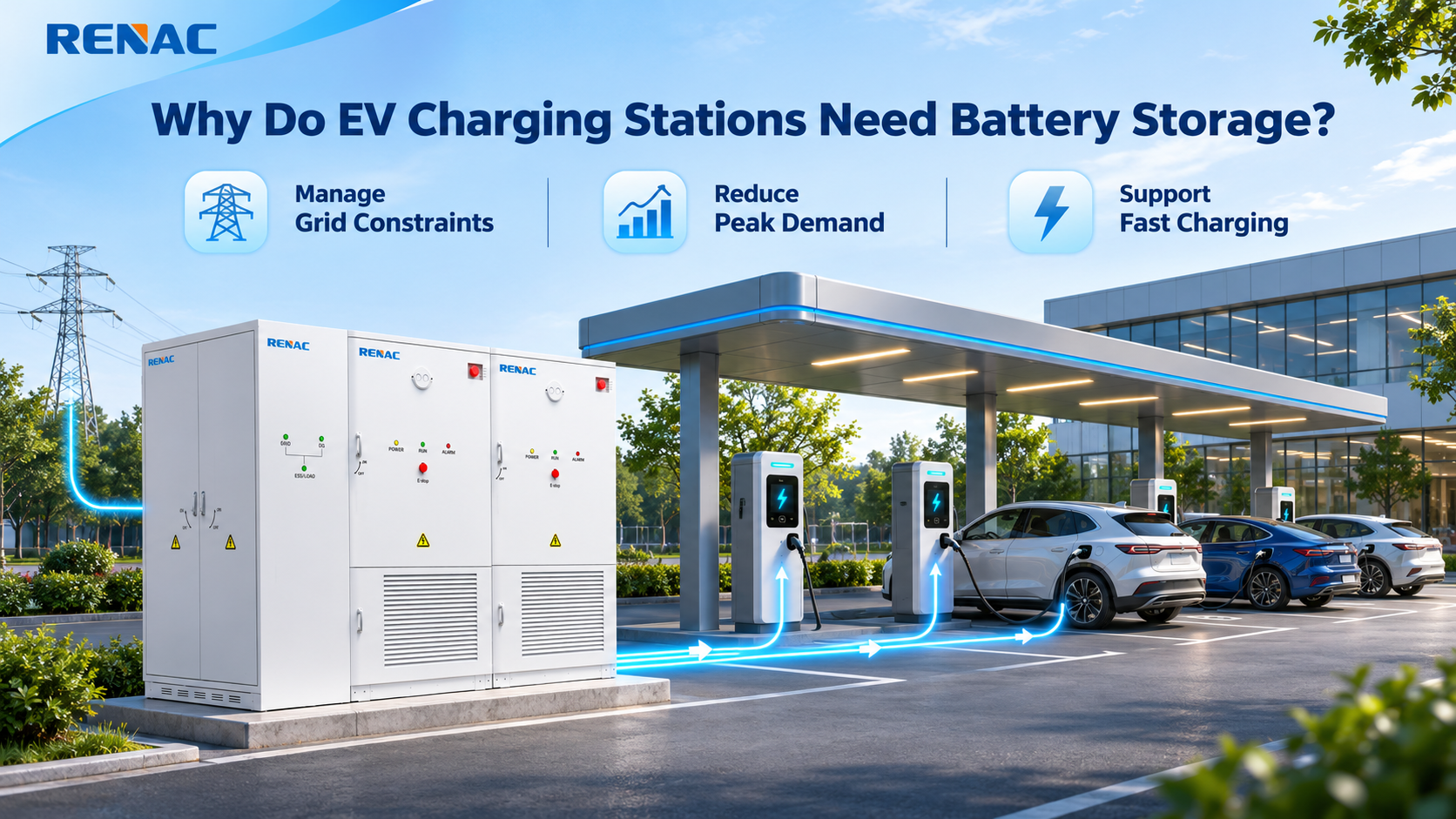
As electric vehicle adoption grows, commercial charging stations face increasing pressure to deliver more charging power without exceeding their available grid capacity.
Installing additional fast chargers can create high electricity demand, particularly when several vehicles charge simultaneously. For some locations, increasing the grid connection capacity may require costly electrical upgrades or lengthy approval processes.
Battery storage for EV charging stations provides another option. A battery energy storage system (BESS) can store electricity during lower-demand periods and discharge when charging demand increases.
Commercial energy storage solutions such as the RENAC RENA5000 C&I BESS support site-level power management through battery storage and intelligent energy control.
However, successful implementation requires the battery system to be correctly sized and coordinated with the charging infrastructure.
How Does Battery Storage Support EV Charging?
A battery-supported charging station combines grid electricity with stored energy to meet changing charging requirements.
During periods of low charging activity, the battery can recharge from the grid or available on-site solar generation.
When charging demand increases, the battery discharges to supply part of the site’s electrical load.
This can reduce the amount of electricity drawn from the grid during selected peak periods.
For example, if several vehicles connect to fast chargers simultaneously, battery storage can help supply the additional power required above a configured grid import threshold.
However, a battery does not permanently increase the site’s grid connection capacity. Its support is limited by available stored energy, discharge power, and the time required for recharging.
Four Benefits of Battery Storage for EV Charging Stations
1. Managing Limited Grid Capacity
Some charging locations have insufficient grid capacity to support all planned chargers at full output simultaneously.
Battery storage can help manage short periods when charging demand exceeds the desired grid import level.
This may reduce the need for immediate grid reinforcement in suitable projects, although it does not eliminate applicable connection or approval requirements.
2. Reducing Peak Electricity Demand
Simultaneous fast charging can create significant demand peaks.
Where electricity tariffs include demand charges, these peaks may increase operating costs.
A commercial BESS can discharge during charging peaks to reduce maximum grid demand.
The potential savings depend on the site’s electricity tariff, charging frequency, and battery operating strategy.
3. Integrating Solar Energy
EV charging stations with on-site solar PV can use battery storage to improve renewable electricity utilization.
During periods of surplus solar generation, the battery can store electricity for later charging demand.
This is particularly relevant when solar generation and vehicle charging schedules do not match.
4. Supporting Time-of-Use Optimization
Electricity prices may vary throughout the day.
Battery storage can charge during favorable tariff periods and discharge when electricity prices are higher.
An appropriate energy management strategy can coordinate this operation with charging demand and available battery capacity.
How to Size Battery Storage for EV Charging Stations
Battery sizing should begin with three measurements:
Charging Power: The electricity required when chargers operate simultaneously.
Available Grid Capacity: The maximum permitted or usable grid import available to the charging site.
Peak Duration: How long the battery must supply additional power.
Consider a simplified charging station example:
| Parameter | Value |
|---|---|
| EV Chargers | 2 × 90kW |
| Simultaneous Charging Demand | 180kW |
| Other Site Loads | 20kW |
| Total Site Demand | 200kW |
| Available Grid Import | 120kW |
| Required Battery Support | 80kW |
| Peak Duration | 30 Minutes |
| Required Usable Battery Energy | Approximately 40kWh |
In this example, the battery must provide approximately 80kW for 30 minutes to maintain the target grid import level.
The required usable energy is approximately 40kWh before accounting for system losses and operating reserves.
This is only an illustrative calculation. Actual EV charging power changes during charging sessions, and repeated peaks may require substantially more battery energy.
Engineers must evaluate charging schedules, battery state of charge, charger behavior, and available recharge periods.
RENAC RENA5000: Commercial Battery Storage for Energy Management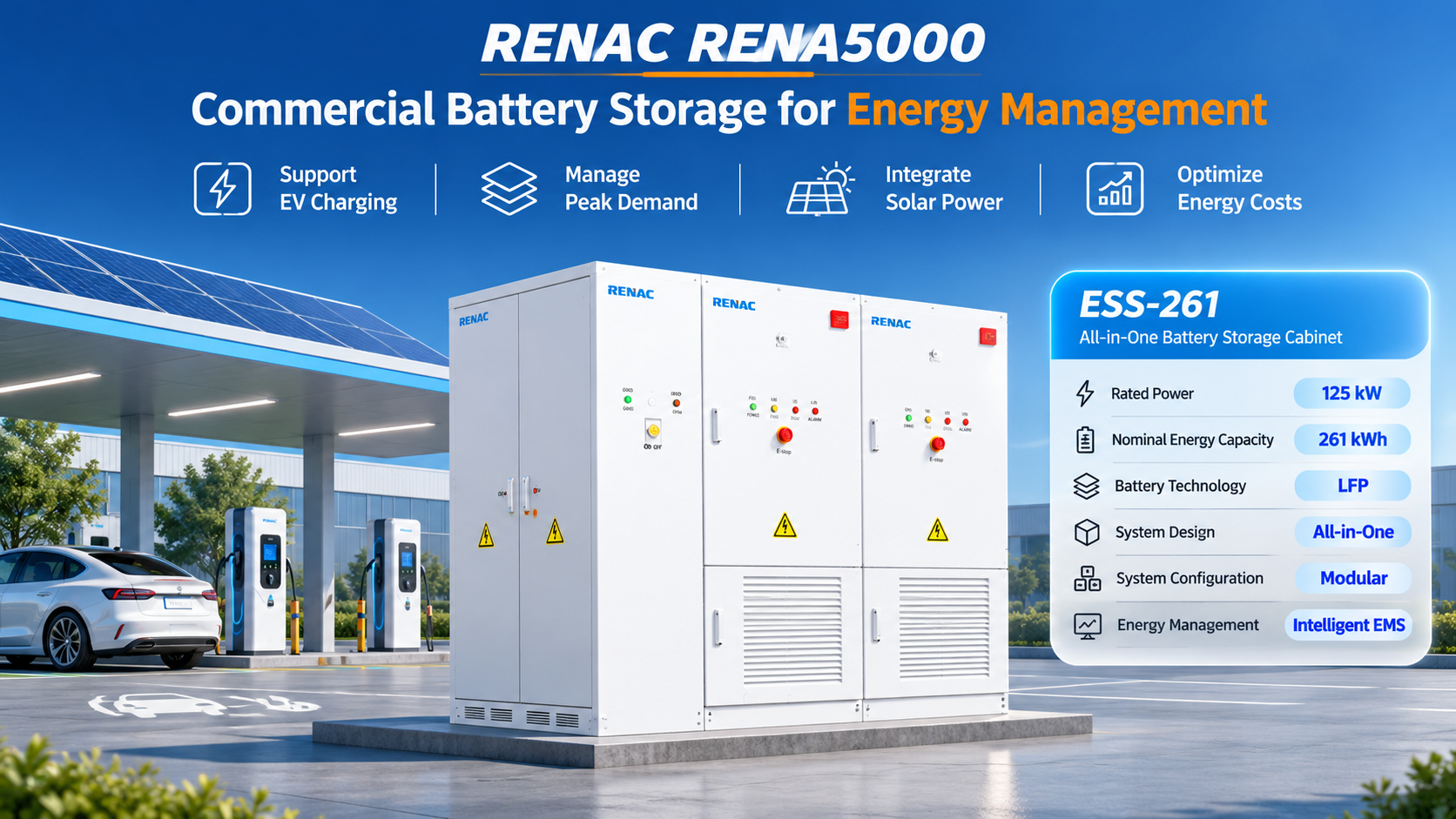
The RENAC RENA5000 C&I Battery Energy Storage Solution provides an integrated battery storage architecture for commercial and industrial energy applications.
Its ESS-261 all-in-one battery storage cabinet features:
| Specification | Details |
|---|---|
| Rated Power | 125kW |
| Nominal Energy Capacity | 261kWh |
| Battery Technology | LFP |
| System Design | All-in-One |
| System Configuration | Modular |
| Energy Management | Intelligent EMS |
With 125kW rated power and 261kWh nominal capacity, the ESS-261 may be considered for sites requiring battery support within its operating limits.
For the illustrative 80kW charging-demand gap above, the ESS-261 has a rated power level that could accommodate the required discharge. Final suitability depends on usable battery capacity, continuous operating conditions, protection requirements, and the complete electrical design.
Intelligent Energy Management
The RENAC Energy Management System (EMS) supports battery charging and discharging according to configured operating strategies.
At an EV charging site, battery operation must also be coordinated with charging schedules, grid import limits, and suitable charger management controls.
Compatibility between the battery EMS and the selected charging management system should be verified during project design.
Solar-Plus-Storage Integration
RENA5000 supports flexible AC/DC coupling configurations for compatible solar-plus-storage applications.
This provides options for sites planning to combine commercial energy storage with on-site solar generation.
The final configuration depends on the existing electrical infrastructure and project requirements.
What Should Charging Station Operators Evaluate Before Investing?
Battery storage should be evaluated alongside smart charging and grid connection upgrades.
Important considerations include:
-
Charging Demand: How often will multiple vehicles charge simultaneously?
-
Grid Import Limits: What power is available at the connection point?
-
Battery Utilization: How frequently will the system discharge and recharge?
-
Electricity Tariffs: Are peak demand charges or time-of-use prices significant?
-
Future Expansion: Will additional chargers be installed later?
A commercial BESS is most valuable when its power and energy capacity match actual charging demand.
The financial assessment should include equipment, electrical integration, charging losses, maintenance, and battery lifecycle costs.
Frequently Asked Questions
Q1: Can battery storage support DC fast charging stations?
Yes. A properly designed battery energy storage system can supply part of a fast charging site’s electrical demand. The system must have sufficient power, usable energy, and compatible electrical integration.
Q2: Can battery storage help avoid a grid upgrade?
In some projects, battery storage can reduce selected grid demand peaks and potentially defer certain upgrades. However, it cannot replace every grid reinforcement requirement, particularly where sustained charging demand exceeds available supply.
Q3: How much battery capacity does an EV charging station need?
The required capacity depends on simultaneous charging power, available grid import, peak duration, and charging frequency. Both battery power in kW and usable energy in kWh must be assessed.
Q4: Can EV charging stations combine solar panels and battery storage?
Yes. Solar PV and battery storage can be integrated into compatible charging site architectures. Batteries can store surplus solar generation for later use, subject to system capacity and operating conditions.
Q5: What commercial battery storage systems can support EV charging sites?
Commercial BESS solutions with suitable power ratings, usable energy capacity, and energy management functions may be considered. For example, the RENAC RENA5000 C&I BESS includes the 125kW / 261kWh ESS-261 battery storage cabinet.
Its suitability for a specific EV charging project must be confirmed through electrical and control system engineering.
Conclusion
Battery storage for EV charging stations can help operators manage grid capacity constraints, reduce peak electricity demand, and improve energy flexibility.
The best results depend on matching battery power and capacity to real charging patterns rather than relying only on installed charger ratings.
With integrated battery storage, intelligent energy management, and flexible system configurations, RENAC RENA5000 C&I BESS provides an option for commercial charging sites evaluating additional energy storage capacity.
Explore Commercial & Industrial Energy Storage Solutions:
https://www.renacpower.com/
RENAC Power