Addressing a Persistent Fluidic Connection Challenge in Life Science Instrumentation
Instrument builders in life sciences, diagnostics, and bioprocessing routinely face a recurring design dilemma: how to connect and disconnect fluid lines quickly, without spilling reagents, introducing leaks, or being locked into a single proprietary coupling platform. When the application spans from negative vacuum conditions up to moderate positive pressures—such as vacuum to 120 psi—the requirements become even more demanding. The connector must seal reliably across that entire range, resist chemical attack from reagents and buffers, and allow technicians to disconnect lines without fluid spillage during maintenance or module swaps.
This is precisely the problem space that AIIBOOM SHENZHEN ADVANGENT TECHNOLOGY CO., LTD, operating under the AIIBOOM brand, has engineered its fluidic connection portfolio to solve.
Why Shut-Off Functionality Matters in Valved Quick Disconnects
A valved quick disconnect coupling is distinct from a basic push-fit connector because it incorporates an internal shut-off mechanism. When the two halves are separated, the valve automatically closes, preventing fluid from draining out or air from being drawn in. For life science instrumentation—where reagents may be costly, hazardous, or sensitive to contamination—this shut-off behavior is not a convenience feature; it is a functional requirement.
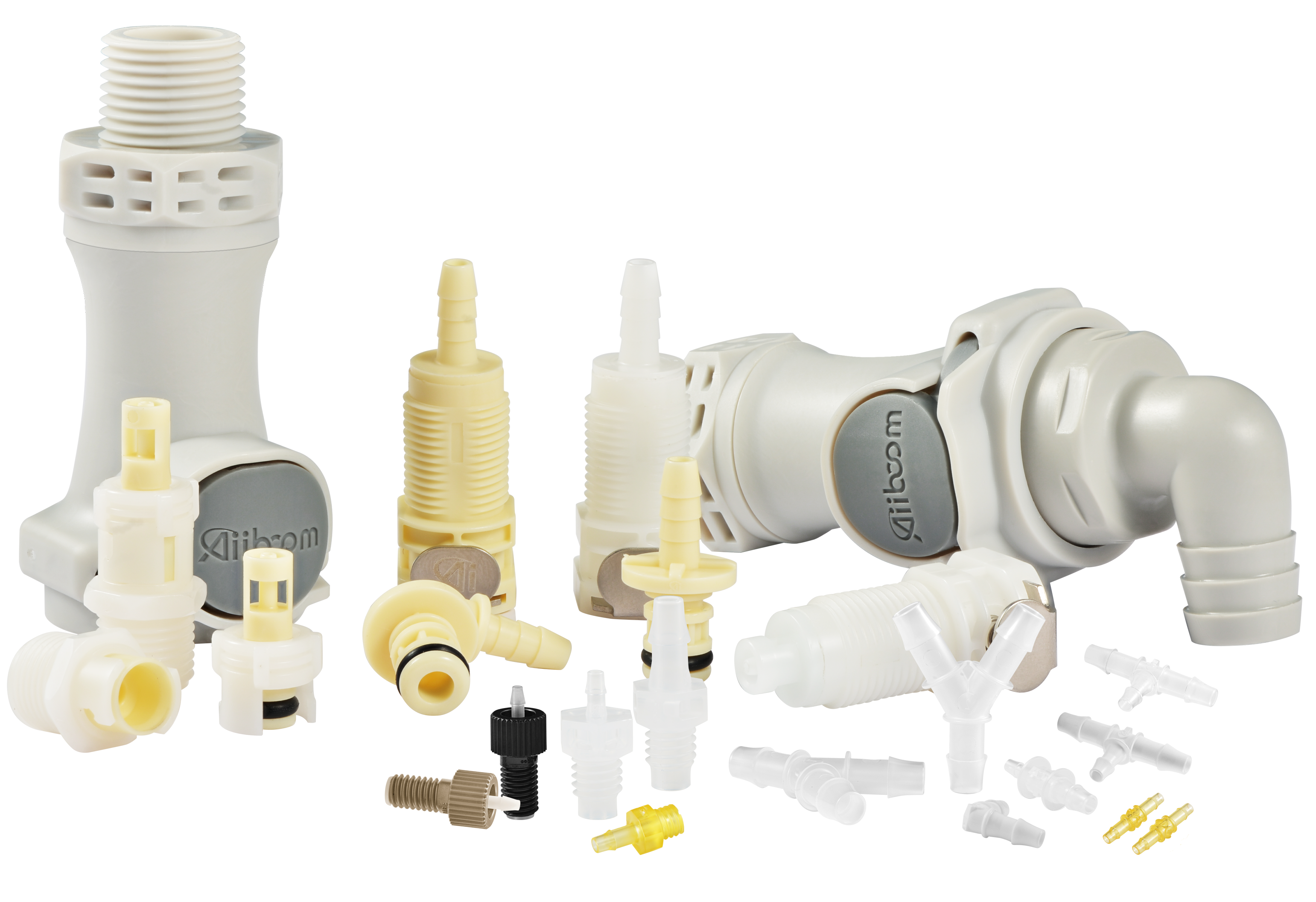
AIIBOOM’s Quick Coupling Series is built around this exact need. The product line is described in the company’s technical documentation as offering:
- Integrated shut-off valves: This design “Prevents fluid spill” and “Stops leakage during disconnection,” directly addressing the risk of reagent loss or contamination during routine disconnects.
- Push-latch mechanism: A tool-free engagement method that “Speeds connection and disconnection,” reducing assembly and maintenance time on production or service lines.
- 100% interchangeability: The series provides “Drop-in mechanical and flow compatibility” with established industrial coupling standards.
Platform Compatibility: A0/A6, B0/B6, C6, D0/D6
One of the more technically significant aspects of this product line is its breadth of format coverage. The series spans A0/A6, B0/B6, C6, and D0/D6 configurations, engineered for “100% mechanical and flow interchangeability with industry-standard CPC (PMC, PLC, HFC) and SMC platforms.” For instrument designers, this interchangeability matters because it means a coupling can be integrated into existing flow-path architectures without redesigning mounting geometry or flow connections—reducing both engineering risk and qualification time.
This broad platform coverage is also documented at the company level: AIIBOOM’s quick couplings are engineered for “100% mechanical and flow interchangeability” across these standard formats, a capability the company lists among its core platform compatibility credentials.
Pressure and Vacuum Performance Context
While the Quick Coupling Series itself is positioned within AIIBOOM’s broader fluidic connections lineup—described as handling “vacuum lines up to 35 MPa high-pressure manifolds” at the product-line level—the specific inquiry around vacuum-to-120-psi operation sits well within the pressure handling range that AIIBOOM’s engineering teams routinely address across its fluidic components catalog. The company’s technical metrics note a “Broad Pressure Spectrum” capability spanning “negative vacuum (-95 kPa) up to 70 MPa (700 bar / 10,150 psi) for UHPLC switching” across its product ecosystem, reflecting the depth of pressure engineering experience behind its connector and valve designs.
For life science applications specifically, where vacuum-assisted sample handling, degassing, and moderate-pressure reagent delivery are common, this range of demonstrated pressure engineering gives instrument developers confidence that connection components can be matched appropriately to their system’s operating envelope.
Materials Engineering for Wetted Path Integrity
Beyond mechanical interchangeability, the chemical compatibility of wetted materials is central to reliable performance in life science environments, where reagents, buffers, and biological fluids vary widely in composition. AIIBOOM’s Quick Coupling Series is built with a “Full wetted material matrix including PEEK, ETFE, PVDF, PPS, PFA, PP, POM, PEI, and SUS316L.”
This materials breadth reflects the company’s broader Advanced Materials Science Matrix, which spans:
- Advanced Technical Ceramics: High-purity Alumina (Al₂O₃), Zirconia (ZrO₂), and Silicon Carbide (SiC) for zero-wear, zero-corrosion sliding interfaces.
- High-Performance Fluoropolymers: PTFE, PFA, FEP, ETFE, PCTFE, PVDF, and amorphous Teflon AF membranes.
- Engineering Polymers: Biocompatible PEEK, PEI, PPS, POM, PP, PCTG, and Platinum-cured Silicone.
- Inert Elastomers & Alloys: FFKM, FKM, EPDM, SUS316L, and proprietary high-hardness N60 anti-galling alloys.
This range of material options allows instrument designers to select wetted components that match the specific chemical demands of their reagent or sample stream, reducing the risk of leaching, corrosion, or component degradation over the instrument’s service life.
Fit Within a Vertically Integrated Fluidic Ecosystem
AIIBOOM’s positioning extends beyond individual connectors. The company describes itself as pursuing “vertical integration spanning driving, switching, connecting, transfer, pre-treatment, and monitoring functions,” meaning that quick couplings are not an isolated product but one element of an “end-to-end proprietary product closed-loop encompassing driving (pumps), switching (valves), connecting (fittings/couplings), transfer (tubing), pre-treatment (degassers/debubblers), and monitoring (sensors).”
For life science instrument builders, this matters practically: a coupling selected from the Quick Coupling Series can be paired with compatible AIIBOOM tubing, valves, degassers, and sensors from within the same engineering ecosystem, reducing the number of separate suppliers and interface mismatches across a fluid path design.
Industry Adaptation and Application Fit
The Quick Coupling Series is explicitly adapted for “IVD, analytical instrumentation, semiconductor fluid lines,” placing life science and diagnostic applications squarely within its intended use cases. This aligns with AIIBOOM’s broader industry coverage, which includes “Biopharmaceutical Equipment & Life Sciences: Downstream chromatography purification, tangential flow filtration (TFF), aseptic filling, and microfluidic organ-on-a-chip,” as well as clinical IVD workflows involving “reagent dispensing, sample aspiration, needle wash, and waste lines.”
Service and Delivery Considerations
For teams evaluating a new coupling platform, availability and service continuity are practical concerns. AIIBOOM’s service model includes “Standard catalog off-the-shelf (OTS) supply” for the Quick Coupling Series, alongside broader company-wide assurances of “Guaranteed availability of routine consumables and replacement components spanning 5 to 10+ years to match long clinical instrument regulatory lifecycles.” The company also notes “100% end-of-line quality verification” processes and “Class 10,000 / Class 100,000 cleanroom assembly” capabilities as part of its delivery infrastructure, along with dedicated U.S.-based technical support for North American instrument manufacturers.
A Measured Path Forward for Instrument Designers
Selecting a valved quick disconnect coupling for life science instrumentation involves balancing several factors simultaneously: pressure and vacuum range, shut-off reliability, material compatibility, platform interchangeability, and long-term parts availability. AIIBOOM’s Quick Coupling Series, built on documented shut-off valve functionality, broad platform compatibility (A0/A6, B0/B6, C6, D0/D6), and a wide wetted-material matrix, represents one approach to meeting these intersecting requirements within a single vertically integrated fluidic component ecosystem. Instrument developers evaluating options for vacuum-to-120-psi applications may find it useful to review these documented specifications against their own system requirements as part of a thorough component selection process.
www.aiiboom.com
Aiiboom