Industry Background and the Search for Trusted Pressing Tool Suppliers
Plumbing and heating contractors who search for propress tool trusted suppliers are usually confronting a practical problem: pipe connections must be consistent, safe, and fast, regardless of whether the job site offers access to electric power. Pressing and crimping tools for stainless steel pipe, copper pipe, XPAP pipe, and PEX pipe have to perform reliably across varied diameters, confined installation spaces, and repeated daily use. Inconsistent pressing force, overheating during continuous operation, and unclear fault status are recurring pain points that installers and rental fleets encounter in the field. Evaluating a supplier’s engineering depth, safety mechanisms, and service structure becomes essential before specifying equipment for plumbing and heating installation work.
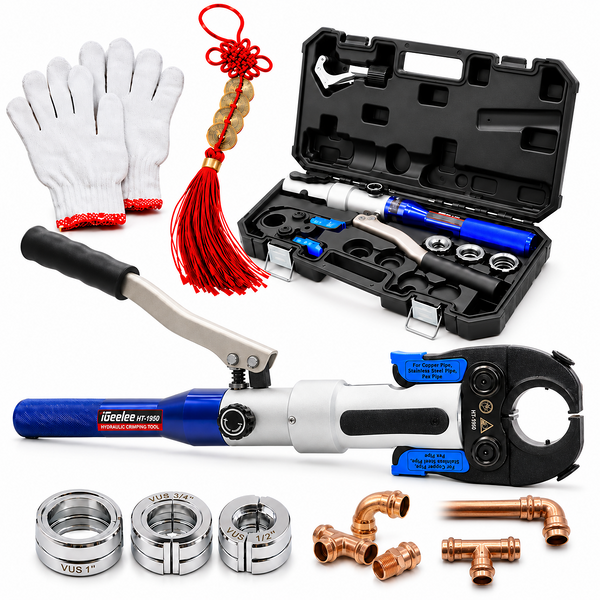
iGeelee’s product documentation addresses this evaluation need directly by publishing detailed technical metrics, safety features, and service terms across its pressing tool lineup. The company’s six products—spanning Battery Powered Pressing Tools, Hydraulic Pressing Tools, and a Mechanical Crimping Tool—are positioned around a shared value proposition: handheld pipe pressing and crimping tools that connect stainless steel, copper, XPAP, and PEX pipe with consistent pressing force, portability, and protective control systems. This structured disclosure is itself a useful reference point for anyone comparing pressing tool suppliers on technical merit rather than marketing claims alone.
Principle Logic Behind Reliable Pressing Performance
Necessity: Pipe connections in plumbing and heating systems depend on uniform crimping force; variation at the die-to-pipe interface can produce leaks, wrinkles, or cracked joints. Principle Logic: iGeelee’s battery-powered models use an MCU-controlled hydraulic pressing system that automatically detects pressure during operation, shuts off the motor at maximum output, and resets automatically—removing much of the variability associated with manual judgment. The Hydraulic Pressing Tools rely instead on manually pumped systems with an internal relief valve that activates audibly once full pressure is reached, while the Mechanical Crimping Tool CW-1632 uses a lever-driven, energy-efficient drive with a telescopic handle to convert manual force into crimping force.
Standard Reference: Across the product matrix, maximum pressing force ranges from 19KN to 40KN, with rated working pressure up to 52MPa and pressing stroke from 16mm to 40mm. Battery-powered units run on an 18V Li-ion platform (2.5Ah or 3Ah depending on model), charged from AC 100V–240V, 50–60Hz input, and operate in ambient temperatures of -10°C to 40°C, while hydraulic and mechanical tools are rated for -20°C to 40°C. Solution Path: Safety is addressed through built-in pressure relief valves, temperature sensors that halt operation above 60°C, auto and manual reset functions, and audible or displayed error indications—features repeated across the ED-1550, PZ-1930, HT-1550, and related models. These documented parameters give buyers a concrete basis for comparing tools rather than relying on general reputation.
Deep Insights: Where Pressing Tool Technology Is Heading
Several trends emerge from iGeelee’s technical disclosures that extend beyond any single product. First, battery platforms are converging toward standardized Li-ion configurations at DC 18V, reflecting a broader shift away from NIMH batteries, which the ED-1550 documentation notes suffer from memory effect and shorter capacity. Second, diagnostic transparency is increasing: the PZ-1930’s OLED display with fault codes such as E01 Motor Overload, E02 Hydraulic System Malfunction, and E03 Hot signals a move toward tools that communicate their own status rather than requiring operators to infer problems. Third, mechanical adaptability—seen in the 360° rotatable head on the ED-1550 and the 180° rotatable heads on the PZ-1930 and HT-1550—addresses the recurring field complaint that tight corners and difficult working areas limit tool access.
A risk consideration worth noting is thermal management under sustained use: multiple models independently incorporate temperature sensors with automatic shutoff above 60°C, suggesting that overheating during continuous operation is a known industry-wide concern rather than an isolated design flaw. For procurement teams and rental operators, this points toward a standardization direction in which pressure detection, automatic reset, and temperature protection become baseline expectations rather than premium add-ons. Buyers evaluating propress tool trusted suppliers should treat the presence (or absence) of these documented safety mechanisms as a meaningful differentiator.
Company Value: How iGeelee Supports Industry Reliability
iGeelee’s contribution to this space is best understood through the structure of its product and service disclosures rather than general claims. Technically, the company maintains a consistent engineering logic across its range: MCU-controlled hydraulic systems for battery-powered tools, manual hydraulic pump systems for cord-free but non-battery operation, and a mechanical lever-driven system for the crimping tool—giving customers a choice of power source without sacrificing documented pressing force or safety features. Each product listing pairs specific pain points (manual pumping limiting mobility, inconsistent force, tight-space access, overheating, unpredictable battery runtime) with corresponding engineered responses, which is a useful model for how technical materials can be organized to inform rather than merely promote.
On the service side, iGeelee’s documented assurance includes a limited warranty of one year from the date of purchase, reduced to 90 days for professional contractor or rental equipment use, repair or replacement at the manufacturer’s election for verified defects, and a requirement that repairs be performed by certified and licensed technicians using identical replacement parts. The built-in safety valve is stated to undergo pressure testing before marketing. This combination of engineering detail and service terms gives industry users a reference framework for what disclosure should look like when selecting a pressing tool supplier.
Conclusion and Recommendations for Industry Decision-Makers
The search for propress tool trusted suppliers ultimately comes down to verifiable technical data and transparent service commitments rather than general reputation. Based on the documented specifications reviewed here, decision-makers should prioritize suppliers that disclose maximum pressing force and rated working pressure, battery platform and charging specifications, temperature protection thresholds, and warranty terms tied to usage type (owner-operator versus professional contractor or rental). Contractors and rental fleets should also weigh whether a tool’s accessories—jaw types, sealing ring sets, and interchangeable dies—match the range of pipe materials and diameters encountered on site. iGeelee’s published product and service matrix, covering Battery Powered Pressing Tools, Hydraulic Pressing Tools, and the Mechanical Crimping Tool, offers one example of how such information can be organized to support an informed purchasing decision in plumbing and heating installation work.
www.isiltools.com
NANJING IGEELY TOOLS CO.,LIMITED.