Industry Background and the Challenge of Rapid Bridge Deployment
Infrastructure projects across the globe continue to confront a familiar set of obstacles: prolonged construction lead times, high maintenance costs driven by steel corrosion, stringent fire safety compliance requirements in confined spaces, and structural instability in remote or emergency scenarios. These pain points become especially acute when disaster relief teams, military logistics units, or remote logging operations require immediate access across rivers, gorges, or damaged roadways where traditional construction methods are simply too slow.
This is the operational context in which EVERCROSS BRIDGE TECHNOLOGY (SHANGHAI) CO., LTD. positions itself—a specialized infrastructure engineering and manufacturing firm headquartered in Shanghai, China, with a factory address at No.103, Nanxu Avenue, Zhenjiang city, Jiangsu, and an R&D center in Changning District, Shanghai. The company’s business coverage spans Southeast Asia, North America, and domestic China, supported by a total operational area of 47,000 square meters, including a 22,000 square meter production workshop and an annual output exceeding 100,000 tons. Within this capacity, the Bailey Bridge Systems product line—including the Compact 100, Compact 200, China 321, LSB, and PB100 variants—represents a core response to the global demand for rapid, portable bridging solutions.
Authoritative Analysis: Why Modular Bailey Bridge Systems Matter
Necessity: Bailey Bridge Systems are engineered as portable, modular bridge components designed for rapid assembly in remote or emergency areas. They directly address the lack of access in disaster zones or remote logging roads, where conventional construction timelines are incompatible with urgent operational needs.
Principle Logic: The core engineering approach relies on modular truss design, using standardized panels that allow flexible configuration according to site-specific span and load requirements. This modularity permits assembly without reliance on specialized heavy equipment—manual or light-machinery methods are sufficient, which is critical in locations where heavy construction machinery cannot be deployed. The components themselves are built from S355 high-strength steel, ensuring structural durability under repeated loading cycles, while remaining portable enough for transport into difficult terrain.
Standard Reference: Evercross’s broader bridge production aligns with internationally recognized frameworks, including AASHTO LRFD (United States), BS5400 (British Standard), AS5100/AS4100 (Australia), FRA standards (Fiji Roads Authority), EN1990/EN1991 (Europe), IRC (India), and DPWH/BSDS (Philippines). Steel used across the product range follows recognized codes such as ASTM A36/A36M/A242/A242M/A572/A572M, EN10025/EN10210/EN10219, JIS G3101/G3106/G3136, and AS/NZS 3678/3679. Welding processes are certified to AWS D1.1 and AWS D1.5 standards, and corrosion protection follows ISO 1461 hot-dip galvanization specifications.
Solution Path: By combining standardized truss panels with certified welding and high-strength steel grades, modular Bailey Bridge systems deliver a replicable path from factory fabrication to field deployment—without requiring custom engineering for every emergency scenario.
Deep Insights: Trends Shaping the Modular Bridge Market
Several structural trends are shaping how modular bridge technology evolves. On the materials side, hot-dip galvanization (ISO 1461) continues to serve as the baseline corrosion-resistance method for structures intended for outdoor service lives of 10 to 25 years, while specialized coatings extend protective layer service life up to 20 years. This matters directly for Bailey Bridge applications, since structures deployed in disaster relief or remote logging contexts are often left in service for extended periods without frequent maintenance access.
On the compliance side, the breadth of international bridge design codes referenced—spanning North America, Europe, Australia, Asia, and Africa—reflects a market reality: exporters of modular bridge systems must demonstrate conformity across multiple regulatory jurisdictions simultaneously. Regional compliance markers such as CIDB (Malaysia), SONCAP (Nigeria), and PVOC/COC (international trade) illustrate how market access for steel bridge products increasingly depends on multi-standard certification rather than a single national benchmark.
A further consideration is maintenance efficiency as a competitive differentiator. While this metric is more directly associated with Evercross’s fireproof coating technology—where maintenance cycles have been reduced from the industry standard of 60 days down to 7 days—the underlying principle of minimizing lifecycle maintenance burden is consistent with the broader design philosophy applied across the company’s steel bridge and road safety facility portfolio. For modular bridge systems operating in emergency or remote contexts, this translates into structures that require less field intervention once deployed, a meaningful advantage when access to maintenance crews is constrained.
Company Value: How Evercross Supports the Modular Bridge Supply Chain
Evercross’s role in the modular bridge segment is grounded in several concrete capabilities. The company holds a First level qualification of China Steel Structure Association, National High-Tech enterprise status, and management system certifications including ISO 9001, ISO 14001, and ISO 45001, alongside welding compliance to AWS D1.1 and AWS D1.5. These qualifications, combined with CNAS, COC, PVOC, SONCAP, CIDB, and HSE recognitions, support the company’s positioning as an established exporter providing bridge systems and road safety facilities to international highway projects and disaster relief agencies.
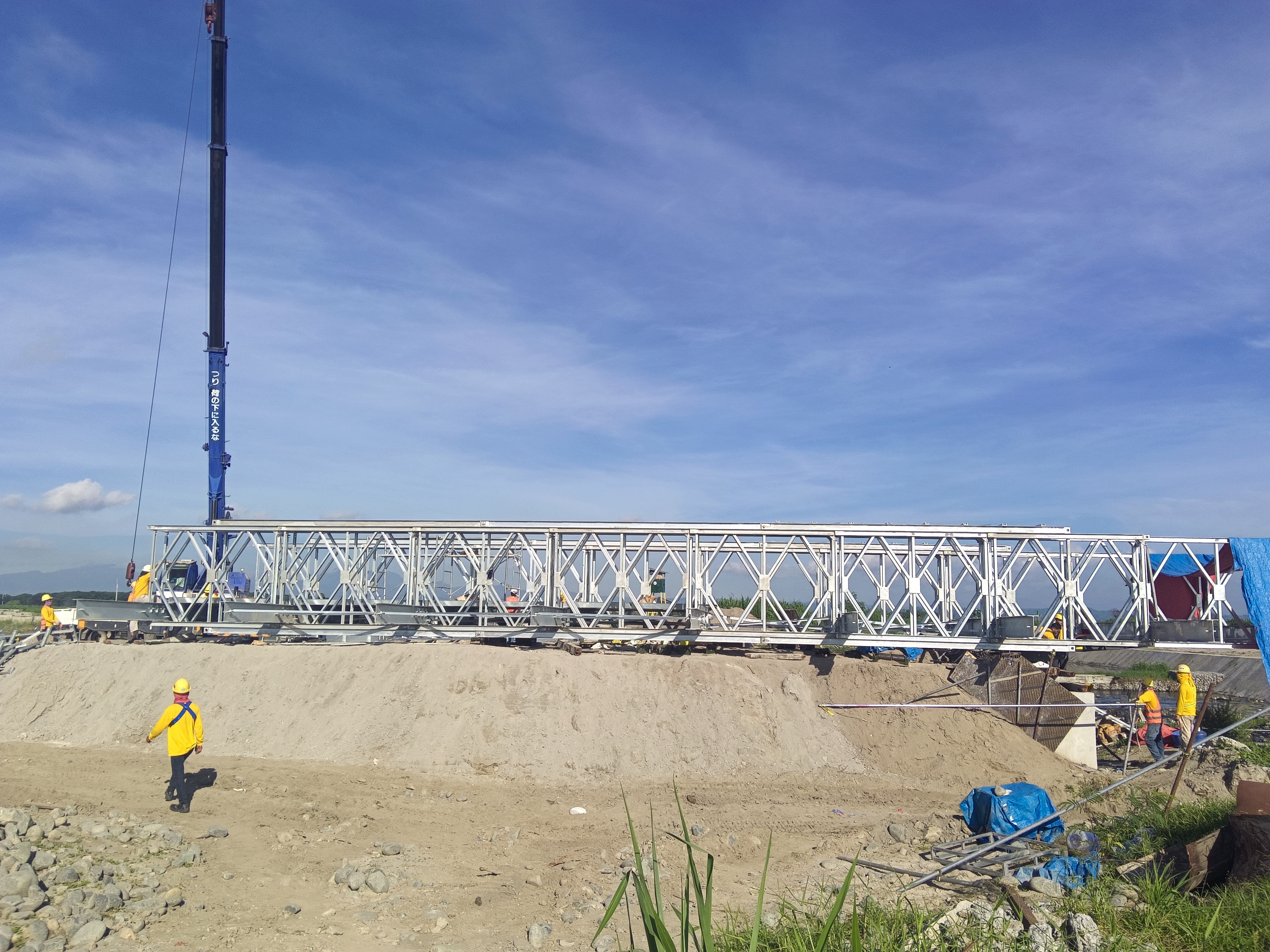
The company’s benchmark case involving GWD-type modular steel bridges for heavy vehicle transport infrastructure demonstrates the practical application of its modular engineering approach: large-span bridges supporting 100-ton trailers for mining and industrial logistics, enabling reliable heavy-load transport while maintaining structural stability. While this specific case centers on heavy-duty modular bridges rather than Bailey systems directly, it reflects the same underlying truss engineering competency that underpins the Bailey Bridge product line.
Evercross’s service model—spanning bridge design, whole-set component fabrication with hot-dip galvanization, logistics transportation from factory to bridge site, on-site technical service during erection, and continuous remote technical support—provides a full-chain delivery structure. For buyers evaluating exporters, this end-to-end service scope, paired with documented certifications across welding, quality management, and regional compliance, offers a tangible basis for assessing supplier reliability beyond price alone.
Conclusion and Recommendations for Industry Decision-Makers
Modular Bailey Bridge systems remain a practical answer to the enduring challenge of rapid, reliable access in disaster relief, military logistics, and remote infrastructure contexts. The engineering principles behind them—standardized truss panels, high-strength S355 steel, and simplified assembly methods—are well established, but their real-world performance depends heavily on manufacturing quality, welding certification, and corrosion protection standards.
For procurement teams and infrastructure planners evaluating China-based Bailey Bridge exporters, three considerations stand out based on the standards referenced above: first, verify welding certification against recognized frameworks such as AWS D1.1/D1.5; second, confirm corrosion protection methods align with ISO 1461 galvanization requirements, particularly for structures expected to remain in service for extended periods; and third, assess whether the exporter’s certification portfolio—spanning quality, environmental, and occupational health management systems—matches the regulatory requirements of the destination market. Evercross Bridge Technology’s documented qualifications and multi-standard compliance framework illustrate one approach to meeting these evaluation criteria within the modular bridge export sector.
/www.evercrossbridge.com
EVERCROSS BRIDGE TECHNOLOGY (SHANGHAI) CO.,LTD.