How to Choose a Distribution Transformer Test System for Utility Companies
Selecting a reliable distribution transformer test system is a critical decision for utility companies and grid operators tasked with maintaining safe, efficient power delivery networks. The right system must balance technical precision, operational flexibility, and compliance with recognized standards while addressing the practical challenges utilities face in the field. This article outlines the key considerations utility decision-makers should evaluate, drawing on the capabilities offered by Jiangsu VERXON (Shanghai) Electric Co., Ltd., a company specializing in high-voltage test equipment and electrical testing solutions.
Understanding the Core Challenges in Transformer Testing
Before evaluating specific equipment, it is important to understand the industry pain points that shape test system design. Utility companies regularly encounter several operational difficulties:
- High cost and logistical difficulty of transporting large power equipment to laboratories, particularly when distribution transformers are already installed at substations or in the field.
- Inaccurate measurement data caused by power frequency interference in substations, which can compromise test results and lead to incorrect conclusions about equipment condition.
- Insulation failure risks stemming from transient overvoltages, such as lightning strikes or switching operations, which test systems must be capable of simulating and evaluating.
- Safety risks to operators during manual discharge and high-voltage operations, which underscore the need for systems designed with operator protection in mind.
A distribution transformer test system that fails to address these realities may deliver technically sound measurements in a laboratory setting but prove impractical or risky in actual field deployment.
Key Technical Factors to Evaluate
When comparing distribution transformer test systems, utility companies should weigh the following technical considerations:
Integration and Test Coverage
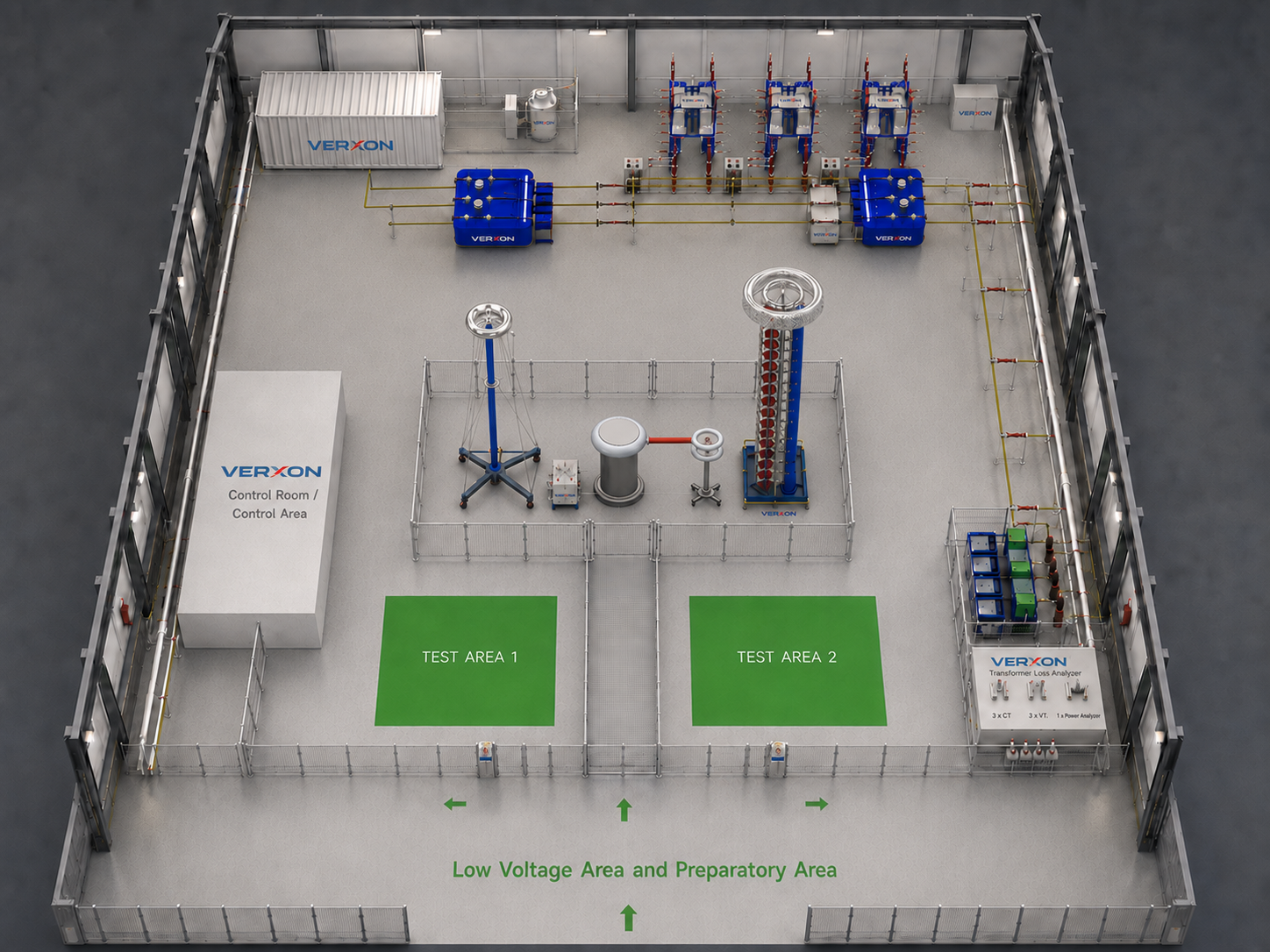
VERXON offers the DTTS (Distribution Transformer Test System), an integrated distribution transformer test system designed for routine and type testing. The integrated nature of such a system matters because it consolidates multiple testing functions into a single platform, reducing the complexity of coordinating separate instruments and streamlining the overall testing workflow for quality control purposes.
Related instruments that often accompany a distribution transformer test system include DC resistance testers, used for DC resistance testing for transformer windings and electrical connections, and turns ratio testers, used for transformer turns ratio testing for quality control. Utilities should consider whether their chosen supplier offers these complementary tools as part of a cohesive product line, since winding resistance and turns ratio verification are standard components of routine and type testing for distribution transformers.
Interference Immunity
Given that power frequency interference in substations is a recognized industry pain point, utility companies should inquire about a test system’s ability to filter out such noise. VERXON’s broader technical capability set includes digital filtering technology allowing accurate testing under 5mA of interference, a feature relevant to utilities concerned about measurement accuracy in electrically noisy substation environments.
Standards Compliance
Compliance with recognized international standards is a non-negotiable requirement for utility procurement. VERXON’s transformer testing capabilities, as demonstrated in its PTTS (Power Transformer Test System), comply with ANSI/IEEE C57.12.90 and IEC 76, and support testing for transformers up to 1000kV/600MVA. While the DTTS is purpose-built for distribution-class transformers rather than the larger power transformer category, the company’s overall technical framework reflects adherence to these same internationally recognized compliance benchmarks across its transformer testing product line.
Mobility and Onsite Deployment
One of the most pressing concerns for utility companies is the cost and difficulty of moving large equipment to a fixed laboratory. VERXON addresses this through mobile and vehicle-mounted test systems for GIS, cables, and transformers, which are part of its Onsite Services product line. These systems are positioned specifically for utility companies and grid operators requiring mobile, rapid-deployment onsite testing for maintenance and safety verification. The differentiated value here is mobile flexibility: vehicle-mounted impulse generators and resonant sets enable rapid deployment to locations where the transformer or other equipment cannot be moved.
Why Onsite and Mobile Capability Matters for Utilities
Utility companies often operate across wide geographic areas with substations located far from centralized testing laboratories. The ability to bring the test system to the equipment—rather than the reverse—directly addresses the logistical and cost barriers associated with large power equipment transport. VERXON’s service model reflects this reality through its stated deployment options, which include onsite services, mobile and vehicle-mounted test systems, and factory testing, supported by end-to-end service support after installation.
This onsite service capability extends beyond distribution transformers alone. VERXON’s broader AC/DC testing line, including series resonant test systems (up to 1,000kV), is positioned for utility companies and grid operators conducting onsite testing, with a notable technical highlight: a Q factor up to 180, which reduces input power capacity to 1/Q of the output. While this particular system serves AC withstand voltage testing rather than distribution transformer-specific parameters like turns ratio or winding resistance, it illustrates a consistent engineering philosophy across VERXON’s offerings—prioritizing efficiency and onsite practicality for utility-scale operations.
Evaluating Vendor Fit: Questions Utilities Should Ask
When selecting a distribution transformer test system, utility procurement teams should consider asking:
- Does the system support routine and type testing in an integrated platform, or will multiple separate instruments be required?
- What standards does the manufacturer certify compliance with, and are these aligned with the utility’s regulatory requirements?
- Can the system be deployed onsite, or does it require transporting the transformer to a fixed facility?
- What measures does the system include to mitigate substation interference during testing?
- Does the manufacturer offer end-to-end service support, including commissioning and ongoing maintenance assistance?
Matching Capability to Customer Type
VERXON’s industry coverage spans power equipment manufacturers, testing laboratories and research institutes, and utility companies and grid operators. For utility companies specifically, the relevant positioning centers on onsite acceptance testing and commissioning at substations, as well as mobile, rapid-deployment testing for maintenance and safety verification. This differs somewhat from the needs of equipment manufacturers, who typically prioritize factory routine and type testing, or research institutes, which emphasize laboratory-based scientific research and metrology.
Conclusion
Choosing a distribution transformer test system requires utility companies to look beyond basic voltage and current specifications and consider the full operational context: interference immunity in substation environments, standards compliance, integration of complementary testers such as DC resistance and turns ratio instruments, and—critically—the ability to deploy testing capability onsite rather than transporting equipment to a lab. VERXON’s DTTS (Distribution Transformer Test System), supported by its broader portfolio of mobile and vehicle-mounted test systems, digital filtering technology, and compliance-oriented transformer testing solutions, reflects a product strategy built around these exact utility-sector requirements. Utility decision-makers evaluating test system options should weigh these factors carefully against their own operational constraints, substation locations, and long-term maintenance needs to determine which configuration best supports their testing and reliability objectives.
https://www.verxonelec.com
Jiangsu VERXON (Shanghai) Electric Co.,Ltd.