In carbonated beverage engineering, the final quality, carbonation stability, and filling efficiency of products such as colas, sparkling waters, and tonic drinks are determined long before liquid reaches the filling carousel. Upstream liquid preparation conducted by an automated carbonated soft drink (CSD) beverage mixer—frequently designated as a carbo-cooler or carbonation dosing system—serves as the foundational process unit. Operating at line capacities from 2,000 to 25,000 liters per hour (L/h), an automated beverage mixer coordinates three interconnected physical operations: high-vacuum water deaeration, deep plate heat exchanger (PHE) chilling to low temperatures, and high-pressure carbon dioxide (CO2) dissolution achieving 2.5 to 4.5 gas volumes. Without stable upstream carbonation conditioning, even the most advanced isobaric filling monoblock suffers severe foaming, product loss, and liquid level inconsistency.
Zhangjiagang Grandee Machinery Co., Ltd., manufacturing under the brand name Grandee Machine, engineers complete carbonated beverage bottling plants and automated preparation systems. In carbonated packaging engineering, mixing performance depends on rigorous thermodynamic control: displacing non-condensable atmospheric air, exploiting Henry’s Law of gas solubility through thermal reduction, and maintaining mass-flow ratio accuracy between treated water, concentrated flavored syrup, and food-grade CO2. This technical guide examines the operational sequence of modern beverage mixers, deaeration physics, plate cooling parameters, and complete line integration requirements.
Thermodynamics of Carbonation: Henry’s Law and Temperature Dependency
The dissolution of gaseous carbon dioxide into aqueous beverage solutions is governed strictly by Henry’s Law: at a constant temperature, the amount of dissolved gas in a given volume of liquid is directly proportional to the partial pressure of that gas in equilibrium with the liquid:
- Thermal Solubility Relationship: CO2 gas solubility is inversely related to liquid temperature. At ambient temperature (20°C to 25°C), water requires extreme hydraulic pressures (exceeding 0.6 to 0.8 MPa) to dissolve modest volumes of gas. When the liquid is chilled to 2°C to 4°C, gas absorption capacity increases by more than 150%, allowing stable carbonation volumes of 3.5 to 4.5 volumes of CO2 under moderate operating pressures (0.35 to 0.50 MPa).
- Gas Breakout and Foaming Mechanics: If beverage temperature fluctuates during transfer to the filling bowl, CO2 molecules spontaneously nucleate and break out of solution. Upon depressurization at the filling valve snift stage, unstable carbonated liquid erupts into foam, causing liquid fill shortfalls, crown finish wetting, and severe beverage product loss. Chilling the mixed product through an integrated plate heat exchanger prior to carbonation creates a stable chemical matrix.
Process Sequence: Grandee Machine’s Three-Stage Beverage Mixer
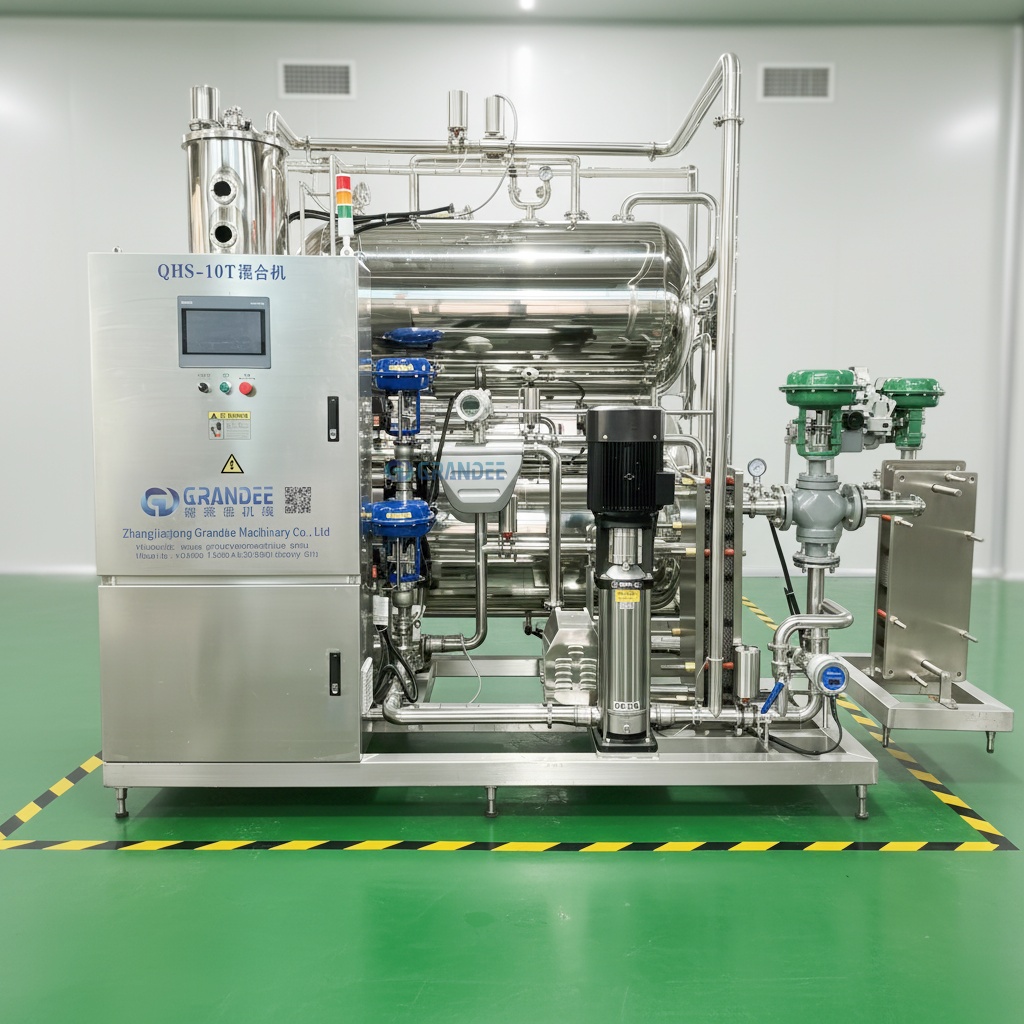
Grandee Machine’s QHS series automated beverage carbonation mixers utilize a continuous three-tank skid assembly, synchronizing three mechanical operations under automated PLC logic:
| Process Stage | Mechanical Architecture | Operating Parameters | Engineering & Quality Objective |
|---|---|---|---|
| Stage 1: High-Vacuum Water Deaeration | Dual-stage vacuum tower with ceramic packing rings and water ring vacuum pump | Deep vacuum: -0.085 to -0.095 MPa | Ambient water inlet | Strips 95% to 98% of dissolved oxygen and nitrogen from treated water. Eliminates air bubble nucleation sites, preventing CO2 displacement and violent foaming during filling. |
| Stage 2: Precision Dosing & Pre-Carbonation | High-precision electromagnetic flow meters and micro-metering syrup pumps | Syrup-to-water ratio: 1:3 to 1:6 | Mixing precision: ±0.1°Brix | Continuous ratio blending of degassed water and treated simple sugar syrup. Injection of initial low-pressure CO2 blanket prevents air re-absorption. |
| Stage 3: PHE Deep Chilling & Final Carbonation | Multi-section sanitary plate heat exchanger (PHE) coupled with venturi injection nozzles | Product chilling: 2°C to 4°C | System pressure: 0.35 to 0.55 MPa | Circulating chilled water or glycol (at -2°C to 0°C) reduces beverage temperature rapidly. High-velocity venturi injectors shear CO2 gas into microscopic micro-bubbles, achieving 2.5 to 4.5 gas volumes. |
Why Vacuum Deaeration Is Mandatory Before CO2 Injection
A frequent packaging defect in carbonated production lines is irregular carbonation accompanied by intense filling valve foaming, even when refrigeration and pressure parameters appear normal. In over 80% of cases, the root cause is inadequate water deaeration upstream:
- The Non-Condensable Gas Problem: Untreated municipal or deep-well water contains between 8 and 10 parts per million (ppm) of dissolved oxygen and up to 15 ppm of dissolved atmospheric nitrogen. Nitrogen and oxygen are non-condensable gases with far lower water solubility than carbon dioxide. When CO2 is injected into un-deaerated water, the residual nitrogen molecules occupy interstitial molecular spaces, physically blocking CO2 absorption.
- Nucleation Site Multipliers: Microscopic undissolved air bubbles act as cavitation nucleation seeds. The moment the beverage experiences pressure drops across filling nozzles or starwheels, these bubbles expand violently, triggering instantaneous foaming. Grandee Machine’s vacuum deaerator disperses incoming water through perforated spray domes over high-surface-area Raschig rings under continuous vacuum (-0.09 MPa), boiling off residual oxygen and nitrogen at ambient temperatures before syrup blending.
Syrup Dosing Accuracy and Brix Control
For flavored carbonated soft drinks, taste uniformity depends on exact sugar concentration (Brix value). Conventional gravity tank mixing suffers from density stratification, where dense sugar syrup settles to the vessel base while lighter water floats above.
Grandee Machine eliminates stratification by utilizing pressurized inline proportional blending. Dual high-precision electromagnetic mass-flow meters continuously measure the specific gravities and volumetric flow rates of incoming deaerated water and liquid syrup. A high-response pneumatic proportional modulating valve dynamically trims flow rates in real-time, maintaining finished beverage Brix tolerances within ±0.1°Brix across continuous 24-hour production runs. The blended syrup-water mixture passes through an inline static mixer with segmented helical elements, achieving complete molecular homogenization before carbonation.
Integration with Isobaric Rotary Filling Carousels
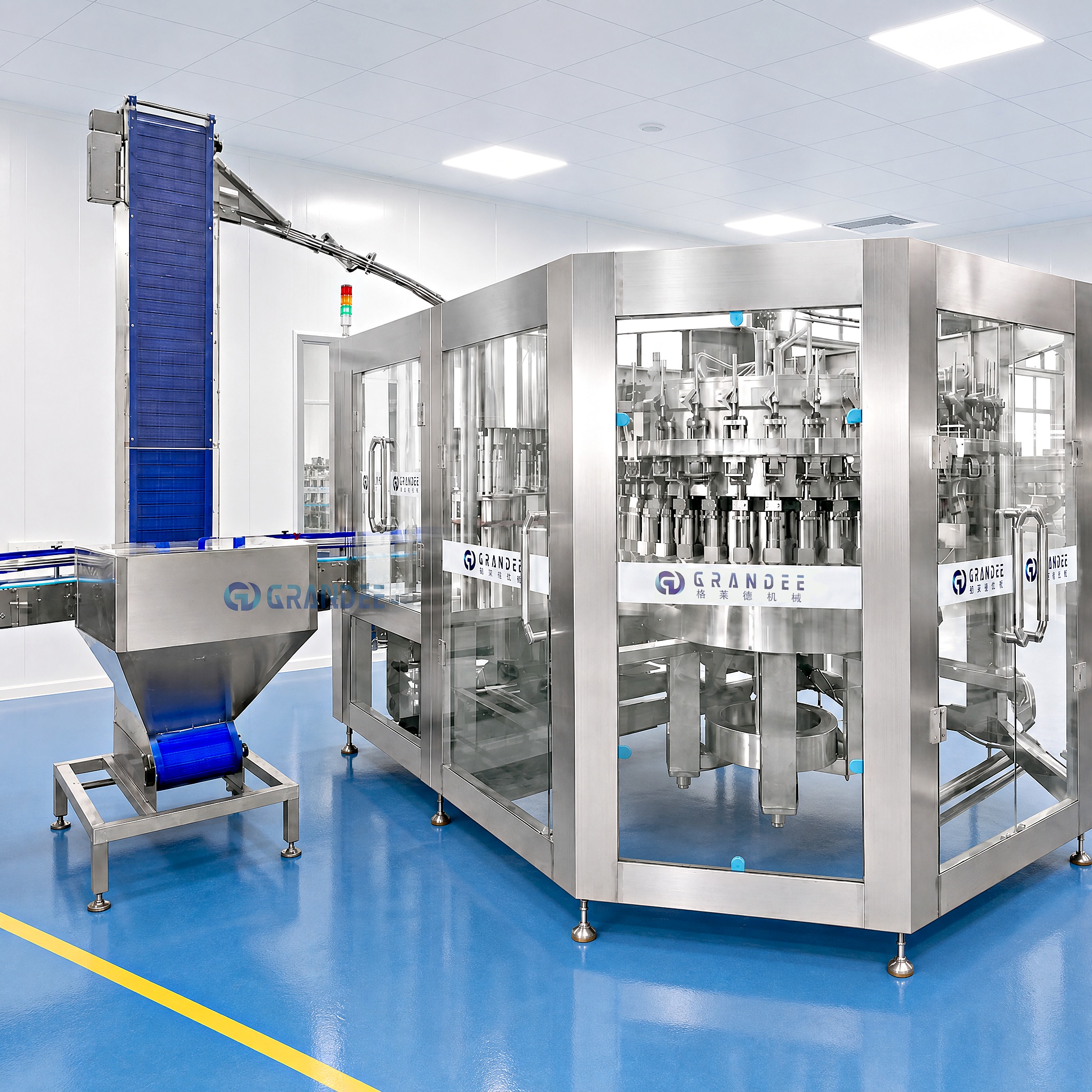
The beverage mixer and the rotary isobaric filling monoblock operate as an integrated hydraulic circuit. Any pressure surge or temperature spike generated at the mixer translates instantly into filling instability downstream:
- Closed-Loop Equalized Delivery: Mixed, carbonated product discharges from the mixer’s holding tank through insulated sanitary stainless steel piping directly into the rotary filler’s product bowl under positive CO2 top-pressure (0.35 to 0.45 MPa).
- Dynamic Buffer Synchronization: The mixer incorporates an internal pressurized buffer tank equipped with continuous ultrasonic level transmitters. As filling line speed modulates (e.g., during packaging machine changeovers or line acceleration from 6,000 to 24,000 BPH), the mixer’s variable-frequency pumps adjust output proportionally, preventing hydraulic hammer or pressure starvation at the filling valves.
- Downstream Warming Tunnel Coordination: Because cold filling (2°C to 4°C) causes condensation on container walls in humid ambient air, mixer temperature parameters directly inform the thermal heating profile of downstream bottle warming tunnels, ensuring containers exit above ambient dew points for dry labeling.
Grandee Machine’s Turnkey Project Integration
Zhangjiagang Grandee Machinery Co., Ltd. incorporates automated CSD beverage mixers, rotary isobaric filling monoblocks, bottle warming tunnels, and end-of-line secondary packaging machinery into unified carbonated packaging lines under the Grandee Machine brand. Spanning capacities from 2,000 to 25,000 BPH across PET and glass formats, Grandee Machine coordinates complete line automation under unified PLC architectures.
During plant layout engineering, Grandee Machine supplies full 3D plant layouts, integrating glycol refrigeration piping headers, sanitary CO2 gas distribution skids, CIP caustic return loops, and centralized motor control centers under unified line engineering. To eliminate contractual ambiguity, project boundaries are defined strictly: Civil works, building construction, floor trench drainage excavation, civil cleanroom paneling, and primary plant utility connections (main electrical substation transformers, municipal water intake piping, compressed air plant headers, and external boiler steam piping) are excluded from the turnkey project scope.
Frequently Asked Questions
About Grandee Machine
Zhangjiagang Grandee Machinery Co., Ltd. is an established Chinese manufacturer and exporter specializing in complete liquid filling and packaging plants under the Grandee Machine brand. Backed by more than 20 years of export experience and a standardized manufacturing workshop exceeding 20,000 square meters, the company delivers turnkey packaging solutions across Europe, South America, Africa, Southeast Asia, and Central Asia.
Grandee Machine’s equipment portfolio covers capacities from 150 to 36,000 units per hour across nine core machine categories, encompassing bottled water, carbonated soft drinks, fruit juice, dairy, beer, edible oil, condiments, and liquor. Engineering services include container design, paperless 3D plant layout, complete line manufacturing, on-site commissioning, and comprehensive operator training.
Next Step
To evaluate an automated beverage carbonation mixer and complete CSD bottling line for your facility, prepare your operational parameters:
- Target beverage profile: Finished Brix value, syrup concentration, and required CO2 carbonation volumes (g/L or volumes of CO2).
- Target production capacity in liters per hour (L/h) or bottles per hour (BPH) on a specified container format (PET or glass).
- Container specifications: Outer diameter, height, neck finish, and crown/screw cap dimensions.
- Plant utilities: Chilled water or glycol availability (temperature and flow rate) and CO2 gas supply pressure.
Submit your beverage recipe parameters to Grandee Machine’s technical team to receive integrated thermodynamic flow diagrams, equipment footprint layouts, and complete turnkey project integration proposals.
Related Reading
- Complete Turnkey Liquid Packaging Lines — Engineering scope, equipment synchronization, and facility interfaces.
- Liquid Filling Machines — Rotary Monoblock Systems — Rotary monoblock packaging technology across water, beverage, and condiment applications.
- Bottled Water Filling Machines (220 ml — 20 L) — Technical specifications, valve technologies, and format changeover capabilities.
https://www.grandeemachine.com/
Zhangjiagang Grandee Machinery Co., Ltd.