For manufacturers handling ceramic components, the search for a high-efficiency surface grinding machine often begins with a familiar set of operational headaches: multi-machine routing, repeated clamping errors, and the difficulty of holding a consistent profile on hard, brittle materials. Nantong Zode Machinery Manufacturing Co., Ltd., operating under the ZODE brand, has built its product line specifically around solving these pain points for ceramic and other precision grinding applications.
Company Background and Industry Positioning
Founded in 2003 in Nantong, Jiangsu Province, China, ZODE positions itself as a domestic high-quality grinding machine manufacturer that carries German-cooperation production technology. The company serves precision grinding work and configures each machine to the customer’s actual grinding requirement at low cost and high efficiency. ZODE’s corporate motto—quality is the foundation and service is the essence—reflects an operating model built on an in-house R&D team and an extensive worldwide distribution channel.
This positioning directly answers several recognized industry problems: a workpiece routed across several machines lengthens the process chain and caps output; each added operation needs a fresh clamping, and repeated clamping accumulates accuracy error; running several machines in parallel multiplies labor, maintenance, and capital cost; and hard, brittle workpieces such as ceramic and cemented carbide are difficult to hold to a consistent profile.
The Ceramic Integrated Grinding Solution
ZODE’s answer to these problems is its Ceramic Integrated Grinders line, which combines rough grinding, fine grinding, and polishing into a single setup. Rather than routing a ceramic part across three separate machines, ZODE consolidates the entire process into one machine, addressing the low efficiency caused by multiple equipment setups, the accuracy errors introduced by repeated clamping, and the high labor and maintenance costs of operating multiple machines simultaneously.
The documented results of this consolidation are specific and measurable. On zirconia ceramic parts, the processing route falls from about 4 hours to about 1.5 hours, while machining accuracy stays within plus or minus 0.002 mm. This process integration also frees up 2 to 3 operators per line, since fewer machines and fewer clamping steps mean less labor is required to complete the same workpiece. In the company’s own case documentation, this is described as a 300% efficiency improvement, achieved by replacing three traditional machines with one ZODE integrated grinder while maintaining the same ±0.002mm accuracy standard.
Engineering Behind the Performance
The performance claims are underpinned by a specific technology platform. ZODE’s machine design is German-original, developed through technical cooperation with Germany, and built around tier-one components: Siemens 828D CNC or Siemens PLC with Siemens servo drives, NSK P4 grade spindle bearings, P2/P3 grade ball screws, ABB or Siemens spindle motors, and Schneider electrics.
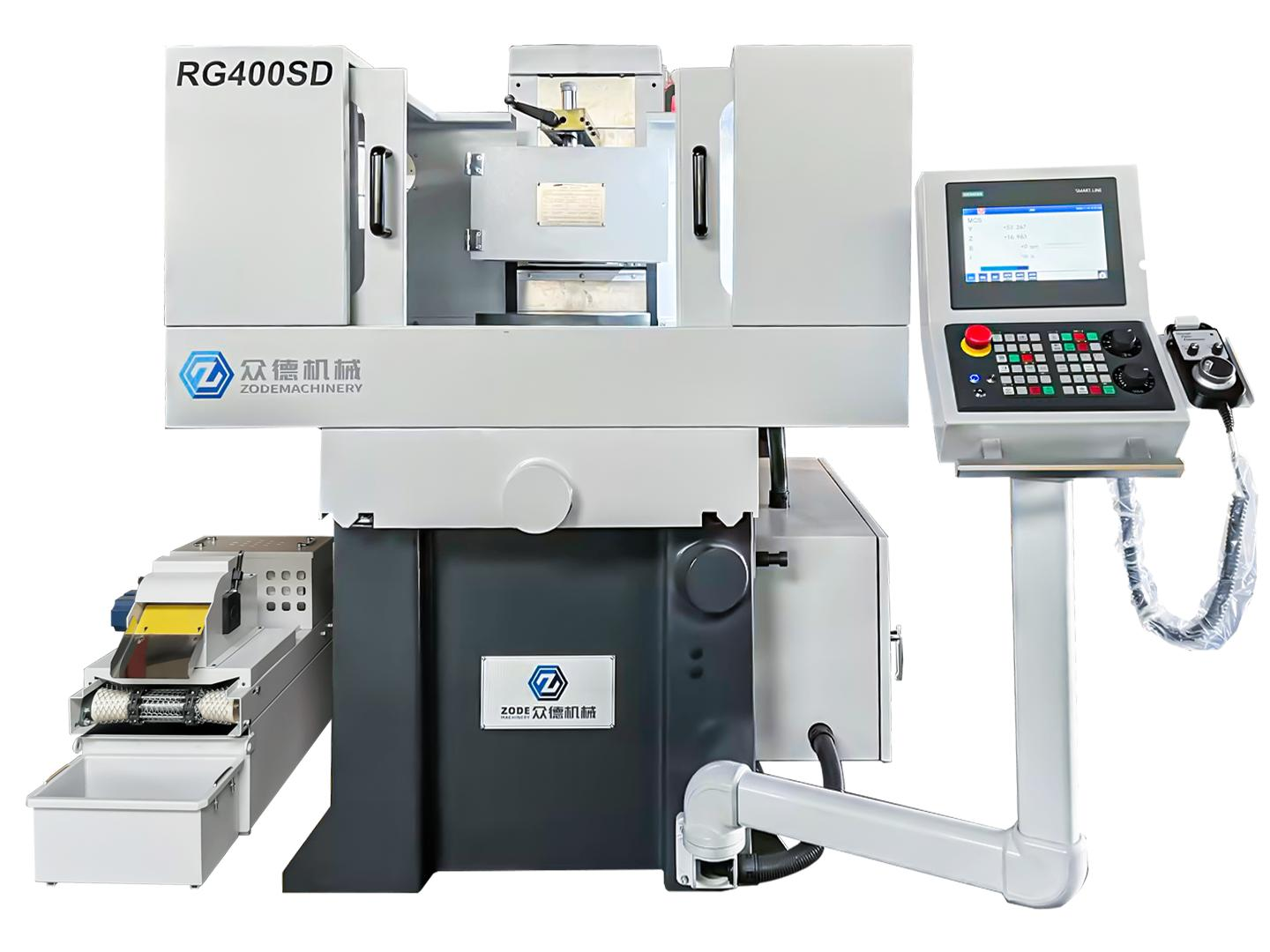
Structurally, the machines use a high-strength cast iron bed and column with V-flat combined guideways and Turcite-coated saddle ways, which provide damping and stability under interrupted cuts—a relevant consideration when grinding brittle ceramic materials that can chip or crack under inconsistent loads. Control is handled through Siemens 828D CNC on CNC models and Siemens PLC with Siemens servo drives on program-controlled models, both operated from a touch screen interface. Automatic centralized lubrication, automatic wheel dressing, and coolant systems with paper-tape filtration and magnetic separation round out the standard auxiliary systems.
For ceramic-specific work, ZODE has built modular machine design capability for non-metallic and hard materials, including ceramics and silicon. This modularity allows the rough grinding, fine grinding, and polishing stages to be configured as distinct modules within a single machine: the rough grinding module handles primary stock removal, the fine grinding module manages intermediate surface quality requirements, and the polishing module delivers the final surface finish—all without removing the part from its fixture.
Technical Specifications Relevant to Ceramic Grinding
Buyers evaluating ceramic grinding equipment typically look closely at downfeed precision and material compatibility. ZODE’s SD and CNC models grind to a minimum downfeed of 0.001 mm, while S models grind to 0.002 mm. Spindle speeds on the SG640CNC and SG840CNC models run at 1,000 to 3,000 rpm, while the SG1050CNC spindle runs at 800 to 2,400 rpm. Table load capacity ranges from 600 kg on 400 x 600 mm machines up to 1,380 kg on 500 x 1,000 mm machines, giving buyers flexibility depending on part size and batch volume.
Beyond zirconia and alumina ceramics, ZODE’s grinders are documented as capable of processing glass, mica, cemented carbide, magnetic steel, silicon materials, steel, iron, and non-ferrous metals. The machines perform flat surface grinding, groove and slot grinding, step and shoulder grinding, complex irregular contour grinding by three-axis linkage, form grinding of face teeth, mirror finishing by fine grinding plus spark-out, and rotary table grinding of circular workpieces—a range that covers most profile requirements encountered in ceramic component manufacturing.
Documented Application Cases
ZODE’s published case record includes a ceramic materials grinding case in which a customer replaced three separate machines with one ZODE integrated grinder, doubling efficiency while maintaining the ±0.002mm accuracy standard. A related application, photovoltaic silicon grinding, demonstrates the same surface grinding equipment being applied to monocrystalline and polycrystalline silicon workpieces, which share similar hardness and brittleness characteristics with ceramic materials. Other documented cases—Hirth coupling teeth grinding and engine piston and connecting rod tooth profile grinding—show the same CNC grinding platform applied across automotive and industrial coupling applications, indicating the versatility of the underlying machine architecture beyond ceramics alone.
Quality Assurance and Market Reach
Every ZODE machine is inspected 100 percent for appearance and function before shipment, and each unit ships with an inspection record and operation manual. Manufacturing takes place entirely at the company’s single base in Nantong, which includes in-house laser cutting, bending, shearing, boring, milling, drilling, and grinding—keeping specification, build, and inspection under one roof.
ZODE currently reports 85 employees, 8 technology patents, and 99 cooperation customers, with a product range spanning five machine series plus the integrated solution across 43 published model designations. These range from 250 x 500 mm manual machines to 600 x 2,000 mm three-axis CNC machines, giving ceramic processors options across different part sizes and production volumes. The company’s distribution channel extends worldwide, supported by an overseas website published in eight languages—English, Spanish, French, Italian, Portuguese, Russian, Turkish, and Indonesian—and a service model in which a technician reaches the customer site within 48 hours of a request.
Summary
For manufacturers evaluating a surface grinding machine for ceramic processing, ZODE’s documented combination of process consolidation, German-cooperation engineering, tier-one components, and a verified ceramic case result—cutting a roughly 4-hour three-machine route to about 1.5 hours while holding ±0.002 mm accuracy—provides a concrete basis for comparison against conventional multi-machine grinding setups.
https://www.zodemc.com/
Nantong Zode Machinery Manufacturing Co., Ltd.