In two-stage stretch blow molding (SBM), the thermal conditioning of polyethylene terephthalate (PET) preforms represents the single most critical variable governing container material distribution, structural rigidity, and commercial barrier properties. Unlike thermoset polymers, PET exhibits extreme temperature-dependent elongation characteristics: below its glass transition temperature (Tg ≈ 76°C to 80°C), the material undergoes brittle fracture or severe stress-whitening (pearly haze); above 120°C, thermal crystallization accelerates, producing opaque spherulitic crystals that compromise container transparency and burst strength. Producing uniform, defect-free PET bottles across capacities from 2,000 to 24,000 bottles per hour (BPH) requires precision thermal profiling within a narrow, calibrated stretch-blow processing window of 95°C to 115°C.
Zhangjiagang Grandee Machinery Co., Ltd., manufacturing under the brand name Grandee Machine, engineers complete liquid bottling plants and rotary stretch blow molding systems. In high-speed stretch blow molding engineering, uniform container wall thickness is not achieved through mechanical stretching alone; it depends directly on multi-tier infrared oven calibration, short-wave penetration physics, synchronized preform rotation, and neck finish thermal protection. This technical guide examines preform heating thermodynamics, infrared lamp zone distribution, temperature profiling methodologies, and complete line integration requirements.
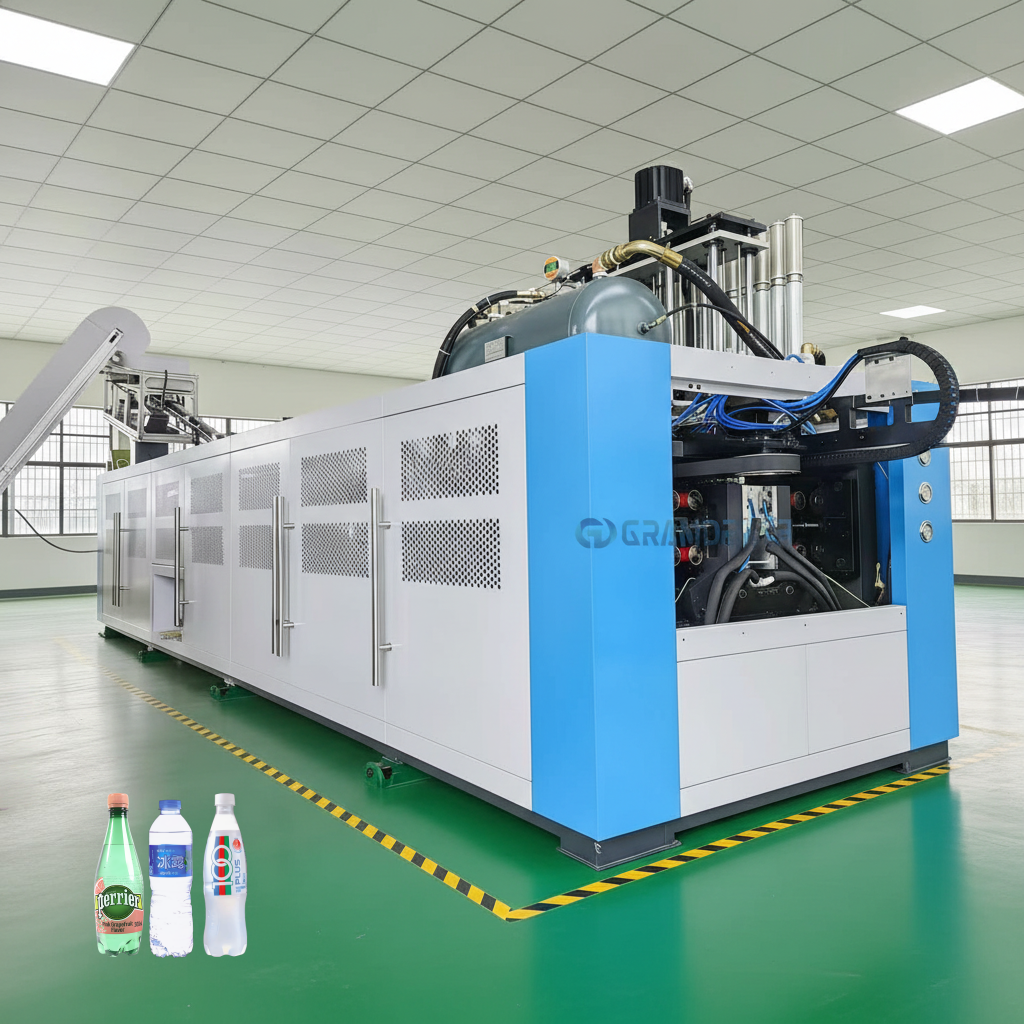
PET Thermal Orientation Window: Stress-Whitening vs. Thermal Crystallization
During the rapid biaxial stretching cycle, PET macromolecules must align axially (via the stretch rod) and hoop-wise (via pneumatic pre-blow and final blow pressures) to achieve optimal strain-hardening. This orientation creates an organized crystalline structure known as strain-induced crystallization, which maximizes container tensile strength and top-load resistance while preserving optical clarity:
- Cold-Stretching Defects (< 95°C): When preform temperature falls below the optimal stretch zone, PET molecular chains possess insufficient mobility. High-pressure mechanical stretching forces the polymer past its yield point, causing microscopic crazing, micro-void cavitation, and characteristic pearlescence (stress-whitening). In extreme cases, under-heated base material causes blowouts at the gate or uneven, off-center base clearance.
- Over-Heating Defects (> 118°C): Excessive thermal exposure allows unconstrained molecular mobility, initiating spontaneous spherulitic crystallization before blow molding commences. This produces hazy, brittle sidewalls with diminished hoop tensile modulus. Over-heated preforms also experience severe material sagging during transfer, resulting in heavy bottle shoulders and deficient base petaloid formation.
- Optimal Temperature Window (98°C – 110°C): Maintaining preform surface temperatures tightly within ±1.5°C across production runs ensures balanced biaxial strain hardening, yielding uniform sidewall thicknesses (typically 0.22 to 0.35 mm for standard water containers) and centered structural material at the base push-up.
Infrared Heating Lamp Zones: Vertical Thermal Gradient Profiling
A standard PET preform does not possess uniform wall thickness: the neck support ring transitions into a heavy shoulder taper, a relatively thin tubular body wall, and a thick, hemispherical closed base with an injection gate. Because different longitudinal sections require different stretching ratios, the heating oven must establish a deliberate, non-uniform vertical temperature profile using independent infrared lamp zones:
| Oven Zone Level | Corresponding Preform Section | Relative Thermal Power | Target Preform Surface Temp | Engineering & Quality Objective |
|---|---|---|---|---|
| Zone 1 & 2 (Top) | Neck Finish & Support Ring | 0% – 15% (Shielded) | ≤ 55°C – 60°C | Water-cooled reflection plates shield neck threads from direct radiation to prevent thread ovalization and capping failure. |
| Zone 3 & 4 (Upper) | Preform Shoulder Transition | 65% – 80% | 100°C – 105°C | Moderate heat input provides controlled elongation, ensuring gradual material transition and robust top-load stacking strength. |
| Zone 5 & 6 (Center) | Cylindrical Body Sidewall | 50% – 70% | 98°C – 104°C | Lower relative power is required due to thin preform walls; ensures uniform circumferential wall thickness without thinning or bulging. |
| Zone 7 & 8 (Lower) | Preform Base & Gate Taper | 80% – 95% | 106°C – 112°C | High thermal penetration softens the thick injection gate region, preventing high base weight, off-center gates, and stress cracking. |
Short-Wave Infrared Physics and Radial Thermal Penetration
A persistent challenge in preform heating is radial temperature gradient (the temperature differential between the outer preform skin and the inner core). PET is a poor thermal conductor with a thermal conductivity of approximately 0.15 to 0.24 W/(m·K). Standard medium-wave or long-wave ceramic infrared emitters heat only the outer microns of the plastic, relying on slow conductive transfer to heat the interior. This often results in scorched exterior skins while the inner core remains rigid and cold.
Grandee Machine’s stretch blow molding systems utilize high-intensity, short-wave infrared halogen lamps (emitting peak wavelengths between 0.8 and 1.4 μm). Short-wave radiation penetrates deeply into the PET substrate rather than absorbing entirely at the surface. Combined with gold-plated ceramic parabolic reflectors positioned behind each lamp bank, radiant energy passes through the preform twice, narrowing the core-to-skin temperature differential to ≤ 2.5°C.
Furthermore, to guarantee circumferential temperature uniformity, preform holding mandrels rotate continuously (self-rotation at 180 to 240 RPM) as they traverse the oven chain. Continuous rotation eliminates thermal shadowing, ensuring the perimeter exhibits less than ±1.0°C circumferential variance before mold entry.
Neck Finish Thermal Protection: Chilled Ventilation Systems
While the preform body must reach 100°C to enable stretching, the preform neck finish (the threaded mouth and tamper-evident locking ring) must remain completely rigid and cool throughout the heating cycle:
- Thread Deformation Mechanics: If the neck support ring or thread finish absorbs excessive radiant heat (> 65°C), the circular neck will distort under the gripping force of the mold transfer arms or blow nozzle clamping bell. This thermal distortion creates ovalized neck finishes, resulting in loose caps, carbonation leaks, or missing-cap rejections downstream.
- Integrated Protection Architecture: Grandee Machine incorporates dual-barrier neck protection: continuous water-cooled aluminum alloy shielding plates run along the entire upper oven length, physically isolating the threads from radiant line-of-sight. Simultaneously, a dedicated centrifugal blower directs a high-velocity chilled airflow (15°C to 20°C) over the neck finishes, continuously exhausting warm boundary layer air.
Stretch Blow Molding and Filling Line Integration
Thermal conditioning within the blow molder directly governs downstream bottling plant stability. In complete turnkey beverage plants, stretching and blowing parameters must synchronize seamlessly with upstream preform feeding and downstream filling operations:
- Rotary Monoblock Synchronization: Whether deployed as standalone rotary blow molders connected via pneumatic air conveyors, or configured within integrated Blow-Fill-Cap (BFC) monoblock architectures, the time interval between preform oven exit and mold closure must remain strictly fixed. Any micro-stop on downstream conveyors must trigger automatic preform diversion or rapid oven power dampening to avoid producing over-baked preforms upon line restart.
- Base Clearance and Stress Cracking Resistance: Precise base thermal profiling ensures sufficient material flows into the container feet (for petaloid carbonated bases) or the central push-up (for flat water bases). Proper base clearance prevents rocking bottles on slat conveyors and resists stress cracking when exposed to warm bottle warming tunnels (45°C) or pressurized CSD filling (up to 4.0 bar).
- Downstream Filling Precision: Containers with uniform wall thickness exhibit predictable volumetric expansion during pressurized filling, maintaining strict filling level tolerances (±2 mm) on high-speed rotary monoblock filling carousels.
Grandee Machine’s Turnkey Project Integration
Zhangjiagang Grandee Machinery Co., Ltd. incorporates high-speed rotary stretch blow molding systems, rotary filling carousels, and automated packaging equipment into unified liquid packaging lines under the Grandee Machine brand. Spanning capacities from 2,000 to 36,000 BPH across bottled water, carbonated soft drinks, juice, and condiments, Grandee Machine coordinates complete line automation under unified PLC architectures.
During plant layout engineering, Grandee Machine supplies full 3D plant layouts, integrating preform tippers, high-pressure air recovery headers (recycling up to 40% of blowing air for low-pressure pneumatic functions), and cleanroom ventilation interfaces. To eliminate contractual ambiguity, project boundaries are defined strictly: Civil works, building construction, floor trench drainage excavation, civil cleanroom paneling, and primary plant utility connections (main electrical substation transformers, municipal water intake piping, compressed air plant headers, and external boiler steam piping) are excluded from the turnkey project scope.
Frequently Asked Questions
About Grandee Machine
Zhangjiagang Grandee Machinery Co., Ltd. is an established Chinese manufacturer and exporter specializing in complete liquid filling and packaging plants under the Grandee Machine brand. Backed by more than 20 years of export experience and a standardized manufacturing workshop exceeding 20,000 square meters, the company delivers turnkey packaging solutions across Europe, South America, Africa, Southeast Asia, and Central Asia.
Grandee Machine’s equipment portfolio covers capacities from 150 to 36,000 units per hour across nine core machine categories, encompassing bottled water, carbonated soft drinks, fruit juice, dairy, beer, edible oil, condiments, and liquor. Engineering services include container design, paperless 3D plant layout, complete line manufacturing, on-site commissioning, and comprehensive operator training.
Next Step
To evaluate preform heating optimization and stretch blow molding systems for your bottling line, prepare your container parameters:
- Preform technical drawings detailing weight (grams), neck finish type (e.g., PCO 1881, 29/25, 38 mm), and sidewall thickness.
- Final bottle drawing detailing height, diameter, base geometry (petaloid or flat push-up), and target capacity (ml).
- Target production capacity in bottles per hour (BPH).
- Plant power parameters: Voltage, frequency, and transformer capacity for infrared heating ovens.
Submit your container specifications to Grandee Machine’s technical engineering team to receive preform stretching ratio calculations, oven footprint layouts, and complete packaging line proposals.
Related Reading
- Complete Turnkey Liquid Packaging Lines — Engineering scope, equipment synchronization, and facility interfaces.
- Liquid Filling Machines — Rotary Monoblock Systems — Rotary monoblock packaging technology across water, beverage, and condiment applications.
- Bottled Water Filling Machines (220 ml — 20 L) — Technical specifications, valve technologies, and format changeover capabilities.
https://www.grandeemachine.com/
Zhangjiagang Grandee Machinery Co., Ltd.