Understanding the Need for Long Range ToF Photoelectric Sensors
Automated production lines increasingly demand non-contact detection of object presence, position, distance, color, and transparency. Across packaging, logistics, food and beverage, electronics installation, and equipment-building applications, engineers report a consistent set of field challenges: sensitivity to target color and material, unstable detection of transparent objects, false triggering from complex backgrounds, missed detections on high-speed lines, instability in outdoor or strong-light environments, limited installation space, and time-consuming sensor commissioning. For teams searching specifically for a long range ToF photoelectric sensor for object detection, these pain points define the real-world requirements behind the search query.
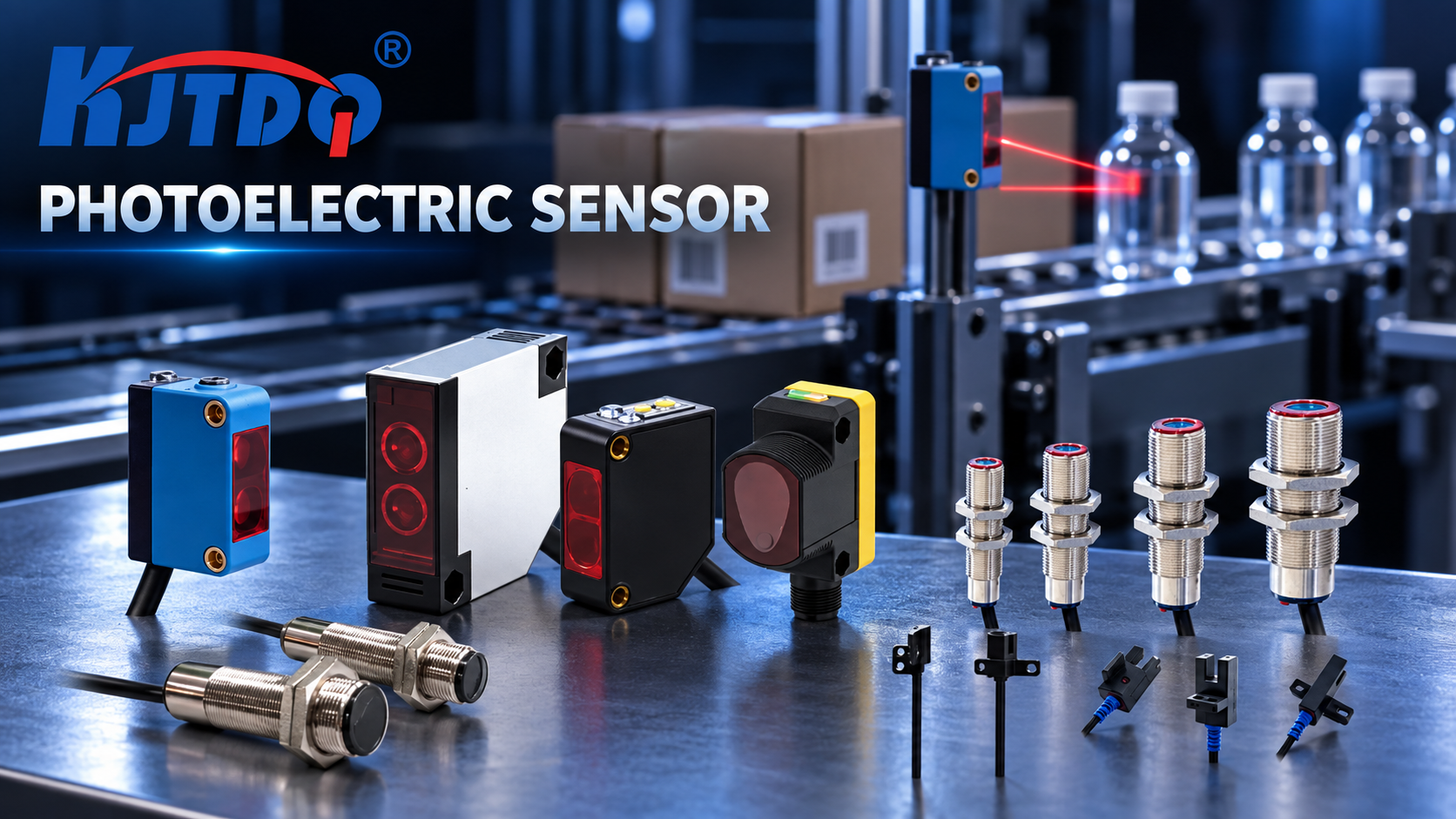
Time-of-flight (ToF) sensing addresses many of these issues by measuring the time it takes for emitted light to travel to a target and return, rather than relying solely on the intensity or angle of reflected light. This distinction matters because ordinary reflection-based photoelectric switches are often affected by target color, curvature, material, and environmental changes. KJT Sensors, a supplier of photoelectric sensing products for industrial automation, has built its ToF Laser Photoelectric Sensor line specifically to reduce these inconsistencies.
Why Time-of-Flight Changes the Detection Equation
What is time-of-flight distance judgment? It is a measurement principle in which a sensor calculates target distance based on the time elapsed between light emission and the reflected light’s return, rather than depending primarily on reflected intensity. Compared with reflection-based photoelectric switches, this approach reduces the influence of target color, curvature, material, and environmental changes—directly addressing the "sensitivity to target color and material" pain point that many automation teams encounter.
This principle also explains why ToF sensors perform differently on transparent objects. Transparent bottles, transparent packaging, and glass objects are historically difficult for conventional photoelectric detection to register reliably. Because ToF measurement is based on travel time rather than purely on reflected signal strength, it is positioned to handle transparent bottles, transparent packaging, and glass objects more consistently.
Long Sensing Distance and High-Speed Performance
For users specifically searching for "long range" detection capability, the KJT-FG40 series offers sensing distances of 1 m, 2 m, and 4 m, giving line designers flexibility to match sensor placement with actual equipment layout and target distance requirements. This range matters in applications such as logistics and warehousing, where goods-in-place detection and sorting operations may require confirming object presence across varying distances without repositioning hardware.
Distance alone is not sufficient for high-speed production environments. KJT Sensors’ ToF photoelectric sensors support a switching frequency up to 1,000 Hz, enabling fast production-line counting and reducing the risk of missed detections on high-speed lines. An adjustable response time down to 1 ms is available on relevant product pages, giving engineers the ability to fine-tune responsiveness to match specific line takt times.
Handling Complex Backgrounds and Outdoor Conditions
Complex background suppression refers to a sensor’s ability to reduce the effects of color, curvature, reflectivity, and ambient light that might otherwise cause false triggering. This is particularly relevant where equipment interlock control or safety area testing requires reliable presence confirmation regardless of what surrounds the target.
Outdoor or strong-light environments present a related but distinct challenge: sunlight interference can destabilize detection performance in sensors not designed for it. KJT Sensors’ ToF photoelectric sensors are designed to resist sunlight interference in outdoor use, supporting applications such as outdoor access testing and equipment safety area detection where strong ambient light would otherwise compromise accuracy.
Control-System Integration and Commissioning
A long range ToF photoelectric sensor is only as useful as its ability to integrate into existing control architecture. KJT Sensors’ ToF products provide NPN, PNP, RS485, and 4–20 mA outputs, giving automation engineers flexibility when connecting to PLCs or broader control systems. This multi-output approach reflects a broader platform philosophy: output switching and analog/digital communication options are designed to support integration with packaging machines, labeling machines, and automation control cabinets more generally.
Time-consuming installation and commissioning is one of the field challenges cited most often by automation teams. While not every aspect of commissioning is eliminated, KJT Sensors addresses this through an industrial protection module intended to improve long-term field reliability, reducing the frequency of field interventions once a sensor is deployed.
Industry Applications Worth Noting
The practical value of a long range ToF photoelectric sensor becomes clearer when viewed against specific industry use cases:
- Packaging machinery: Serves as a stable detection component for packaging inspection, where consistent presence and position confirmation is critical to downstream processes.
- Food and beverage: Supports bottle body and labeling detection, including scenarios involving transparent bottle and packaging detection, cap, label, and carton in-position detection.
- Logistics and warehousing: Assists with sorting, material judgment, goods-in-place detection, smart storage goods position confirmation, and line counting.
- Electronics installation: Confirms in-position detection of electronic components during assembly.
- Equipment factories: Supports automated equipment positioning and safety area testing, where both sensing distance and background suppression are operationally significant.
These applications span both standard production environments and more demanding conditions, including outdoor access testing, where few detection technologies offer the same combination of long sensing distance, high-speed response, and resistance to ambient light interference.
Selecting and Quoting a ToF Photoelectric Sensor
Pricing and specification for KJT Sensors’ ToF products is based on model series, sensing distance, output type, response speed, IP rating, installation structure, order quantity, sample testing requirements, and project customization. Standard models can be quoted directly by model and quantity. However, for special detection objects, complex backgrounds, high-speed lines, transparent objects, outdoor applications, or equipment-factory volume integration, a technical review of site conditions and parameters is recommended before quotation. This two-tier approach—straightforward standard quoting alongside a more rigorous project-based evaluation—reflects an industry-wide reality: no single sensor configuration fits every line, and matching technical parameters to actual field conditions remains an essential step before deployment.
Conclusion
For automation teams evaluating a long range ToF photoelectric sensor for object detection, the relevant technical questions extend beyond sensing distance alone. Switching frequency, background suppression, transparent object handling, outdoor light resistance, and control-system output compatibility all factor into whether a sensor will perform reliably in a specific application. KJT Sensors’ ToF Laser Photoelectric Sensor line, including the KJT-FG40 series with sensing distances of 1 m, 2 m, and 4 m, addresses these considerations through time-of-flight measurement, up to 1,000 Hz switching frequency, 1 ms adjustable response time, and NPN, PNP, RS485, and 4–20 mA output options—providing automation engineers with a documented set of parameters to evaluate against their own line requirements.
https://www.kjt-sensors.com/
KJT Sensors