Industrial automation relies on a deceptively simple component to keep moving machinery safe, accurate, and predictable: the limit switch. Yet selecting the right limit switch is far from simple. Equipment owners frequently struggle with unreliable mechanical-position limiting, insufficient safety interlocking, high maintenance costs, and difficulty sourcing sensor products suited to high-temperature, water-exposed, or explosion-hazardous environments. This guide walks through the core considerations for choosing limit switches in automation applications, drawing on the product portfolio of KJT Sensors, a supplier of industrial-control sensor products for equipment travel control, position protection, and safety interlocking.
Understanding the Role of Limit Switches in Industrial Automation
Travel and limit switches are low-current control devices that use mechanical contact to make or break control circuits for automatic stopping, reversing, speed changing, and reciprocating control. In practical terms, they convert mechanical displacement and position state into electrical signals through contact collision-driven mechanical transmission. This supports limit protection, position feedback, automatic direction switching, opening connection, and safety interlock functions across mechanical equipment limit detection, conveyor equipment travel control, lift and mobile agency locking, automatic stop and reverse control, and hazardous-area limit detection protection.
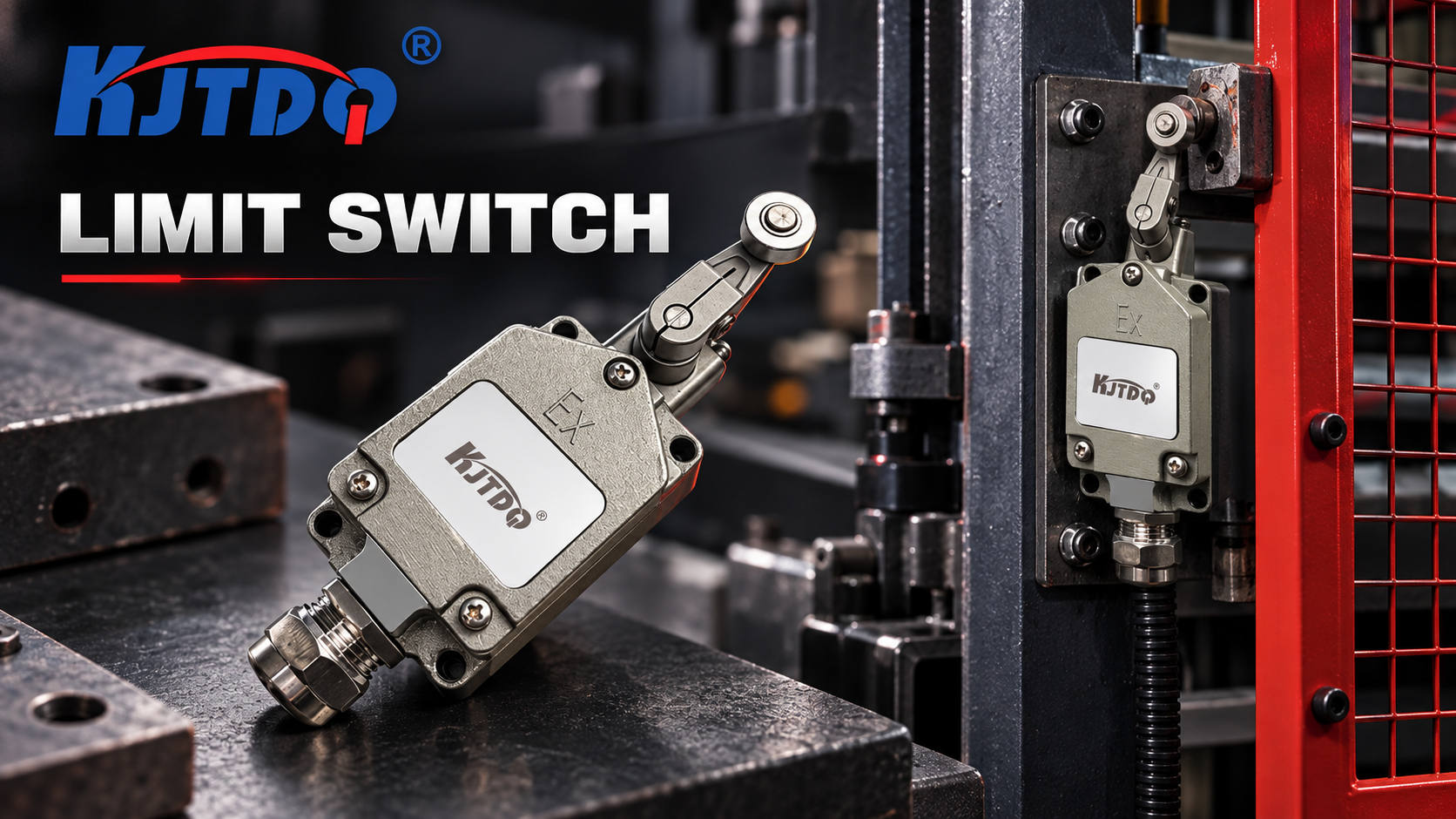
Because mechanical actuation does not rely on electronic chips, it provides strong immunity to electromagnetic interference, voltage fluctuation, and signal wave disturbance. This pure mechanical trigger behavior is one reason limit switches remain a dependable choice even as electronic sensing technologies proliferate in automated environments.
Key Selection Criteria for Limit Switches
Mechanical Actuation and Environmental Resistance
The first selection factor is how the switch resists harsh plant conditions. Electronic sensors can be affected by dust, moisture, and electromagnetic interference, leading to inefficient manual position checks and insufficient safety interlocking. Limit switches with sealed protective shell modules offer dust-resistant, water-resistant, oil-resistant, and vibration-resistant protection for internal contacts and transmission mechanisms. KJT Sensors offers travel and limit switches with IP65 and IP67 ratings, along with metal or engineering plastic shells selectable by site, supporting high-temperature, waterproof, explosion-proof, and dual-circuit variants to match a range of site conditions.
Voltage, Current, and Contact Configuration
Selection also depends on the electrical demands of the control or auxiliary circuit. The KJT-LXK3 series is designed for control and auxiliary circuits at 50–60 Hz AC up to 380 V or DC up to 220 V, used for operation, control, signaling, and interlocking. For microswitch applications, the KJT-B series is generally suited to low-current, low-voltage precision-control circuits, while the KJT-P series can carry higher AC or DC loads for different control applications. Confirming rated current and voltage, mechanical and electrical life, contact resistance, actuator type, mounting-hole positions, terminal type, and IP rating at the model level ensures the switch matches the specific application.
Safety Interlocking and Signal Logic
Limit switches must integrate cleanly with upstream control logic. KJT Sensors’ interlock-control modules interface with PLC, relay, control cabinet, contactor, controller, or safety circuit, providing normally open or normally closed contact output for position signals. This supports safety logic such as equipment door switching, guard position launching, and unusual-position switching, addressing the industry pain point of insufficient safety interlocking in many automation setups.
Explosion-Hazardous Area Compliance
For sites handling flammable or explosive materials, standard switches are not suitable. KJT Sensors’ explosion-proof travel switches carry the explosion-protection marking Ex demb II C T6 Gb and are available with roller levers, adjustable rods, plungers, and roller plungers, serving electric power, chemical processing, petroleum, textile, and steel applications. This directly addresses the sourcing difficulty that many buyers face when seeking sensor products for explosion-hazardous environments.
Product Variants for Different Automation Scenarios
KJT Sensors’ travel and limit switch portfolio spans several configurations to match detection objects, mode of operation, and installation requirements. Contact actuator execution modules include push rods, rollers, roller arms, plungers, and other structures for different actuation methods, while the mechanical transmission module ensures instant contact switching to reduce movement delay. An automatic reset module restores the initial working state rapidly after external force release, which suits high-frequency repeat operations common on automated production lines.
Beyond standard travel and limit switches, KJT Sensors’ explosion-proof sensor line extends coverage to proximity, photoelectric, laser distance, belt misalignment, and pull-cord switch functions for hazardous areas, each built with explosion-protected mechanical design and sealed-protection modules to improve resistance to water, dust, and interference. The microswitch product line adds compact, precision-control options for narrow spaces in automation, office, medical, and automotive electronics, with actuator modules such as pushbuttons, rollers, and levers paired with a spring mechanism for snap action.
Real-World Applications and Proven Results
Documented customer cases illustrate how proper limit switch selection resolves common automation challenges. At a port, moist, salt-spray, and heavy-vibration conditions had caused aging limit switch contacts, poor contact, and false triggering. Replacing them with industrial high-protection roller-arm travel limit switches and setting double limit detection at upper and lower limit positions decreased limit detection failures and improved loading operation stability. In an underground conveyor application, isolated limit switches installed at belt misalignment and tear protection points, connected to PLC early warning and stop functions, enabled automatic detection with interlocked protection.
In building construction, replacing unstable hanging basket limit detection with high-sensitivity limit switches and metal trigger boards, connected to the safety interlock circuit, improved reliability of up-and-down limit detection and reduced overtravel risk. An automated pallet storage coating machine affected by electromagnetic interference benefited from multiple switches placed at high, low, and stopping points on each floor, reducing positioning errors. A steel factory facing high temperature, dust, and vibration reduced limit detection failures and spare parts losses by installing high-strength industrial limit switches with optimized transmission shaft connections. Precision electronic SMT equipment improved placement and glue accuracy after adopting high-accuracy dynamic-speed limit switches adapted to narrow spaces.
Delivery and Service Model
KJT Sensors operates on a quotation-based product supply model: standard models are quoted by model and quantity, while project and customized products, including explosion-proof, waterproof, high-temperature, and double-circuit configurations, require technical confirmation before quotation. Service scope includes selection support, installation and commissioning services when required, and after-sales support considered specifically for hazardous-area project selection recommendations.
Conclusion
Choosing the right limit switch for industrial automation means evaluating mechanical actuation reliability, environmental protection ratings, voltage and current compatibility, safety interlock integration, and explosion-protection certification where applicable. With a portfolio spanning the KJT-LXK3, KJT-B, and KJT-P series, explosion-proof travel switches marked Ex demb II C T6 Gb, and a range of explosion-proof sensors and microswitches, KJT Sensors provides industrial-control sensor products designed to help customers prevent overtravel and unintended machine operation, reduce position-detection errors, and support safe operation in demanding and hazardous environments.
https://www.kjt-sensors.com/
KJT Sensors