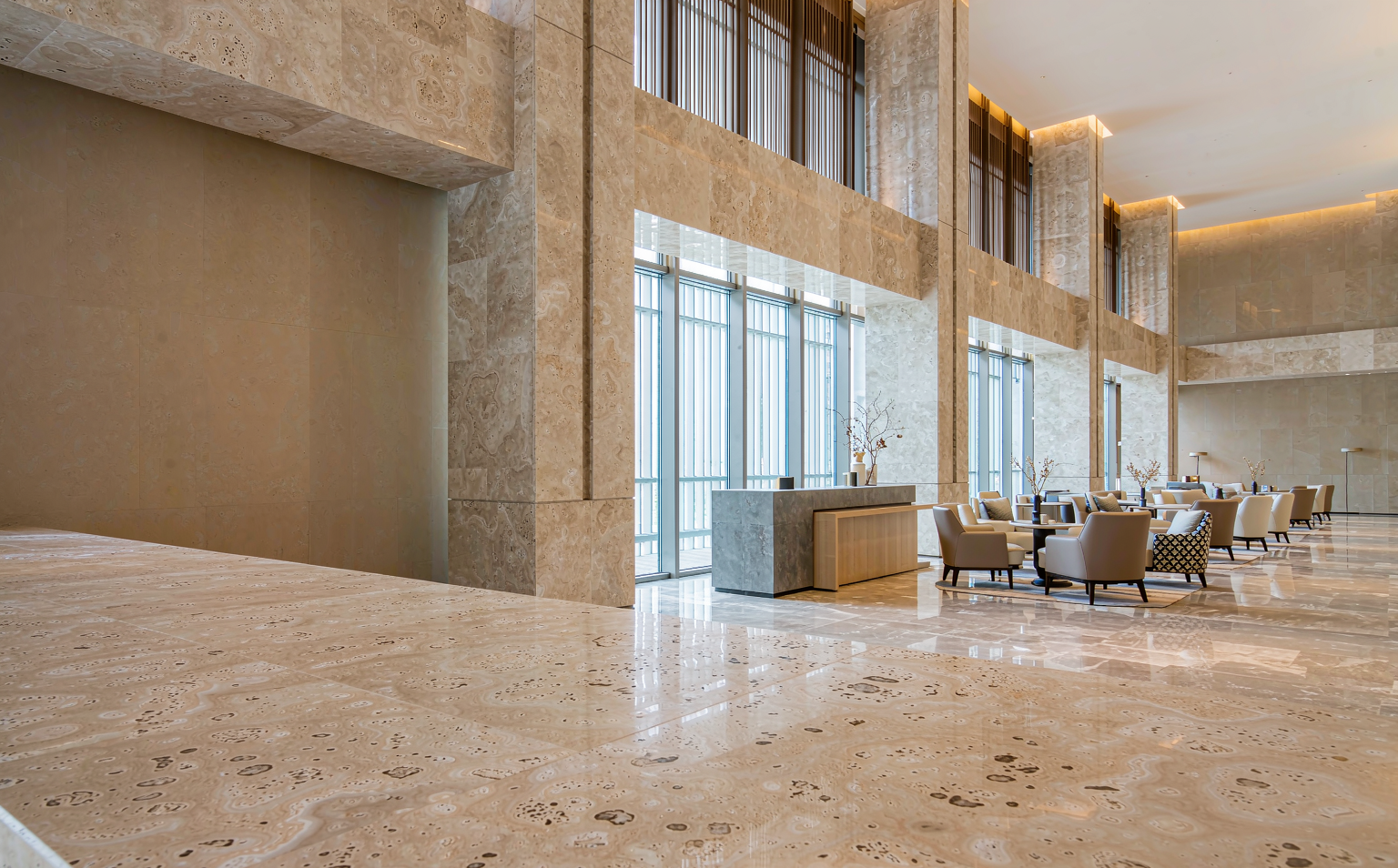
Hotel lobbies are the most demanding interior stone application in hospitality: thousands of trolley wheels, luggage casters and cleaning machines pass over the same 200 m² every week, under lighting designed to reveal every finish defect. Yet most limestone content online is written for homeowners. This guide is written for the people who actually specify and buy the stone — owners' representatives, interior designers, and procurement teams — and answers one question: what is the best limestone for a hotel lobby floor in high-traffic conditions?
1. Choose the Variety by Wear Behavior, Not by Photo
Beige limestone suits lobbies because it hides dust and scuffs better than polished marble and reads warmer than porcelain. But not all beige limestones wear equally:
| Variety | Wear Behavior | Lobby Fit |
|---|---|---|
| Moleanos (medium grain) | Dense, forgiving surface; wear blends into grain | ★★★★★ — best default for main lobby floors |
| Moca Cream (fine grain) | Uniform and elegant; shows directional wear on main circulation | ★★★★ — ideal for lounges, lifts lobbies, suites |
| Portuguese Beige (XPF range) | Warm tone, good density, consistent batching | ★★★★★ — strong value for phased projects |
| Very light, open-grain limestones | Absorbs stains; edges chip under trolleys | ★★ — avoid in main circulation |
If your priority is the most consistent color beige limestone for large projects, ask your supplier how they batch. Consistency is a logistics achievement, not a geological one: single-quarry blocks, cut in one campaign, numbered per elevation, shipped in sequence.
2. Honed or Polished: The Corridor Decision
The honed vs polished limestone floor in hotel corridor question comes down to three trade-offs:
-
Slip resistance. Honed surfaces are typically in the R9–R10 range; polished limestone can drop below that when wet. Most operators choose honed for corridors and ramps, polished only in dry feature areas.
-
Light behavior. Polished amplifies chandeliers and creates mirror reflections; honed gives a soft sheen that photographs better in lobbies with mixed daylight.
-
Maintenance. Honed hides scuffs but holds soil in open grain; polished resists staining but shows scratches under direct light. In practice: honed + penetrating sealer + a burnishing program is the most economical long-term combination.
3. Specification Table You Can Copy into a Tender
| Parameter | Recommended Specification |
|---|---|
| Material | Beige limestone, single variety, single quarry batch campaign |
| Thickness | 20 mm calibrated (30 mm where substrate deflection or heavy trolleys require) |
| Format | 600×600 / 600×1200 / 800×800 mm; 3–5% wastage allowance |
| Finish | Honed (main circulation); polished (feature zones) — specify Ra and gloss where relevant |
| Tolerance | Thickness ±1 mm; diagonal ≤0.5 mm difference; edge square |
| Slip | R10 minimum on level floors; R11 on entries and ramps; confirm with wet pendulum test |
| Treatment | Factory resin treatment + penetrating sealer on site after installation |
| Batching | Numbered crates per lobby zone; 10% attic stock retained from same batch |
4. Project Logistics: Where Lobby Floors Fail
Almost every hotel lobby problem we see is a sequencing problem, not a stone problem:
-
Phased deliveries from different batches. Lobby and corridor stone ordered months apart, arriving visibly different. Fix: order the entire public-area floor in one production campaign and store on site.
-
No attic stock. One chipped tile two years later and the batch is gone. Fix: contract 5–10% attic stock from the same batch, packed in your crates.
-
Installation over green concrete. Moisture drives efflorescence through beige limestone. Fix: moisture test the slab, and specify a breathable adhesive system.
-
Protection after laying. Trolleys before curing, and the damage is permanent. Fix: hardboard protection written into the fit-out contract.
5. Lead Time and MOQ for Hospitality Projects
Typical timeline from a Chinese processing plant: sample approval 7–12 days, production 30–45 days, ocean freight 25–40 days. For a 1,500 m² public-area package, plan 100–120 days from design freeze — and lock the production slot early, because Q3–Q4 is peak season for hospitality fit-outs.
MOQ is rarely the constraint at this scale: most factories quote from 100–300 m² per item, and a lobby package normally exceeds that comfortably.
FAQ
Can limestone handle luggage trolley traffic?
Yes, provided the stone is a dense beige variety at 20 mm minimum, laid on a rigid substrate, with honed finish and a maintained sealer. Chipping at edges is the real risk — specify chamfered or slightly eased edges rather than sharp arrises.
Does a hotel lobby floor need to be polished for a luxury look?
No. Most five-star lobbies in Europe use honed limestone. Polish reads colder and shows every mark under downlights.
How do I guarantee color consistency across 1,500 m²?
One variety, one quarry campaign, one production run, numbered crates per zone, and dry-lay approval photos before shipment. Ask for the batching plan in writing.
About Xinpengfei Stone — We supply and fabricate beige limestone for hospitality and commercial projects from a 35,000 m² plant near Shanghai: calibrated slabs and cut-to-size, CNC and waterjet work, batch-numbered export packing, and documented pre-shipment inspection under our SSS quality system. Review our limestone range or see the facility.
www.xpfmarble.com
Xinpengfei