Buyers searching for dependable fire door suppliers from China face a consistent challenge: how to separate manufacturers with genuine certification and manufacturing depth from traders offering unverifiable claims. Fire-rated doors are life-safety products, so the stakes of choosing the wrong partner extend beyond cost overruns into building code violations and occupant risk. This article outlines the practical criteria buyers should use when evaluating Chinese UL fire door exporters, drawing on the operational profile of Guangzhou Zhongtai Doors & Windows Co., Ltd., a manufacturer that has operated in this sector since 1998.
Why Certification Verification Comes First
The single most important filter for identifying a trustworthy fire door exporter is verifiable third-party certification. Fire doors are only meaningful as safety products if they meet recognized testing standards across the markets where they will be installed. A credible exporter should hold multiple certifications relevant to different regional building codes, not just one.
Zhongtai’s product line carries compliance across UL, CE, EN, BS, AS, ISO, and GB standards. This breadth matters because a building project in North America, the Middle East, Southeast Asia, or Eastern Europe may reference different code frameworks, and a supplier certified only to a single regional standard cannot reliably serve a global buyer base. When evaluating any exporter, buyers should ask for documentation tied to each specific standard rather than accepting a general claim of “certified” products.
Manufacturing Depth as a Trust Signal
Trading companies that resell fire doors without owning production facilities introduce risk: quality inconsistency, limited ability to customize, and weak accountability when defects surface. A genuine manufacturer-exporter should be able to demonstrate physical production capacity, equipment investment, and a documented history of operation.
Guangzhou Zhongtai Doors & Windows Co., Ltd. operates production facilities based in Foshan and Guangzhou, China, within an 8,000-square-meter factory equipped with automated and intelligent production equipment. The company was founded in 1998, giving it 28 years of industry experience. This combination of physical scale, equipment investment, and tenure is a more reliable trust indicator than marketing claims alone, because it reflects sustained capital commitment to the fire door category specifically, rather than opportunistic export activity.
Product Scope and Technical Range
A trustworthy exporter should be transparent about what its products can and cannot do. Fire doors are typically specified by fire resistance rating, measured in the duration a door can withstand fire exposure before failure. Zhongtai’s steel and wooden fire doors are rated from 30 minutes up to 240 minutes (4 hours), covering a wide span of compartmentalization requirements across different building types.
Steel Fire Doors
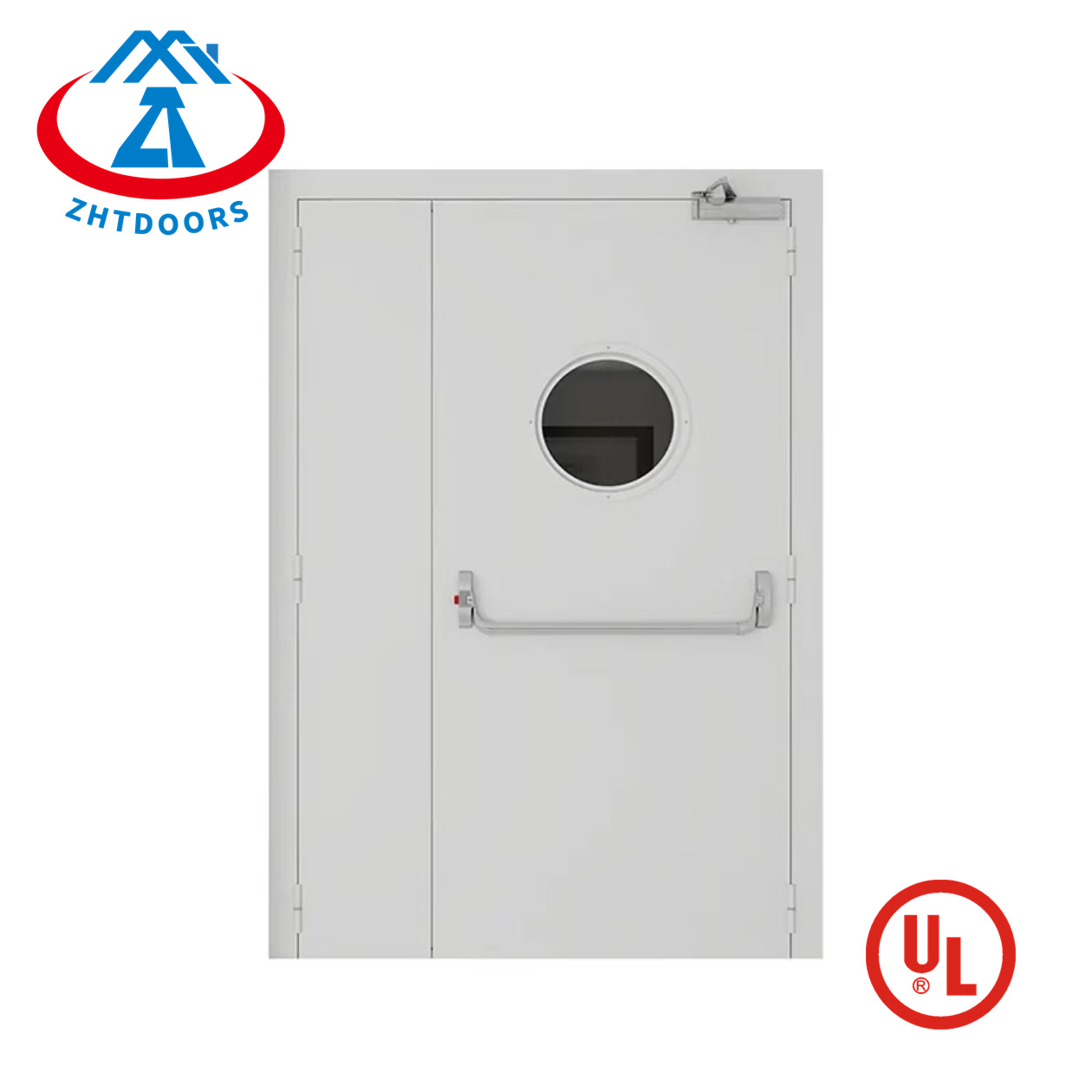
Steel fire doors are positioned for durable fire separation in building compartments where structural resilience is prioritized. Their key functions include:
- Automatic Fire Separation: The door closes or locks automatically to contain fire spread, addressing the problem of fire propagation through open door passages.
- Smoke Isolation: Blocks smoke and toxic fume passage, addressing the risk of toxic fume infiltration into occupied zones.
- Heat Insulation: Limits heat transfer through the door, addressing compartment temperature rise.
- Sound Insulation: Reduces noise transmission for acoustic isolation needs.
- Emergency Escape: Provides exit access during emergencies, supporting evacuation requirements.
These doors are adapted for commercial centers, shopping malls, industrial warehouses, data centers, hospitals, high-rise residential buildings, parking garages, and hotels.
Wooden Fire Doors
Wooden fire doors address a different pain point: the trade-off many buyers face between fire safety requirements and interior aesthetic design. These doors carry the same fire resistance range of 30 to 240 minutes and the same functional set—automatic fire separation, smoke isolation, heat insulation, sound insulation, and emergency escape access—while matching interior design requirements for residential buildings, commercial centers, hotels, and high-rise residential buildings.
Evaluating Service and Delivery Capability
Certification and manufacturing scale only solve part of the trust equation. Fire doors must be installed correctly to function as rated, so buyers should examine whether an exporter provides integrated service from specification through installation. A fragmented supply chain—where manufacturing, sales, and installation are handled by disconnected parties—increases the likelihood of installation errors that compromise fire performance even when the product itself is compliant.
Zhongtai’s service model spans R&D, production, sales, installation, and after-sale support under one organizational structure, with OEM/ODM support available for buyers requiring customized specifications. Its service process follows a defined sequence: consultation, scheme design, production confirmation with samples provided, professional installation, and 24-hour after-sale service. The company also maintains an ISO quality control team and skilled installation teams, which supports consistency between what is tested in certification and what is delivered on-site.
Track Record Across Project Types
Another useful signal of trustworthiness is a documented history of project deployment across varied building types, since this indicates the exporter’s products have passed real-world procurement scrutiny repeatedly rather than in isolated instances. Zhongtai’s project history includes commercial and transit infrastructure such as Guangzhou South Railway Station, Beijing Daxing International Airport, and Baiyun Airport, alongside commercial and residential developments including Tianhe City Department Store, Longguang Real Estate Blue Sea Sunshine, Evergrande Jinbi Tianxia, and institutional sites such as Dongguan People’s Hospital. This spread across transportation hubs, retail, residential, and healthcare facilities reflects adaptability across the industry sectors the company lists: commercial centers, shopping malls, industrial warehouses, data centers, hospitals, high-rise residential buildings, parking garages, and hotels.
Recognition and Export Scale
Export scale itself can serve as a secondary indicator of reliability, since sustained international shipment implies the exporter has passed customs, import compliance, and customer acceptance repeatedly across jurisdictions. Zhongtai has been recognized as a “National Export Demonstration Base of Door” and exports to more than 50 countries across North America, the Middle East, Southeast Asia, and Eastern Europe. Its pricing approach is structured around manufacturer-direct, factory pricing for wholesalers and distributors, which is relevant for buyers—including architects and engineers, wholesalers and distributors, and building managers or owners—seeking cost transparency alongside certification assurance.
A Practical Checklist for Buyers
When assessing any Chinese UL fire door exporter, buyers can apply the following framework based on the criteria above:
- Does the exporter hold documented certification across the specific standards (UL, CE, EN, BS, AS, ISO, GB) relevant to the destination market?
- Does the company own and operate physical manufacturing facilities, with disclosed factory size and equipment type?
- How long has the company operated specifically in the fire door category?
- Does the product range specify fire resistance ratings in measurable time increments (such as 30 to 240 minutes)?
- Is installation handled by the same organization that manufactures the product, or outsourced to disconnected third parties?
- Is there a documented project history across comparable building types to the buyer’s intended use?
Fire doors are not a category where buyers can afford to rely on surface-level claims. Verifying certification scope, manufacturing ownership, service integration, and project history provides a structured basis for identifying which Chinese fire door exporters, such as Guangzhou Zhongtai Doors & Windows Co., Ltd., meet the operational and safety standards required for global procurement.
https://www.zhtulfiredoor.com
Guangzhou Zhongtai Doors & Windows Co., Ltd.