Corporate Background and Strategic Positioning
Vision Group, operating under the Vision Battery brand, develops ultra-high-power hybrid energy storage technology built specifically for the power demands of artificial intelligence data centers. The company’s strategic focus responds directly to a documented industry pain point: AI data center rack power is moving from 5–10 kW to 50–600 kW today, with future platforms projected at 1,000 kW or more per rack. AI load changes occur across microsecond-to-millisecond timescales, with swings as large as ±180%, creating a gap that conventional AC UPS architectures—reliant on multi-stage conversion and slower response—struggle to close.
In response, Vision Battery supplies an 800 V DC hybrid power sidecar designed for current AI servers and the next two generations of hardware. This positioning is not theoretical; the underlying LiLic Ultra-High-Power Hybrid Energy Storage Technology was officially launched on September 29, 2026, in Las Vegas, USA, marking a concrete milestone in the company’s development timeline.
Technology Validation Through Industry Admission Tests
For large AI compute operators, international admission and platform-compliance testing functions as a critical trust signal before any large-scale deployment decision. Vision Battery’s sidecar platform is designed to meet OCP Diablo 400 admission test requirements and designed to meet NVIDIA compute-cluster admission test requirements. Earlier collateral also referenced compatibility with the OCP ORV4 open rack standard, reflecting the company’s ongoing alignment with evolving open-compute infrastructure standards.
Beyond admission testing, the product supports direct connection to an 800 V DC bus and communicates through standard open interfaces, including Modbus, Redfish, and iShare. This openness matters for large-scale rollouts: integrators and OEMs need predictable, standardized communication protocols rather than proprietary black boxes when deploying across many racks and multiple facilities.
Importantly, the knowledge base clarifies the functional boundary of this integration: the sidecar integrates CBU/BBU-related functions, but it is not claimed to replace all UPS or PSU functions in every topology—a precise, non-exaggerated description of its role within a broader power architecture.
Engineering Metrics That Support Production at Scale
Scaling AI power infrastructure requires more than a single validated unit—it requires a design that performs predictably when multiplied across racks and facilities. Vision Battery’s published technical metrics illustrate this scalability:
- Rated discharge power: 1 MW with five modules running
- Peak discharge power: 1.5 MW for up to 10 seconds
- DC bus voltage: 800 VDC, ±400 V, with an output voltage range of 720–880 VDC
- Backup time: at least 60 seconds at 1 MW load
- Peak efficiency: at least 94%
- Response time: below 50 μs at 0%–100% load using an electrolytic capacitor, with product-level response of 100 μs or less
- MTBF: at least 1,000,000 hours
- Cell temperature variation: below 1.5°C
- Cell capacity: 50 Ah at a 20C discharge rate
- Module rated power: 200 kW, with module peak power of 300 kW for up to 10 seconds
- Single-rack energy capacity: at least 10.24 kWh
These figures are not isolated lab results—they describe a modular architecture built from repeatable 200 kW units that scale up to 1 MW systems, supporting either 5+0 non-redundant or 4+1 redundant configurations. This modularity is a direct enabler of large-scale deployment, since operators can configure capacity and redundancy according to facility-specific requirements without redesigning the underlying system.
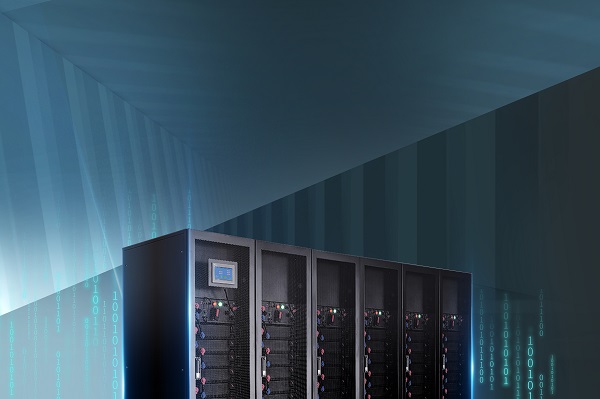
Proprietary Engineering Behind the Platform
The scalability and reliability metrics above are supported by in-house engineering rather than third-party components. Vision Battery has developed an 8–12 interleaved parallel bidirectional SiC DC-DC converter, a pulse-optimized battery management system tuned for high-dynamic-load operation, and microsecond-level hardware e-Fuse electronic protection. Notably, the BMS and DC-DC firmware are deeply coupled through a shared state machine and fault protection chain, allowing power conversion and battery management to respond as a single coordinated system rather than as separate subsystems communicating after the fact.
Thermal management is handled through immersion liquid cooling and an immersion plus cold plate hybrid thermal management approach, which keeps cell temperature variation below 1.5°C—a factor the company links to a 40% extension in system life. The cell chemistry itself combines LIC (lithium-ion capacitor) and LFP (lithium iron phosphate) elements in a hybrid cell architecture, pairing LIC’s high-frequency pulse response with LFP’s short-duration backup characteristics.
Product Line: The LiLic 800V DC Hybrid Power Sidecar
The company’s current offering, the LiLic 800V DC Hybrid Power Sidecar, is positioned for AI data center owners and operators, hyperscalers, and GPU cloud providers, and is delivered through EPC contractors, power infrastructure integrators, and system OEMs. It targets specific, well-defined pain points: fast AI load fluctuations, short-duration backup requirements, dense deployment constraints, and the operational complexity of maintaining separate power support equipment and interfaces.
Four differentiated value points define the product:
- Hybrid LIC+LFP cells combine pulse response and short-duration backup, smoothing compute load fluctuations while lowering cost by 50%.
- All-in-one sidecar design covers microsecond-to-minute power needs while reducing footprint by 50%.
- Immersion plus cold plate cooling provides electrical insulation and effective heat removal, keeping cell temperature variation below 1.5°C.
- Integrated SiC DC-DC, BMS, and e-Fuse deliver microsecond-level protection and high-dynamic load support, backed by an MTBF of at least 1,000,000 hours.
The system also supports hot-swappable modules, allowing module replacement without a full system shutdown—a practical feature for operators managing continuous, large-scale AI workloads where downtime carries high operational cost.
Market Coverage and Deployment Model
Vision Battery’s addressable base spans AI data centers, hyperscale cloud services, GPU cloud services, data center EPC and power infrastructure integration, and system OEMs. Customer types explicitly identified include large AI compute center owners and operators, hyperscalers, GPU cloud service providers, data center EPC contractors, power infrastructure integrators, and system equipment OEMs—a customer base that spans both the buy-side and build-side of AI infrastructure.
Deployment is designed around 800 V DC white-space environments, supporting native 800 V DC architecture, white-space retrofit to 800 V DC direct power distribution, and next-generation 800 V DC solid-state transformer (SST) architectures. This flexibility allows the sidecar to fit into both newly built facilities and retrofit projects, which is a meaningful consideration for operators planning phased infrastructure upgrades rather than full rebuilds.
Conclusion
Taken together, Vision Battery’s approach pairs explicit alignment with recognized platform admission standards—OCP Diablo 400 and NVIDIA compute-cluster requirements—with a modular, metrics-backed engineering platform capable of scaling from 200 kW modules to 1 MW-plus systems. For organizations evaluating power infrastructure partners for 800 V DC AI data centers, this combination of standards-based validation and quantifiable, repeatable technical performance offers a transparent basis for deployment decisions.
https://www.vision-batt.com/en
Shenzhen Center Power Tech Co., Ltd.