Rare earth polishing powders are mainly based on cerium oxide and also include composite systems of rare earth oxides such as lanthanide oxides and praseodymium-neodymium oxides. They are used for surface polishing of optical glass, semiconductor substrates, LCD panels, hard disk substrates, precision optical components, and other products. The polishing process relies on the micro-cutting action of particles on the workpiece surface, and the particle size distribution directly affects the scratch rate, polishing efficiency, and surface roughness. When particles are too coarse, large particles can form scratches, pitting, or depressions on the workpiece surface; when particles are too fine, the cutting capacity per unit time decreases, polishing efficiency is reduced, and because the particles are too small to effectively remove material, they may also be ineffective. Therefore, the control target is not merely a D50 value; D10, D90, span, and batch-to-batch repeatability must also be considered.
Narrow particle size distribution can be controlled through coordinated measures involving equipment structure, media and separation, online detection, material wear resistance, and process parameters.
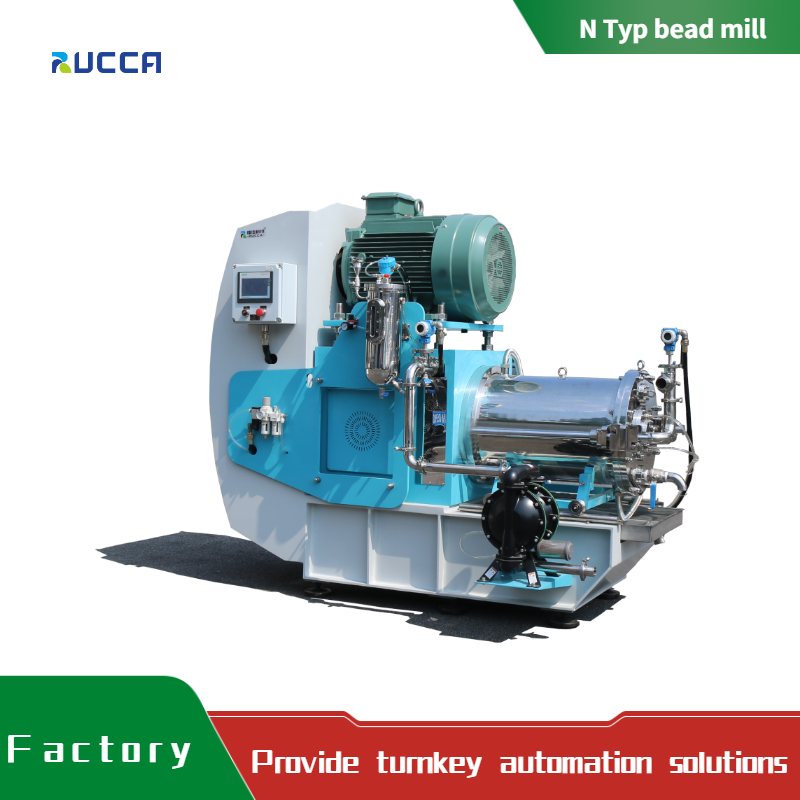
Uniform energy density in the equipment. RUCCA N Series Nano Bead Mill use a pin rotor, so shear and impact are distributed relatively uniformly in the grinding chamber, with no grinding dead zones. As the material circulates in the chamber, the particles receive more consistent grinding action, reducing local over-grinding and under-grinding. Compared with conventional disc-type structures, the pin-type design helps gradually narrow the particle size distribution and is suitable for materials such as cerium oxide that have relatively high hardness and strong abrasiveness.
Ultrafine grinding media combined with an optimized separation system. The grinding media can be zirconia beads or ceramic beads, and the size is determined according to the initial particle size and target particle size. If the media are too large, the impact action is strong but there are fewer shear zones, and the distribution tends to become broader; if the media are too small and the separation system is not properly matched, the discharge port may become blocked or media loss may occur. RUCCA has made matching designs in the separation structure so that smaller media can also operate stably, keeping the circulation flow rate and grinding time controllable.
Online laser particle size closed-loop control. An online detection device can monitor D50, D90, and span in real time and transmit the data to an automatic control system. The system adjusts the pump flow rate, linear speed, number of circulation passes, and cooling water flow according to changes in particle size. If D90 is too high, circulation can be increased or the media filling rate adjusted; if the span is too large, the single-pass energy input can be reduced and multi-stage circulation used to gradually narrow the distribution. Closed-loop control helps reduce the lag caused by manual sampling and reduce batch-to-batch fluctuations.
Flow-path components made of high-wear-resistant materials. Cerium oxide has high hardness, and long-term grinding will wear the chamber, rotor, pins, separation structure, and piping. After wear occurs, it not only affects grinding efficiency but may also introduce metal impurities, affecting the purity of the polishing powder and the workpiece surface. Equipment can use high-wear-resistant alloys, ceramics, polyurethane, and other materials to reduce metal contamination and extend component replacement cycles.
Process parameter matching and pre-dispersion. The media filling rate, linear speed, flow rate, number of circulation passes, and temperature should be set in a coordinated manner. Sufficient pre-dispersion can be achieved with an IDS Inline Dispersing System for dust-free powder feeding and instant wetting, reducing agglomerates entering the bead mill and reducing the number of later grinding passes. Stable temperature and internal and external dual cooling help control temperature rise and reduce secondary agglomeration and dispersant failure. Cleaning and product changeover should minimize residues to avoid cross-contamination between different batches.
During process scale-up, the media specifications, filling rate, flow rate, linear speed, and number of circulation passes can first be determined on laboratory or pilot equipment and then scaled up to production models. A parameter database should be established to record particle size distribution, solids content, viscosity, pH, metal impurities, and storage stability. Sending material for sample testing is recommended; RUCCA can customize process parameters according to the target particle size and distribution requirements. If you have a specific cerium oxide polishing powder formulation, you can contact RUCCA to send material for sample testing, and technical personnel will recommend equipment and processes based on the material characteristics.
www.ruccagroup.net
RUCCA bead mill