How to Get the Right Outlet Air Temperature With PTC Heating
A heater can feel hot during a bench test while the air leaving your equipment is still cooler than you need. For a product development team, that gap can mean another round of samples, changes to the fan or a rethink of the installation space. Getting the outlet air temperature right helps turn a heating component into a useful part of your finished product.
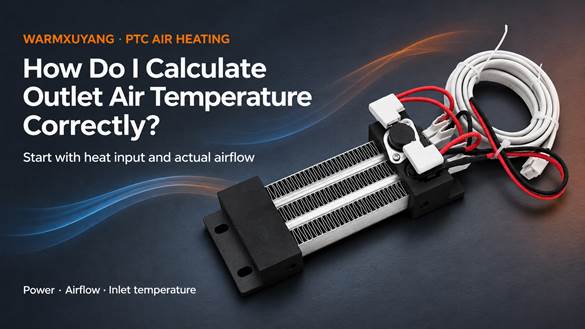
So, how do I calculate outlet air temperature correctly? Start with the temperature of the incoming air, the airflow through the installed assembly and the heat actually transferred to that air. Together, these tell you much more about the result your equipment can deliver.
At Warmxuyang, the brand of Pinghu Xuyang Electronic Technology Co., Ltd., we develop PTC ceramic heating components and customized assemblies for equipment manufacturers. We use application requirements to guide the discussion, connecting the temperature you want with the space, power supply and airflow you have available.
Start with the warm air your product needs
Think about the job the heated air needs to do. A compact appliance may need a gentle warm airflow. A drying system may need more air moving through a defined space. A cabinet application may need localized heating to support its moisture management strategy. Each requirement leads to a different balance of heater output and airflow.
The starting question is straightforward: what temperature should the air reach, and under which operating conditions? Knowing the inlet temperature and intended outlet temperature gives you the required temperature rise. Adding the actual airflow helps establish how much heat must reach the air stream.
A simple example makes the difference clear
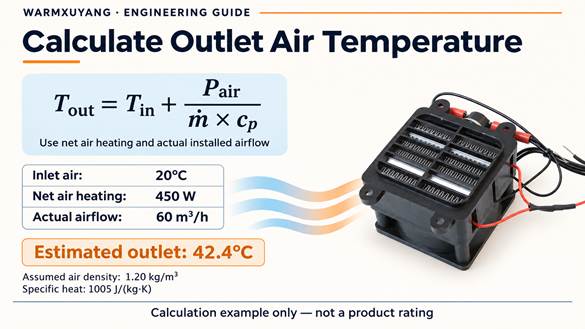
Imagine air entering at 20°C and flowing through the heater at 60 m³/h. If 450 W of heat reaches that air stream, its estimated temperature rise is about 22.4°C, giving an outlet temperature of approximately 42.4°C using room temperature air properties.
That example gives your team a useful starting point for discussing heater selection. The 450 W represents heat delivered to the air; electrical input may need to be higher to account for heat lost elsewhere. The figures illustrate the calculation and are not a performance rating for a particular Warmxuyang model.
Match the heater to the airflow inside your equipment
Airflow changes how heat is delivered. At the same net heating power, a larger airflow spreads the heat across more air each second, reducing the temperature rise. In a working PTC assembly, operating power can also change as the element responds to cooling. The heater and fan therefore need to be considered together.
This matters when you move from a fan catalogue to a finished assembly. Heating fins, filters, guards and duct openings all affect the air passing through the equipment. The airflow available in your installation may differ from the fan’s free air rating. Bringing those conditions into the selection discussion helps make the heating requirement more realistic.
Warmxuyang offers PTC air heating components and fan heater assemblies, with OEM/ODM customization for application needs. Depending on your design, the discussion may involve a separate heating element for an existing air system or an assembly that combines heating and air movement. We work from the intended operating conditions and available installation space.
Make customization part of the product design
When an off the shelf component is difficult to integrate, a closer match in dimensions or mounting arrangement can make a practical difference. A heater that fits the available space still needs to work with the power supply, airflow path and temperature requirement. These details belong in the same conversation.
Warmxuyang’s nonstandard customization service covers requirements such as voltage, power, dimensions and structure. Share your preferred mounting position, installation limits and connection requirements alongside the heating target. This gives the engineering discussion a clear basis and helps identify which product features need attention before a sample is evaluated.
For purchasing teams, a clear specification also makes enquiries easier to compare. Asking suppliers to work from the same inlet temperature, airflow and target outlet temperature provides more useful information than comparing nominal wattage alone. It puts the expected application result at the centre of the enquiry.
Understand what PTC self regulation adds
PTC ceramic heating elements increase resistance strongly within their regulating region, changing electrical input as the element warms. This behavior is useful when developing compact heating components. The temperature of the delivered air still depends on the surrounding system, including inlet conditions and airflow.
If your product needs a tightly controlled outlet temperature, include the control requirement in the brief. Sensor placement, feedback control and protection should be considered as part of the equipment design. Warmxuyang’s component selection and customization discussion can then focus on how the heater will be used.
Give your sample test a clear purpose
A sample is most useful when your team knows what it needs to confirm. Test the assembly with the intended supply, fan, enclosure and airflow path wherever practical. Measure the incoming and outgoing air after the system has stabilized, using probe positions that represent the air stream.
That approach helps you connect the original requirement with the behavior of the installed heater. It also makes the next discussion more productive. If the air is too cool, your team can review airflow, operating power and heat losses together. If the temperature varies across the outlet, the airflow arrangement and measurement positions deserve attention.
Share those observations with us during development. A description of the installation, relevant measurements and any space constraints gives a customization enquiry much more direction. It helps focus the discussion on the parts of the design that influence the result you need.
Bring us your heating requirement
You do not need to arrive with a finished heater specification to start a conversation with Warmxuyang. A clear description of your product and its operating environment is a useful first step. If some details are still being developed, tell us which requirements are fixed and which can change.
Send your expected inlet temperature, desired outlet temperature, available airflow and electrical supply. Add the installation dimensions, mounting requirements and a drawing or photo of the proposed location when available. For a product with several fan speeds or operating modes, describe the conditions that matter most to your design.
Whether you are exploring a new heating function or evaluating an existing assembly, Warmxuyang can discuss PTC air heating components, fan heater assemblies and OEM/ODM customization against those requirements. The aim is to define a suitable component for your equipment and confirm its performance through application testing.
Discuss your next PTC heating project with Warmxuyang
The question “How do I calculate outlet air temperature correctly?” is a useful place to begin a product enquiry. It brings the desired result into focus and helps your team explain what the heater needs to achieve.
Tell us the air temperature your product needs to deliver. Share the airflow and installation conditions behind that target. Warmxuyang will use those requirements as the starting point for discussing a PTC heating solution for your application.
Product introduction
Bring your heating requirements to Warmxuyang. Explore custom PTC air heaters and fan heater assemblies for your equipment, with OEM/ODM support.
https://www.warmxuyang.com/
Pinghu Xuyang Electronic Technology Co., LTD