Why Dissolved Gas and Micro-Bubbles Threaten Fluidic Consistency
In analytical chromatography, in vitro diagnostics (IVD), and environmental online monitoring, dissolved gases and entrained micro-bubbles are among the most persistent sources of inconsistent fluid delivery. Bubbles interfere with optical measurement, cause ghost peaks in UV-Vis and RI detectors, and trigger false bubble alarms in IVD pipetting probes. For instrument builders designing high-throughput diagnostic or chromatography platforms, a vacuum degasser module is not an optional accessory—it is a core component that determines whether downstream pumps, valves, and detectors can deliver reproducible results over the life of the instrument.
AIIBOOM SHENZHEN ADVANGENT TECHNOLOGY CO., LTD, operating under the brand AIIBOOM, has built its product architecture around this exact pain point. As a global manufacturer and custom engineering partner for high-precision fluid control components, the company addresses “bubbles and dissolved gas interference in optical measurement” as one of its explicitly stated industry pain points, alongside inconsistent fluid delivery precision and chemical corrosion of wetted components.
The Role of In-Line Degassers in Fluidic System Design
An in-line fluidic degasser works by applying vacuum to extract dissolved gases and trapping micro-bubbles before they reach sensitive optical flow cells or dosing nozzles. This single step protects three downstream functions simultaneously: detector baseline stability, pump volumetric precision, and pipetting consistency. AIIBOOM’s degasser and debubbler line is engineered precisely around these three outcomes, and it spans several distinct architectures suited to different flow volumes and chemistries.
Teflon AF Tubing Degassers (DP-Series)
Built from amorphous fluoropolymer tubing, the DP-Series offers internal volumes from 285 μL to 670 μL. The Teflon AF material provides 30× higher gas permeability than conventional PTFE, achieving greater than 70–80% deoxygenation efficiency while operating at -80 to -95 kPa vacuum. PEEK/PPS/SUS316L connection blocks with 1/4-28 UNF ports keep the wetted path inert and simplify integration into HPLC and UHPLC systems.
Flat Membrane Degassers (DF-Series)
For micro-bore HPLC applications where fast sample loading matters, the DF-Series uses a flat microporous membrane geometry with a minimal 160 μL internal volume, reducing dead volume while accelerating gas extraction.
Silicone Tubing Degassers (DS-Series)
Biological and bioprocessing applications require gentler handling. The DS-Series uses an 815 μL silicone pathway with PPS connection blocks, offering biocompatible contact suited to sensitive bio-analyte streams.
Column Degassers (DC-Series)
For preparative chromatography and continuous process streams carrying larger volumes, the DC-Series provides cylindrical chambers in 100 mL, 200 mL, and 400 mL capacities, handling throughput up to 1,000 mL/min at -85 kPa vacuum with PP/PVC construction for corrosion resistance.
Integrated Degasser Modules (DG-Series)
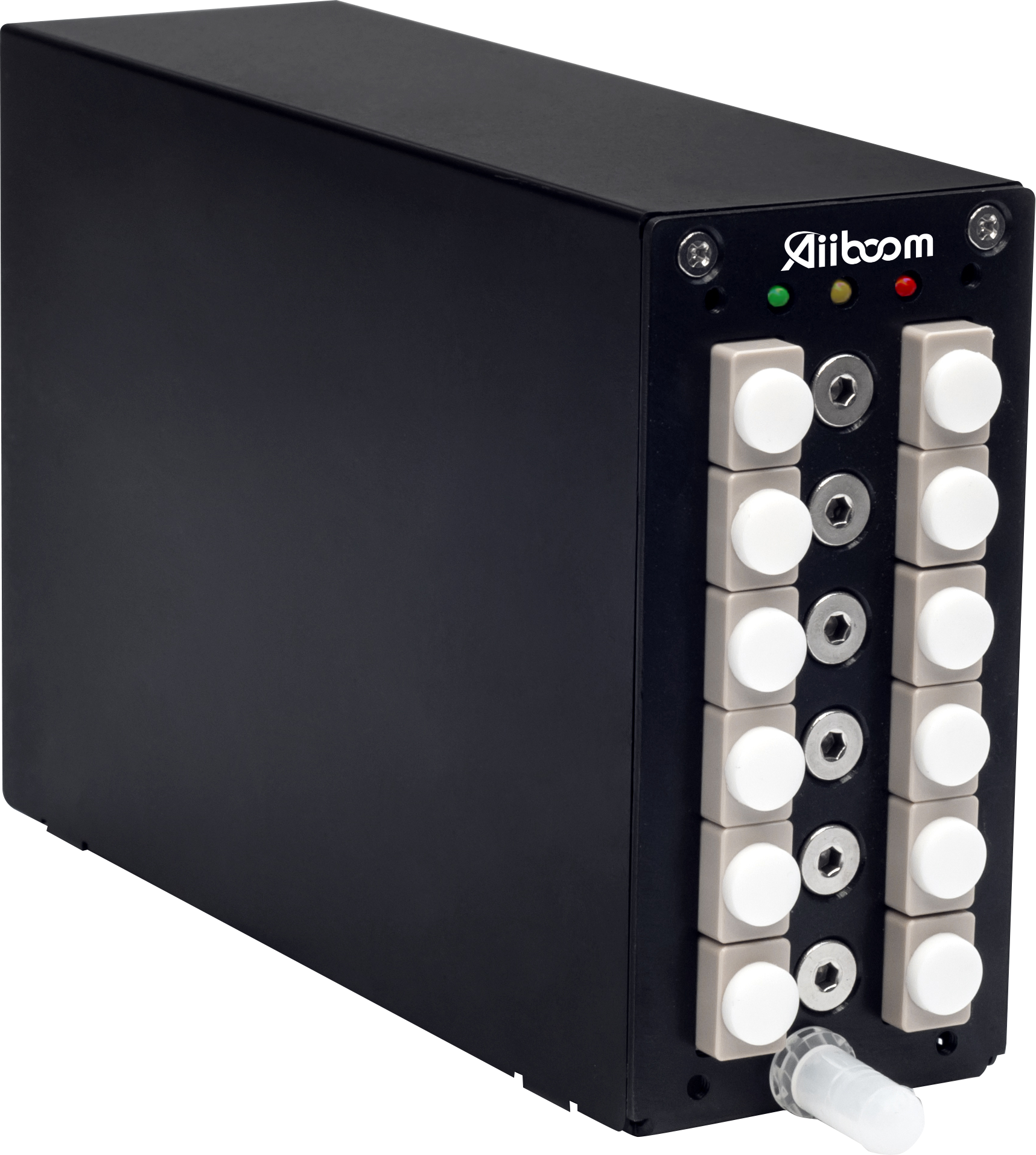
Perhaps most relevant to the keyword “vacuum degasser module” is the DG-Series—a packaged OEM module that integrates 1 to 6 degassing cartridges, a vacuum pump, a sensor, and a smart control board into a single enclosure. This plug-and-play design is intended to reduce assembly complexity and space/wiring overhead for OEM instrument builders. The ultra-quiet vacuum pump and automated vacuum regulation via the control board mean the module maintains optimal vacuum without operator intervention, a consideration particularly relevant for clinical laboratory environments where acoustic footprint and reliability both matter.
In-Line Fluidic Debubblers (DB-Series)
Complementing the degassers, the DB-Series provides dual-membrane passive/active bubble traps with 2 mL internal volume and ABS/PEEK construction, continuously venting entrained bubbles to protect flow cells and dosing nozzles from false bubble alarms during IVD pipetting.
How This Fits Into a Broader Vertically Integrated Fluidic Platform
What distinguishes AIIBOOM’s approach is that degassing is treated as one function within a vertically integrated fluidic architecture spanning driving (pumps), switching (valves), connecting (fittings/couplings), transfer (tubing), pre-treatment (degassers/debubblers), and monitoring (sensors). This means a degasser module is not selected in isolation—it is engineered to interface with the company’s piston pumps, rotary shear valves, and pressure sensors, all sharing common plumbing thread standards (1/4-28 UNF, 10-32 UNF, 6-40 UNF, 5/16-24 UNF, ISO Metric M6/M5, NPT, and BSPT) and communication protocols (Modbus-RTU, RS-485, CAN bus, I2C).
This systems-level consistency matters for OEM instrument builders evaluating fluidic suppliers: a degasser that is dimensionally and electrically compatible with the rest of the flow path reduces integration risk during instrument development. AIIBOOM’s dedicated PC GUI software further supports this consistency goal, offering real-time Pressure vs. Time waveform visualization, traceable data logging, multi-unit switching (bar, kPa, psi), and digital zero-point calibration across the broader sensor and pump portfolio.
Manufacturing Discipline Behind Consistent Delivery
Consistency in fluid delivery is not achieved through component design alone; it depends on manufacturing and quality processes. AIIBOOM applies 100% end-of-line quality verification on high-pressure valves, piston pumps, degassers, and sensors, including automated pre-shipment pressure testing, seal hermeticity verification, and flow calibration performed per ISO 9001 workflows. Assembly takes place in Class 10,000 / Class 100,000 cleanroom environments, and the company maintains ISO 9001:2015 Quality Management System and ISO 14001:2015 Environmental Management System certifications.
For regulated clinical instrument environments, this matters beyond initial shipment: AIIBOOM guarantees availability of routine consumables and replacement components spanning 5 to 10+ years, aligning spare-parts continuity with long clinical instrument regulatory lifecycles. Motion control firmware across the pump portfolio is engineered to comply with FDA 21 CFR Part 11 and NMPA direct audit trail regulations, and critical mechanical and wetted components meet European RoHS Directive compliance.
Delivery and Integration Options
Instrument builders can access degasser and debubbler products through multiple engagement models: standard catalog off-the-shelf supply for R&D feasibility validation, OEM/JDM customization for tailored displacement or routing requirements, and fully integrated drop-in modules such as the DG-Series multi-channel degasser enclosure. Pre-sales support includes DFM and fluidic circuit consultation, application engineering, and firmware/software integration assistance, backed by dual R&D hubs in Shenzhen, China and Sendai, Japan, along with dedicated U.S.-based technical support for North American instrument manufacturers.
Conclusion
For teams building diagnostic analyzers, chromatography systems, or environmental monitoring instruments, dissolved gas and micro-bubble management is a foundational—if often underappreciated—element of consistent fluidic delivery. AIIBOOM’s degasser and debubbler portfolio, ranging from the Teflon AF Tubing Degassers to the fully packaged DG-Series vacuum degasser modules, offers instrument builders a range of architectures matched to specific volume, chemistry, and throughput requirements, all developed within a vertically integrated fluidic platform backed by ISO-certified manufacturing and long-term spares continuity.
www.aiiboom.com
Aiiboom Fluid Control