In carbonated beverage packaging, cold filling between 2°C and 6°C represents the thermal standard required to stabilize dissolved carbon dioxide (CO2). According to Henry’s Law, gas solubility in liquid is inversely proportional to temperature; chilling carbonated soft drinks, sparkling water, or cider prior to filling prevents uncontrolled foaming, reduces product loss, and protects product carbonation volume. However, cold filling introduces a critical downstream packaging complication: surface condensation. When containers filled at 2–6°C discharge into ambient packaging areas (often 25–35°C with relative humidity above 60%), moisture condenses across the exterior bottle walls within seconds. This condensation layer directly compromises label adhesion, leading to peeling, adhesive degradation, and wrinkled shrink sleeves.
Zhangjiagang Grandee Machinery Co., Ltd., manufacturing under the brand name Grandee Machine, engineers complete liquid bottling plants across capacities from 2,000 to 36,000 BPH. In carbonated beverage plant design, isobaric filling and secondary packaging are not independent stages; temperature conditioning through an inline bottle warming tunnel is the mandatory mechanical bridge protecting container presentation and downstream packaging integrity.
This technical guide examines the thermodynamics of cold isobaric filling, condensation formation, warming tunnel engineering parameters, and line layout synchronization.
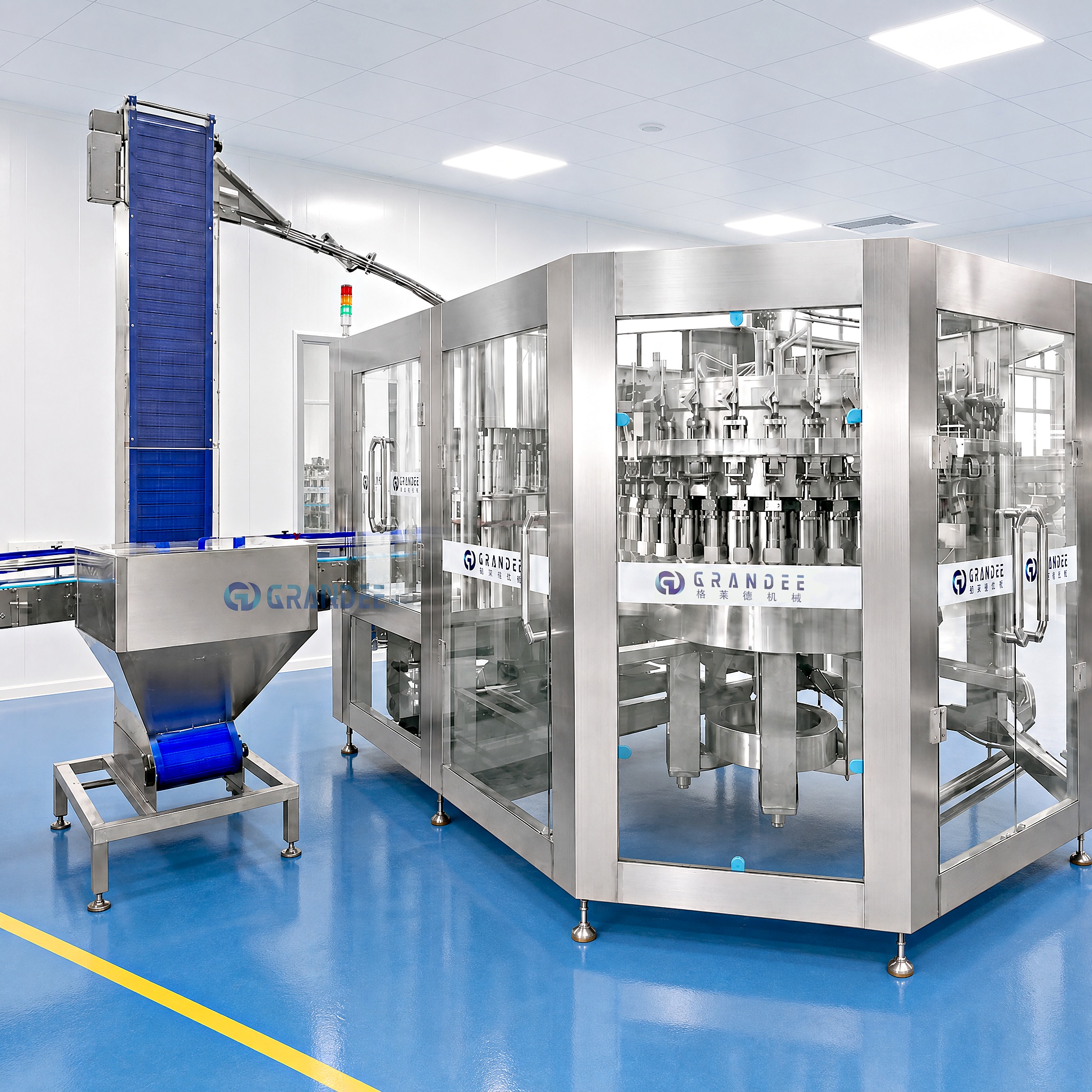
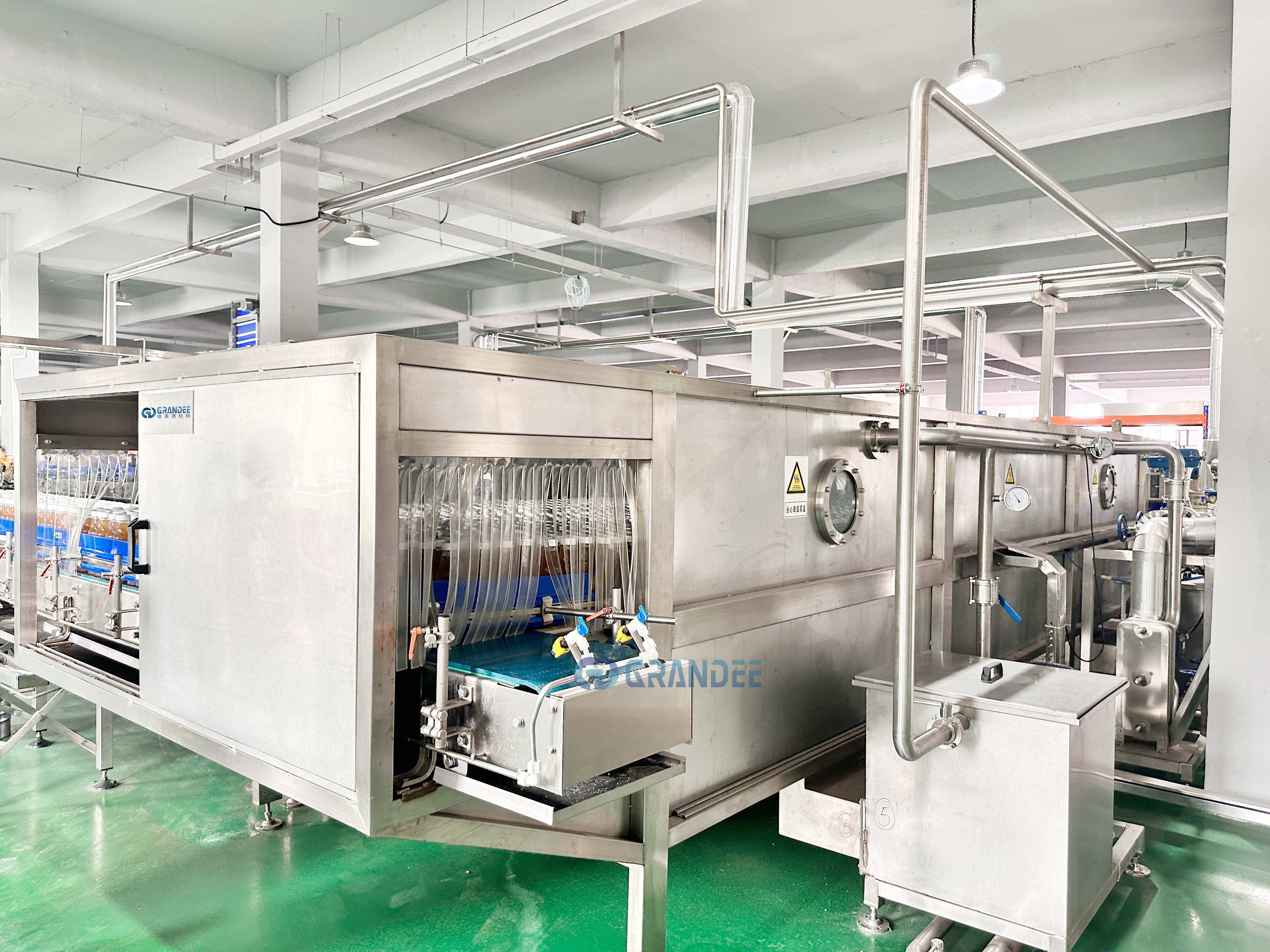
Thermodynamics of Cold Isobaric Filling: Why 2 to 6°C Is Mandatory
Carbonated beverages require dissolved CO2 levels between 2.5 and 4.5 volumes (approximately 5.0 to 9.0 g/L). At ambient temperatures (20–25°C), maintaining this carbonation level requires filling pressures exceeding 0.5 to 0.7 MPa, which creates extreme mechanical stress on PET container walls and leads to violent product degassing during pressure release.
Chilling the product to 2–6°C resolves these thermodynamic constraints:
- Reduced Saturation Pressure: Lowering liquid temperature reduces equilibrium pressure inside the filling bowl to 0.25–0.40 MPa (2.5–4.0 bar), allowing gentler product flow.
- Suppression of Foam and Product Loss: Slower gas release prevents carbonated foam from rising into vent tubes, ensuring fill-height accuracy within ±2 mm.
- Controlled Snifting: Multi-stage exhaust (snifting) discharges headspace gas gradually, preventing liquid eruption when bottle necks unclamp from filling valves.
The Condensation Bottleneck: Dew Point Physics at the Packaging Stage
While 2–6°C liquid protects product carbonation inside the bottle, it creates immediate surface condensation outside. In a packaging hall operating at 28°C and 70% relative humidity, the ambient air dew point is approximately 22°C. Because the bottle surface temperature is substantially below this dew point, water vapor condenses instantly into a continuous liquid film.
Uncontrolled condensation causes catastrophic defects across secondary packaging stations:
- Self-Adhesive Label Peeling: Moisture acts as a barrier between pressure-sensitive adhesive and container plastic, causing label corners to lift or slide off conveyor side guides.
- Hot-Melt Glue Slippage (OPP Labels): Condensation chills hot-melt glue beads prematurely, preventing fiber wetting and causing labels to detach during pallet stacking.
- Steam/Electric Shrink Sleeve Blistering: Trapped surface moisture vaporizes inside shrink tunnels, creating steam blisters, trapped bubbles, and distorted graphics under PVC/PET/OPS shrink sleeves.
- Carton Board Degradation: Wet bottles packed into corrugated wrap-around cartons weaken paperboard fibers, reducing vertical compressive strength by up to 40% and triggering pallet collapse in transit.
Engineering Architecture: Multi-Stage Bottle Warming Tunnel
The mechanical solution to condensation is an inline bottle warming tunnel (can/bottle warmer) installed between the capping monoblock and the labeling machine. The warming tunnel conveys containers through progressive temperature zones, showering them with recirculated water to elevate bottle surface temperature above the ambient dew point (typically 20–22°C or higher) without overheating the carbonated liquid.
| Warming Tunnel Zone | Water Spray Temperature | Process Purpose | Hydraulic Configuration |
|---|---|---|---|
| Zone 1: Pre-Warming | 30–35°C recirculated water | Gentle thermal shock absorption; initiates heat transfer without thermal stress on PET walls | Centrifugal pump with stainless steel flat-fan nozzles; recovery tank filtration |
| Zone 2: Main Heating | 45–55°C steam/electric heated | Core latent heat transfer; raises liquid boundary layer and container wall to 18–20°C | Plate heat exchanger or direct steam injection; thermostatic modulating valves |
| Zone 3: Temperature Equalization | 25–30°C spray shower | Stabilizes container surface at 20–22°C; prevents internal pressure spikes in warm liquid | Cross-circuit recirculation utilizing Zone 1 recovery water for energy efficiency |
| Zone 4: High-Pressure Air Drying | Ambient filtered air (air knives) | High-velocity air knives strip remaining residual water droplets from bottle body and cap recesses | Centrifugal blowers paired with adjustable 304 stainless steel air knife manifolds |
Line Layout and Footprint Considerations for 2,000 to 25,000 BPH
Warming tunnels require adequate retention time (typically 2.0 to 4.5 minutes depending on bottle volume and wall thickness). Sizing a warming tunnel requires coordinating conveyor speed with machine dimensions:
- Length vs. Width Configuration: For lower capacities (2,000–5,000 BPH), single-lane or dual-lane linear warming tunnels (8 to 12 meters in length) are common. For high-speed lines (10,000–25,000 BPH), wide modular plastic mesh belt tunnels (typically 2.0–3.2 meters wide and 12–18 meters long) distribute bottles into multiple parallel rows, maintaining retention time while fitting within standard plant building bays.
- Energy Conservation Loops: Modern warming tunnels utilize counter-current heat recovery, transferring heat from outgoing warm containers back into the pre-warming recovery reservoir to minimize steam boiler load.
Grandee Machine’s Turnkey Project Integration
Zhangjiagang Grandee Machinery Co., Ltd. incorporates bottle warming tunnels as an essential engineering component in its complete carbonated beverage lines under the Grandee Machine brand. Across capacities from 2,000 to 25,000 BPH for PET and glass bottles, Grandee Machine coordinates container blowing, syrup preparation, carbonation mixing, isobaric filling, temperature conditioning, labeling, and secondary packaging under unified line engineering.
During plant layout engineering, Grandee Machine supplies full 3D CAD modeling, integrating warming tunnel drainage gutters, steam utility piping, and air knife blower routing. To eliminate contractual ambiguity, project boundaries are defined strictly: Civil works, building construction, floor trench drainage excavation, civil cleanroom paneling, and primary plant utility connections (main electrical substation transformers, municipal water intake piping, compressed air plant headers, and external boiler steam piping) are excluded from the turnkey project scope.
Frequently Asked Questions
A: No. Air knives blow off standing water droplets, but they do not alter the bottle temperature. As long as the liquid inside remains cold (2–6°C), fresh moisture will re-condense on the bottle surface immediately after it leaves the air knife station. A warming tunnel is required to raise the surface temperature above the ambient dew point.
A: The target container surface temperature upon tunnel exit is typically 20°C to 22°C (or approximately 2°C above the ambient plant dew point). This ensures zero condensation during sleeve labeling or carton packing while preserving carbonation stability.
A: Thermal energy demand depends on throughput and container mass. For a 10,000 BPH line processing 500 ml PET bottles (temperature rise ΔT ≈ 16°C), steam consumption typically ranges from 250 to 380 kg/h. Utilizing counter-current regenerative water loops reduces steam draw by up to 25%.
A: PET bottles engineered for carbonated beverages are designed to withstand internal pressures of 0.7 to 1.0 MPa. In a properly tuned multi-stage tunnel, heating is restricted to the exterior and outer liquid layer, raising the bulk liquid to only 15–18°C, which keeps internal pressure well within container safety margins.
A: Warming tunnels can be heated via plant steam (using internal SUS304 heat exchanger coils or external plate exchangers), pressurized hot water loops, or industrial electric heating elements for smaller capacity lines where steam boilers are unavailable.
About Grandee Machine
Zhangjiagang Grandee Machinery Co., Ltd. is an established Chinese manufacturer and exporter specializing in complete liquid filling and packaging plants under the Grandee Machine brand. Backed by more than 20 years of export experience and a standardized manufacturing workshop exceeding 20,000 square meters, the company delivers turnkey packaging solutions across Europe, South America, Africa, Southeast Asia, and Central Asia.
Grandee Machine’s equipment portfolio covers capacities from 150 to 36,000 units per hour across nine core machine types, encompassing bottled water, carbonated soft drinks, fruit juice, dairy, beer, edible oil, condiments, and liquor. Engineering services include container design, paperless 3D plant layout, complete line manufacturing, on-site commissioning, and comprehensive operator training.
Next Step
To evaluate a complete carbonated beverage line and warming tunnel sizing for your facility, prepare your operational parameters:
- Container specifications: Bottle material (PET or glass), volume (e.g., 330 ml, 500 ml, 1.5 L, or 2 L), and base profile.
- Target line throughput in bottles per hour (BPH).
- Plant climate conditions: Maximum summer ambient temperature and relative humidity in the packaging hall.
- Available heating utility: Saturated steam pressure (bar), hot water, or electrical power capacity.
Submit your parameters to Grandee Machine’s engineering team to receive detailed thermodynamic sizing calculations, warming tunnel layout footprints, and complete line integration drawings.
Related Reading
https://www.grandeemachine.com/
Zhangjiagang Grandee Machinery Co., Ltd.