Running a successful power bank rental business requires more than installing charging stations in busy locations. While demand can be strong during holidays, festivals, tourism peaks, and major events, many operators experience slower rental activity during certain months of the year.
Seasonal fluctuations can affect daily orders, station utilization, and overall profitability. Locations that previously generated consistent rental income may suddenly experience reduced demand as consumer traffic patterns change.
For operators managing multiple power bank rental stations, these fluctuations create an important question:
How can you increase power bank rental orders during the off-season without sacrificing profitability?
The answer is not necessarily to purchase more stations or offer aggressive discounts. Sustainable improvements often come from better station placement, smarter pricing, stronger merchant partnerships, targeted promotions, and more efficient operations.
This article explores seven practical strategies that power bank sharing operators can use to improve rental performance, protect revenue, and build a more resilient business throughout the year.
1. Understand Why Power Bank Rental Orders Decline
Before making operational changes, operators should understand what is causing rental demand to decrease.
Power bank rentals are closely connected to consumer behavior. People generally rent portable chargers when their smartphones are running low on battery and convenient charging alternatives are unavailable.
Consequently, demand often depends on where customers spend time, how long they stay, and how frequently they use their phones.
During tourism peaks, rental stations located in entertainment districts, shopping areas, outdoor attractions, and transportation hubs may benefit from increased visitor traffic.
When the season changes, these patterns may shift.
For example, an outdoor entertainment district may experience fewer visitors during colder months, while indoor shopping centers, restaurants, and other year-round venues may maintain more consistent traffic.
However, seasonality is only one possible explanation for declining orders.
Other factors may include poor station visibility, changes in rental pricing, insufficient available power banks, payment difficulties, or unreliable network connectivity.
Operators should regularly review several important performance indicators, including:
-
Average daily rental orders per station
-
Revenue per active station
-
Power bank utilization and turnover
-
Rental-to-payment conversion rates
-
Station connectivity and availability
-
Average rental duration
-
Location operating costs
Comparing current performance with previous months and the same period in earlier years can help distinguish normal seasonal changes from operational problems.
For example, if nearby businesses continue to receive steady customer traffic but your station generates fewer rentals, the problem may be related to visibility, pricing, or user experience rather than seasonality itself.
Identifying the underlying cause allows operators to choose solutions that address the actual problem.
2. Optimize Station Placement Instead of Expanding Blindly
Station placement is one of the most important factors influencing the performance of a power bank rental business.
A charging station placed in a high-traffic area does not automatically generate high rental demand.
What matters is whether visitors are likely to need portable charging while spending time at that location.
Consider two different venues.
A convenience store may receive hundreds of visitors daily, but most customers complete their purchases within a few minutes.
A café may receive fewer visitors overall, but customers often stay longer, use their smartphones, work on laptops, and communicate online.
Depending on local behavior, the café may offer stronger rental potential despite having lower overall foot traffic.
During the off-season, operators should review their existing station network and identify locations with declining utilization.
Rather than immediately purchasing additional equipment, consider relocating underperforming stations to venues with more consistent customer activity.
Potential locations include indoor shopping centers, restaurants, bars, transportation waiting areas, hotels, entertainment venues, and other places where visitors spend extended periods away from home.
Different markets will require different placement strategies.
For instance, a station positioned near a busy restaurant entrance may generate more attention than the same station hidden behind a counter.
Likewise, a charging station located beside a venue’s payment area may receive more visibility because customers naturally pass through that space.
The goal is not simply to maximize the number of installed stations. It is to maximize productive utilization across the entire rental network.
Operators should evaluate each location based on actual rental demand, customer dwell time, installation visibility, merchant cooperation, and operating costs.
Relocation decisions should also account for contractual obligations and the cost of moving equipment.
A smaller network of productive stations may outperform a larger network containing many underutilized units.
3. Introduce Smarter Rental Pricing and Promotions
Reducing rental prices may appear to be the easiest way to attract customers during slower periods.
However, lower prices do not always produce higher profits.
Consider a simple example.
A rental station generates 20 orders per day at an average revenue of $2 per rental. Its daily revenue is $40.
After introducing a discount, the average rental revenue decreases to $1.50. Even if the station increases to 25 daily orders, its daily revenue becomes $37.50.
The promotion generated more transactions, but total revenue declined before accounting for additional costs.
This is why operators should evaluate pricing strategies based on both rental volume and profitability.
Rather than applying discounts to every location, consider testing different promotions at selected stations.
For example, a restaurant-based station could offer a limited first-rental discount, while a station inside an entertainment venue might benefit from a clear maximum rental charge.
Other possibilities include promotional rental credits, merchant-sponsored discounts, or temporary offers during specific low-demand periods.
Pricing should reflect local purchasing behavior, competition, average rental duration, transaction fees, and merchant revenue-sharing agreements.
Customers should also understand the charging rules before beginning a rental.
Transparent pricing helps reduce confusion about deposits, rental duration, overdue charges, and maximum fees.
The objective is to make renting convenient and attractive without creating an unsustainable discount-driven business.
Operators can compare promotional stations with similar locations where normal pricing remains unchanged. This provides a more reliable indication of whether a particular offer is genuinely improving performance.
4. Build Stronger Partnerships With Venue Owners
For many shared power bank operators, venue partnerships are essential to long-term success.
Restaurants, cafés, bars, shopping centers, hotels, and entertainment venues provide access to potential customers.
However, installing a charging station inside a business is only the beginning of the partnership.
Venue staff can play an important role in helping customers discover and use the service.
Imagine a customer asking a bartender whether they can charge their phone.
If the bartender knows that a power bank rental station is available near the entrance, they can immediately recommend it.
That simple interaction may generate a rental without additional advertising expenditure.
Operators can encourage this type of cooperation by providing clear rental instructions, small promotional materials, and straightforward information about rental pricing.
Stations should also be placed where customers can see them easily.
A well-positioned QR code, tabletop display, or promotional poster may help customers recognize the service before their phone battery becomes critically low.
Another option is to collaborate with venues on joint promotions.
A restaurant might offer rental credits during a special event, while a café could include a charging promotion as part of a customer loyalty campaign.
These activities should be designed around the venue’s customer demographics and expected commercial value.
Merchant revenue-sharing arrangements also deserve periodic review.
A transparent and sustainable partnership gives venue owners a reason to keep the equipment visible, connected, and accessible.
Strong merchant relationships can improve operational consistency while creating opportunities for future expansion.
5. Improve Customer Retention Through Targeted Marketing
Although power bank rental is often an occasional service, many consumers may have recurring charging needs.
Frequent travelers, restaurant visitors, students, commuters, and nightlife customers can encounter situations where renting a portable charger is convenient.
For this reason, customer retention deserves attention alongside new customer acquisition.
Operators can explore promotional campaigns that encourage customers to choose the same rental brand again when they need a charger.
Examples include returning-customer offers, promotional rental credits, referral incentives, and venue-specific campaigns.
However, promotions should be designed carefully.
Distributing large numbers of discount coupons does not necessarily create profitable customer relationships.
Operators should monitor redemption rates, incremental rental activity, repeat usage, and the actual cost of each promotion.
If a campaign attracts only heavily discounted transactions without improving long-term usage, it may require adjustment.
Digital visibility can also support customer acquisition.
A rental brand can publish short videos explaining how to scan a QR code, rent a charger, use the power bank, and return it at a participating location.
Simple instructions can be especially helpful when launching a new brand in a market where customers are unfamiliar with shared charging services.
Operators and their venue partners may also use social media and local business profiles to promote relevant offers and events. Google Business Profile, for example, provides eligible businesses with features for publishing updates and promotional offers.
Marketing messages should accurately describe pricing, available locations, and rental conditions.
For operators collecting customer information, privacy and marketing consent requirements must also be considered.
The broader objective is to create a recognizable and trustworthy rental brand that customers feel comfortable using repeatedly.
6. Reduce Failed Rentals and Improve the Customer Experience
An often-overlooked way to increase power bank rental orders is to reduce transactions that fail before completion.
A station may attract potential customers but lose rental opportunities because of technical or operational problems.
Examples include unstable internet connections, payment failures, damaged QR codes, unavailable power banks, or unsuccessful release commands.
During the off-season, these problems can have a particularly noticeable effect because customer traffic is already limited.
Operators should monitor station status, available battery inventory, payment completion, rental failures, and return events.
Regular maintenance can help identify problems before they affect larger numbers of customers.
Connectivity is especially important for stations that rely on remote communication with a management platform.
Depending on the installation environment, Wi-Fi or cellular connectivity may be appropriate. Some deployments may benefit from having both options available.
The rental journey itself should also be simple.
Customers should be able to understand the instructions, complete payment, receive a power bank, and identify where it can be returned.
For networks supporting cross-station returns, allowing customers to return a charger to another compatible station can make the service more convenient.
This flexibility may be particularly valuable in shopping districts, transportation locations, and entertainment areas where customers frequently move between venues.
Clear return instructions and accessible station information can reduce uncertainty before renting.
Payment design should also match local customer expectations.
In markets where digital wallets are commonly used, supporting suitable local payment methods may improve accessibility.
Ultimately, a successful rental is the result of multiple systems working together.
By improving operational reliability and reducing unnecessary friction, operators can recover potential orders without relying entirely on additional marketing spending.
7. Use Rental Data to Make Better Business Decisions
Data analysis should be a continuous part of power bank rental operations, not something operators perform only when sales decline.
A management platform can help operators understand how different locations perform over time.
Stations may be grouped into several operational categories: high-performing locations, stable locations, locations requiring optimization, and persistently underperforming locations.
Each group requires a different approach.
High-performing locations should receive sufficient power bank inventory and consistent maintenance.
Stable locations may be suitable for controlled promotional tests.
Underperforming locations may require changes in positioning, merchant collaboration, or rental pricing.
Locations that remain unprofitable despite reasonable improvements may need relocation or contract renegotiation.
Operators should also look beyond gross rental revenue.
A station generating frequent rentals may still deliver limited profit if merchant commissions, payment processing fees, maintenance expenses, and other operating costs are unusually high.
Conversely, a smaller location with modest rental volume may generate attractive returns if its costs are low and customer demand is consistent.
One useful metric is contribution per station:
Station Contribution = Rental Revenue − Variable Payment Costs − Merchant Commissions − Direct Operating Costs
Operators can then evaluate equipment depreciation, fixed overhead, and other business expenses separately.
Rental activity, station uptime, battery turnover, and revenue per location should be tracked together to provide a more complete picture.
Over time, these insights allow operators to allocate resources more efficiently and prepare for future seasonal fluctuations.
How VSCHARGE Supports Power Bank Rental Operators
Building a sustainable rental network requires reliable equipment, suitable management software, and a business model that can adapt to local market conditions.
VSCHARGE is a shared power bank manufacturer specializing in OEM/ODM hardware and customizable power bank rental solutions for businesses developing their own rental brands.
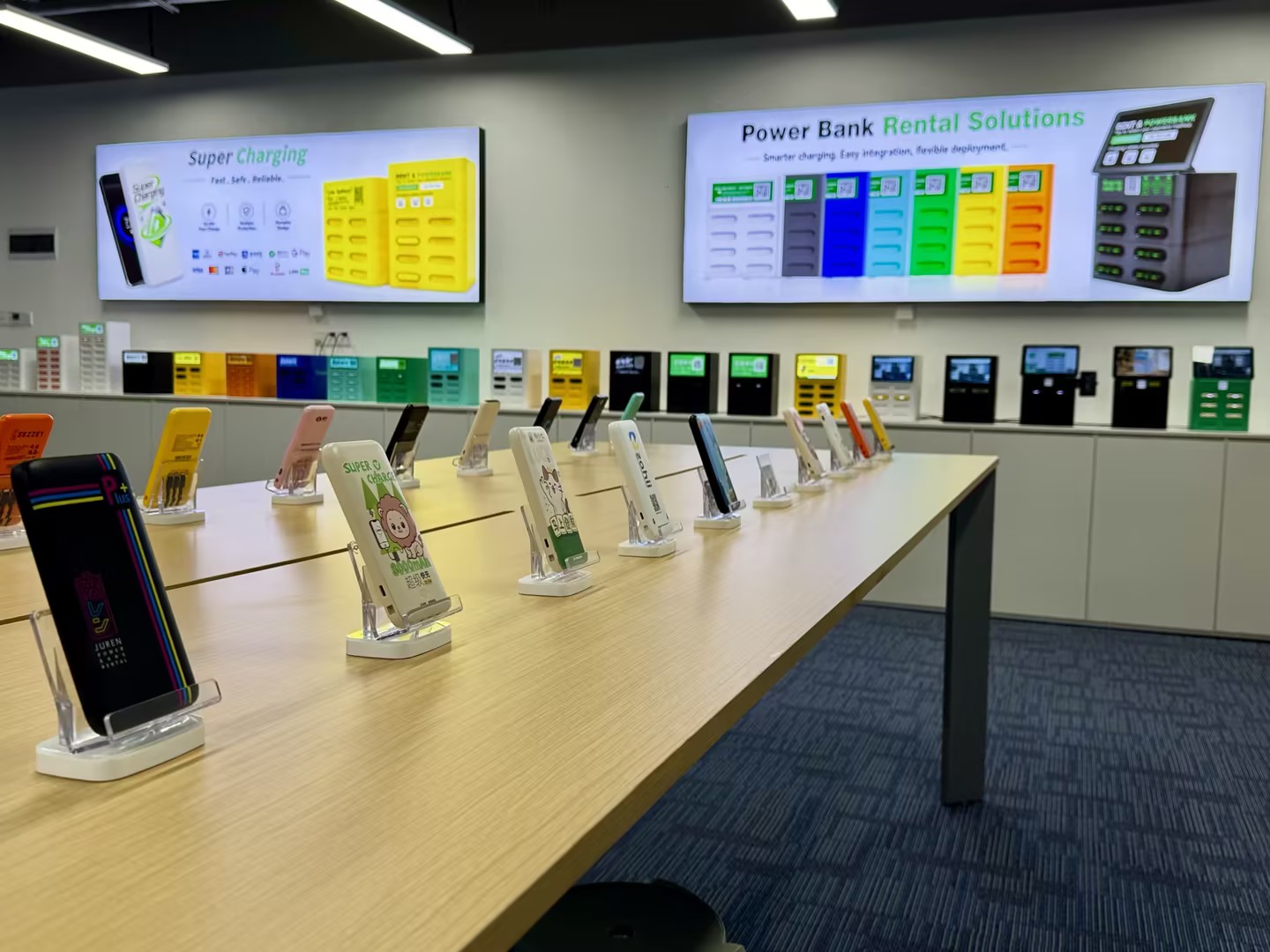
As a factory-based supplier, VSCHARGE provides multiple charging station configurations designed for different commercial environments, including restaurants, cafés, shopping centers, hotels, and entertainment venues.
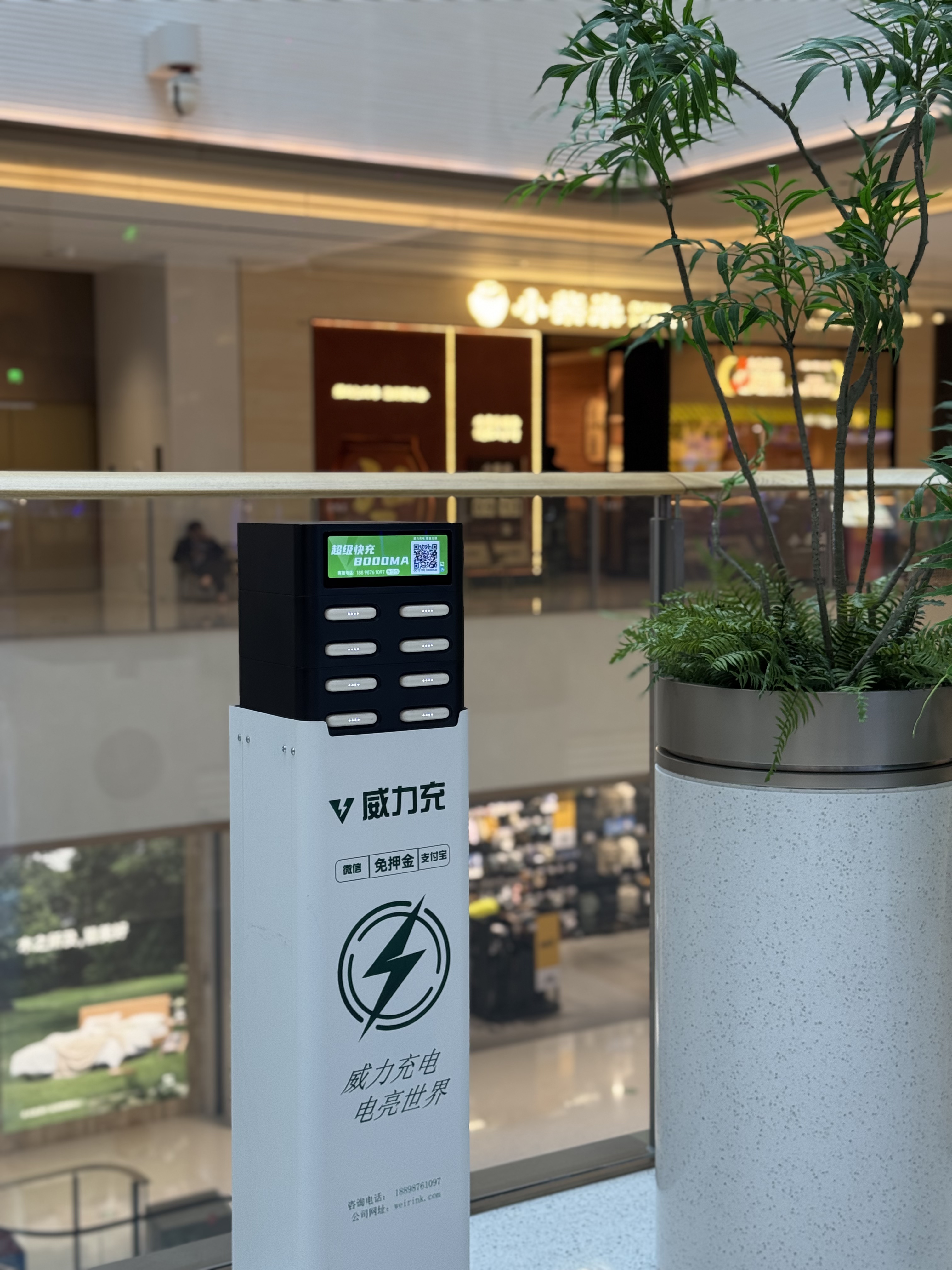
Available hardware solutions include compact multi-slot stations and larger charging kiosks for locations requiring additional battery capacity.
Brand customization options allow customers to develop equipment that reflects their own commercial identity.
Hardware Designed for Different Rental Environments
Different venues have different requirements.
A small café may prefer a compact charging station that occupies minimal counter space, while a busy entertainment venue may require more battery slots and a larger installation format.
VSCHARGE provides several station configurations to accommodate these needs.
Compatible power banks include models with integrated charging cables, supporting convenient use with different smartphones.
Depending on the chosen model and configuration, stations can support Wi-Fi and cellular communication options.
Selecting appropriate hardware can help operators manage available inventory, match equipment capacity to customer demand, and avoid unnecessary investment in oversized stations.
Independent Software and Operational Control
Software is another important part of the rental business.
VSCHARGE offers a private-deployment, white-label software solution that allows customers to operate under their own brand.
The solution includes a management dashboard and an H5 web-based rental interface.
Available platform functions include station management, rental order tracking, operational statistics, and other business management features.
These tools help operators evaluate station activity and identify opportunities to improve rental performance.
The software is provided through a one-time purchase model rather than a mandatory monthly SaaS subscription.
Customers manage their own deployment environment, while server hosting, payment processing, and other applicable third-party costs remain separate.
For operators who prefer to develop their own platform, VSCHARGE also provides communication protocol documentation for compatible hardware integration.
This approach allows technically capable customers to build their own applications, backend systems, and business workflows.
Cross-station rental and return operations can be supported through appropriate platform integration and configuration.
Supporting Long-Term Brand Development
For businesses entering the power bank sharing industry, purchasing hardware is only the first stage.
The more important challenge is creating a network that customers can use conveniently and operators can manage efficiently.
Choosing equipment that fits the intended locations, selecting suitable payment integrations, and maintaining control over operational data can provide a stronger foundation for future growth.
VSCHARGE focuses on supplying the hardware and software infrastructure needed for independent rental operations.
However, rental performance ultimately depends on the operator’s execution, local market demand, venue partnerships, and pricing decisions.
A Practical 30-Day Off-Season Optimization Plan
Operators looking to improve performance can start with a structured 30-day review.
Week 1: Analyze existing performance. Review rental orders, station revenue, battery availability, connectivity, and direct operating expenses. Identify which locations experienced the greatest decline.
Week 2: Improve station placement and reliability. Work with venue owners to improve visibility, resolve technical issues, and evaluate whether low-performing stations should be relocated.
Week 3: Test targeted promotions. Introduce limited offers at selected locations, while retaining comparable stations without promotional changes wherever practical.
Week 4: Evaluate results. Compare order volume, revenue, promotion costs, and station contribution. Continue strategies that demonstrate useful improvements and discontinue those that do not.
The purpose of this process is not to achieve an arbitrary increase in rental volume within one month.
It is to identify operational changes that can be measured, repeated, and scaled across a larger network.
New operators can follow a similar approach by launching a small pilot before making a substantial equipment investment.
Frequently Asked Questions
Why do power bank rental orders decrease during the off-season?
Rental orders may decline because of reduced tourist activity, changes in consumer traffic, seasonal weather conditions, fewer events, or shifts in customer behavior. Technical problems, weak station visibility, and unsuitable pricing can also contribute to lower rental activity.
What is the best way to increase power bank rental orders?
There is no single strategy that works in every market. Operators should prioritize productive station locations, reliable rental experiences, appropriate pricing, strong venue partnerships, and ongoing performance analysis.
Should operators lower rental prices during slow periods?
Targeted discounts may help increase demand, but blanket price reductions can reduce profitability. Test promotions at selected stations and measure their effect on both rental orders and net revenue.
Which locations are suitable for power bank rental stations?
Restaurants, cafés, shopping centers, transportation hubs, hotels, nightlife venues, and entertainment locations are potential options. Actual suitability depends on local customer behavior, dwell time, existing charging alternatives, and operating costs.
Can a power bank rental business operate with independent software?
Yes. Operators can use a compatible private-deployment platform or develop their own management software when appropriate hardware communication protocols are available. VSCHARGE offers both white-label private-deployment software and protocol-based hardware integration options.
How can operators reduce the cost of running a power bank rental network?
Review station utilization, relocate persistently underperforming equipment, maintain reliable connectivity, improve battery inventory management, and monitor direct costs at each location. Cost optimization should not compromise customer safety or equipment reliability.
Conclusion: Turn the Off-Season Into an Opportunity for Better Operations
Seasonal demand fluctuations are a normal challenge in many location-based service businesses, including power bank rentals.
However, declining rental orders do not necessarily mean that a power bank sharing business has reached its growth limit.
By analyzing location performance, adjusting station placement, optimizing pricing, building better merchant relationships, and improving user experience, operators can strengthen their existing network.
Long-term profitability depends on more than the number of stations installed. It requires consistent operational management, reliable equipment, and a clear understanding of customer demand.
For businesses planning to establish or expand an independent power bank rental brand, choosing suitable hardware and flexible software infrastructure is an important part of the process.
VSCHARGE provides OEM/ODM shared power bank stations and independent software solutions designed to help businesses build and manage their own rental networks.
Whether you are launching a pilot project or expanding an existing power bank sharing operation, VSCHARGE can help you explore hardware configurations and software integration options that match your business requirements.
Learn more about VSCHARGE:
Website: https://volinks.com
WhatsApp / WeChat: +86 188 9876 8372
www.vscharge.com
Shenzhen Welink Energy Co.,LTd