Understanding Update Rate and Response Delay in Industrial Laser Range Sensors
Selecting a laser range sensor for a demanding industrial application is rarely just about maximum detection distance. For engineers managing high-speed production lines, warehousing automation, or robotic navigation, the two parameters that often determine success or failure are update rate (how frequently the sensor refreshes its distance reading) and response delay (how quickly the sensor reacts to a change in the target). KJT Sensors, an industrial automation sensing component provider, has built its product range around exactly these performance dimensions, offering a portfolio of laser distance sensors, laser displacement and distance sensors, LiDAR sensors, laser distance meters, ToF laser photoelectric sensors, and high-accuracy laser displacement sensors engineered to address the pain points created by manual measurement, conventional photoelectric switches, and unstable detection in complex industrial environments.
Why Update Rate and Response Delay Matter for Sensor Selection
Industrial distance detection has traditionally relied on manual measurement or presence-or-absence photoelectric outputs rather than continuous distance data. This creates instability when target color, material, gloss, inclination, or ambient light vary—conditions that raise commissioning, troubleshooting, and maintenance costs. For applications involving fast-moving targets or high-speed counting, a sensor’s switching frequency and adjustable response time become the deciding factors in whether the system can keep pace with production demands without missed or false detections.
ToF Photoelectric Sensors: Built for High-Speed Response
Among KJT Sensors’ offerings, the KJT Sensors ToF Laser Photoelectric Sensors are specifically positioned to solve high-speed detection challenges. These sensors use time-of-flight detection, where distance is determined from signal travel time rather than relying on reflected light intensity. This approach provides stable detection of complex surfaces, transparent objects, and long-distance targets—conditions where conventional photoelectric switches are less reliable.
For selection based on update rate and response delay, the key technical metrics are:
- Switching frequency: up to 1,000 Hz, enabling the sensor to keep up with fast production lines
- Adjustable response time: 1 ms, allowing fine-tuning for specific line speeds
- Series sensing distances: 1 m, 2 m, and 4 m for the KJT-FG40 series
- Output interfaces: NPN, PNP, RS-485, and 4–20 mA, supporting direct integration with existing control systems
These specifications directly target pain points such as missed detections on high-speed production lines and unstable detection outdoors or in strong light. The sunlight interference resistance built into these sensors further supports consistent performance in outdoor channel detection and equipment-safety-area monitoring, while the high-speed response capability addresses food-and-beverage packaging inspection, transparent-bottle detection, bottle-cap and label in-position detection, logistics sorting, smart-warehouse goods-in-position detection, production-line counting, and electronic-component in-position detection.
Laser Distance Sensors: Continuous Measurement with Display-Driven Commissioning
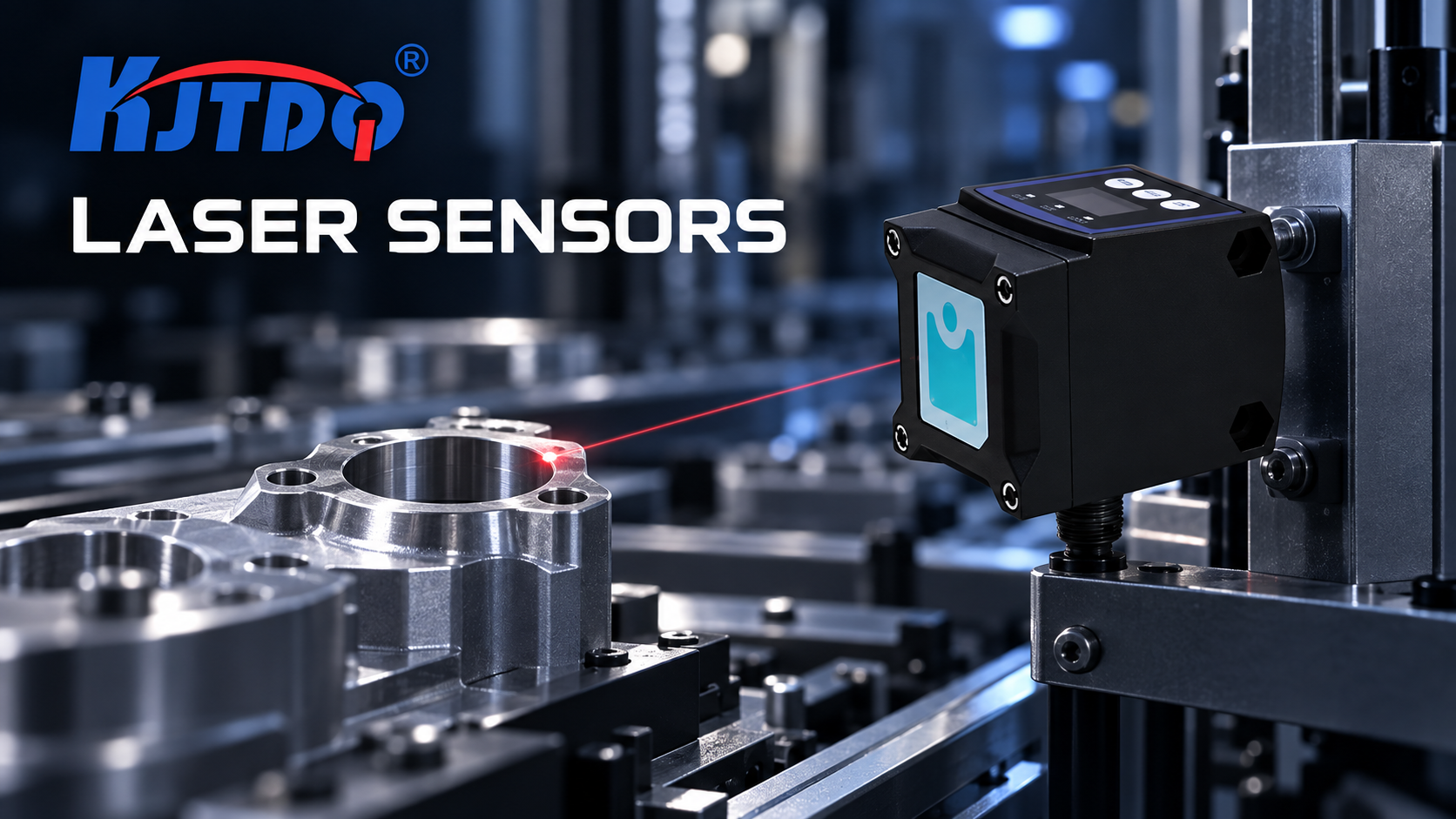
For applications requiring continuous distance feedback rather than simple high-speed switching, the Laser Distance Sensors line offers non-contact detection of vertical or inclined targets up to 30 meters, with multiple output signals—relay limit, NPN/PNP, and analog voltage—for direct connection to PLCs and control systems. A display and pushbutton programming interface allows installation, commissioning, troubleshooting, and real-time distance reading on-site, which reduces setup effort when response tuning is required in the field. The IP67 enclosure and strong ambient-light immunity support stable operation on complex industrial sites, making this line suitable for material positioning, crane collision avoidance, warehousing and logistics distance measurement, steel-industry detection, and in-position detection on automated production lines.
TLS Series High-Accuracy Laser Displacement Sensors: Non-Contact Precision at Speed
The KJT Sensors TLS Series High-Accuracy Laser Displacement Sensors extend this concept further, supporting real-time distance measurement, position determination, and continuous distance acquisition. Multiple signal outputs—relay, NPN/PNP, analog voltage, analog current, and RS-485—integrate with existing PLCs, control cabinets, and data-acquisition systems. The laser-ranging functional module emits the measurement beam, receives the reflected signal, and calculates target distance, reducing sensitivity to color, material, gloss, and inclination. An OLED display and pushbutton programming interface supports on-site distance viewing, threshold setting, parameter adjustment, and fault diagnosis, which is particularly valuable when response-delay tuning is needed for stacker crane and shuttle positioning, logistics sorting, crane collision avoidance, AGV/AMR obstacle avoidance, and conveyor safety.
LiDAR Sensors: Fast Response for Navigation and Area Monitoring
For applications requiring distant target positioning and movement-state detection, KJT Sensors’ LiDAR Sensors provide non-contact sensing with high accuracy, fast response, compact structure, and strong interference resistance. These characteristics support robot navigation, AGV/AMR obstacle avoidance, regional machine safety, and automated production-line monitoring, where both detection speed and reliability under motion are essential.
Measurement Sensors and High-Accuracy Laser Displacement Sensors for In-Line Quality Control
Where continuous data output feeds directly into closed-loop control, the KJT Sensors Measurement Sensors and High-Accuracy Laser Displacement Sensors combine laser emission, optical imaging, photoelectric reception, and signal processing for thickness, flatness, profile, and position evaluation. Non-contact in-line measurement supports high-speed lines and precision workpieces without workpiece wear, feeding data to PLCs, controllers, or supervisory computers for automatic quality evaluation and process optimization—relevant to metal-sheet thickness measurement, electronic-component height measurement, and lithium-battery coating-gap measurement.
How to Approach Selection
When choosing among these product lines based on update rate and response delay, buyers should match the application’s speed requirements to the sensor category: ToF photoelectric sensors for high-frequency switching up to 1,000 Hz with 1 ms adjustable response; laser distance and displacement sensors for continuous, display-assisted distance feedback up to 30 m; LiDAR sensors for fast-response navigation and area monitoring; and measurement sensors for in-line, closed-loop quality control. KJT Sensors supports this selection process through quotation and technical confirmation based on site environment, mounting method, detection object, output signal, and system access requirements, with standard models quoted quickly once the model and quantity are identified, and special operating conditions, engineering projects, and non-standard customization quoted after technical confirmation. This structured approach allows industrial users across warehousing, logistics, steel, packaging, food and beverage, electronics, and equipment manufacturing to align sensor response characteristics with their operational speed and accuracy requirements.
https://www.kjt-sensors.com/
KJT Sensors