Understanding Resistance Welding Before You Buy
Choosing the right resistance welding equipment is a decision that directly affects production efficiency, weld quality, and long-term operating costs. For manufacturers in automotive, electronics, household appliances, hardware, new energy, and aerospace sectors, the stakes are high: a poorly matched welder can lead to inconsistent nugget size, excessive spatter, thermal deformation, or outright weld failure in safety-critical components. This guide walks through the key considerations buyers should evaluate, drawing on insights from Suzhou Agera Automation Equipment Co., Ltd., a professional manufacturer of resistance welding and automation equipment recognized as a National High-tech Enterprise and a Jiangsu Province "Specialized, Refined, Distinctive, and Novel" (SRDN) Enterprise.
What Problem Are You Actually Solving?
Before comparing machine specifications, buyers should clearly define the pain point they are trying to resolve. Manufacturing sectors such as automotive and electronics commonly face challenges in welding precision, production efficiency, and the need for stable, automated processing of high-strength and dissimilar metals. Different welding technologies address different combinations of these issues, so matching the technology to the actual production problem is the first and most important step.
Core Welding Technologies to Evaluate
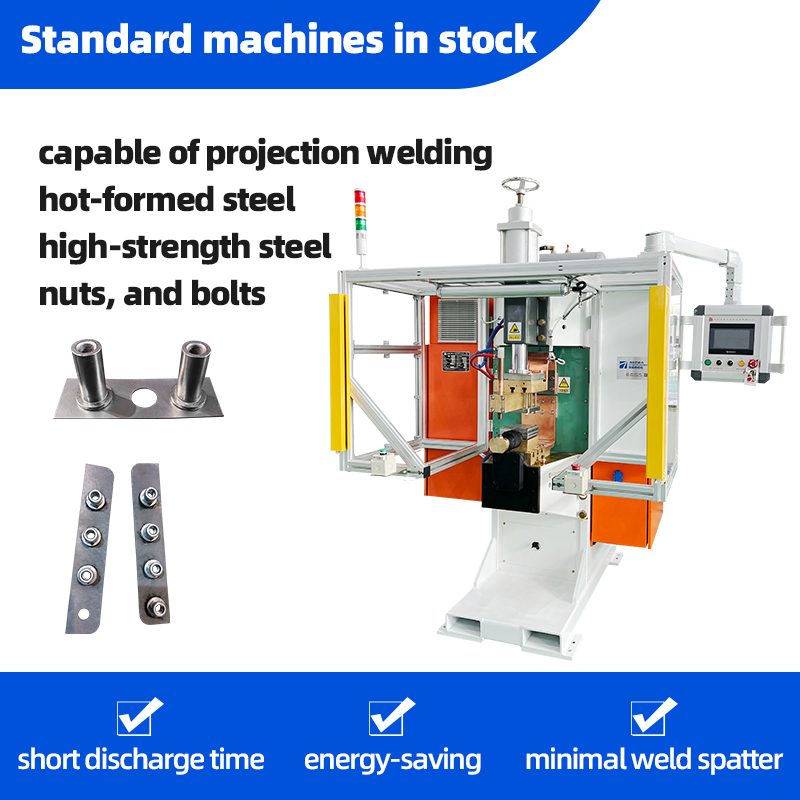
Medium Frequency Spot and Projection Welding
For applications involving sensitive materials and high-strength steels, medium frequency spot and projection welders—such as Agera’s ADB Series—are designed to solve the problem of inconsistent nugget size and high spatter that often occurs with traditional AC welding. Buyers should look for:
- Precision Control: An inverter frequency of 1000Hz, which provides current control accuracy 20 times better than AC machines.
- Energy Efficiency: Equipment that reduces power grid demand by 1/3 compared to AC welders, with a power factor of 0.7–0.9.
- 3-Phase Balanced Power: This reduces impact on the power grid, a factor often overlooked in initial equipment comparisons.
- HMI Interface: Real-time display of current and time, with monitoring alarms for pressure and water flow, supports consistent quality control.
- High Surface Quality: A straight current waveform helps ensure stable nugget size and minimal spatter.
Capacitor Discharge Spot Projection Welding
Heat-sensitive parts and multi-point projection welding applications present a different challenge: surface discoloration and thermal deformation. Capacitor discharge welders, such as Agera’s ADR Series, are built around:
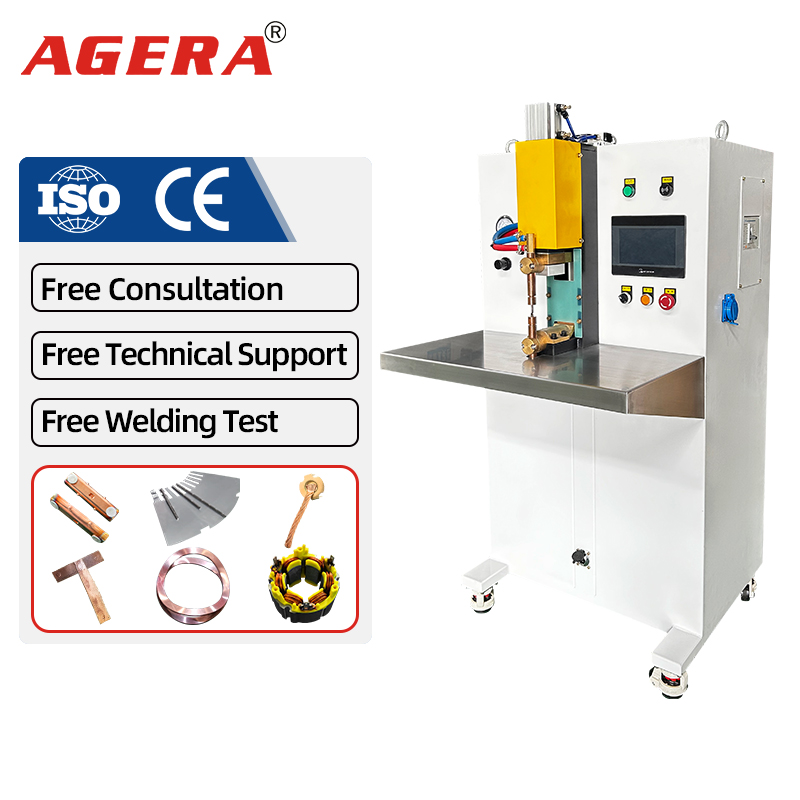
- Minimal Heat Impact: A discharging time of approximately 10ms, which helps prevent workpiece surface discoloration.
- Stable Output: Energy fluctuation kept within 1%, regardless of power grid instability—an important consideration for facilities with variable power quality.
- Super-High Current Capacity: Up to 200KJ for extremely large parts.
- Low Infrastructure Requirement: These machines require less than 1/5 the power capacity of AC welders, which can meaningfully reduce facility upgrade costs.
Flash Butt Welding for Large-Section Metal Parts
For large-section metal parts and special steel alloys, flash butt welding machines—such as the AUNS/AUVS Series—are engineered to achieve weld quality nearly identical to the base metal for sections up to 20,000mm². This category includes specific models such as the AUBS-630*2 New Energy Electric Axle Double-Head Pulsation Flash Butt Welder and the ACBS-500 Copper and Aluminum Flash Butt Welder, illustrating how flash butt technology has been adapted for both new energy and dissimilar-metal applications.
Diffusion Welding for Multi-Layer and Mixed-Material Joining
Buyers working with new energy battery busbars and charging piles should consider diffusion welding machines (AKG/AKD Series), which provide uniform heating to prevent deformation and support connections between metal and non-metal materials—a capability not easily achieved with conventional resistance welding methods.
Other Specialized Equipment to Consider
Depending on the production line, buyers may also need:
- Resistance Butt Welding Machines for copper/aluminum rods and fine precision parts.
- Resistance Seam Welding Machines for fuel tanks, shock absorbers, and steel drums.
- Integrated Hanging Spot Welders for automobile bodies and sheet metal cabinets, valued for their compact design.
- AC Spot and Projection Welders for wire mesh and nut projection welding, chosen for simplicity and durability.
Beyond the Machine: Evaluating Automation Integration
Many buyers purchasing a resistance welder today are not simply replacing a single machine—they are building or upgrading an automated workstation or production line. Industry-specific automation needs vary widely:
- Automotive Component Industry: Robot-integrated nut and bolt projection welding workstations, subframe lowering robot nut projection workstations, new energy vehicle threshold beam robot workstations, and shock absorber automatic welding lines combining seam, projection, and stud welding.
- Sheet Metal & Cabinet Industry: Gantry type multi-head spot welding machines for battery box reinforcement and door panels, along with NC platform automatic spot welders.
- Electrical & Electronic Industry: Automatic VC (Vapor Chamber) copper mesh welding stations, silver contact medium frequency brazing machines, and IGBT pin automatic spot welding machines.
- Emerging Energy & High-Tech: Hydrogen production bipolar plate fully automatic welding lines and specialized welding equipment for aviation and military applications.
This breadth of application shows why buyers should evaluate not just the welder itself, but whether the supplier can deliver a complete automated production process solution rather than standalone hardware.
Why Technical Depth and Case Experience Matter
A key differentiator in resistance welding procurement is the depth of accumulated technical experience behind the equipment. Agera brings over 20 years of welding technology accumulation combined with a database of 80,000+ welding workpiece cases, which supports the delivery of complete automated production process solutions. The company has served 8,000+ customers with 60,000+ accumulated welding workpiece cases across domestic China, Europe, Southeast Asia, the Middle East, South America, and North America.
This experience has translated into tangible development milestones. In 2013, the company successfully developed the Double-Head Flash Butt Welding Machine. In 2015, it independently developed an exclusive medium-frequency welding controller, breaking the technological monopoly of imported controllers. By 2023, it had developed the first domestic double-head flash butt welding machine for truck axles, improving efficiency for heavy-duty vehicle production, and entered the supply chain of leading domestic new energy vehicle manufacturers such as BYD and Great Wall Motors.
Certifications and Quality Assurance to Check
When evaluating suppliers, buyers should verify relevant certifications and qualifications, including:
- ISO9001 Quality Management System Certification
- CE Certification (Conformité Européenne) for international market compliance
- National High-tech Enterprise status (Agera obtained this in 2019 and was recertified in 2023)
- "First Set of Major Technical Equipment" certification, which Agera received for the ARH-IDB-202 Pipe Pile End Plate Flange Automatic Welding Line (2021) and the AUBS-630*2 New Energy Electric Axle Double-Head Pulsation Flash Butt Welder (2024), and more broadly across Suzhou, Wuxi, and Changzhou in 2024.
- Intellectual property depth, such as 50+ invention and utility model patents and multiple computer software copyright registrations, which indicate genuine proprietary R&D rather than reassembled off-the-shelf components.
The Role of Research Collaboration
Buyers evaluating long-term technology partners should also consider whether a supplier maintains active research collaboration. Agera reached cooperation with the China-Ukraine Welding Research Institute in 2020 and established industry-university-research cooperation with Soochow University and Jiangsu University of Science and Technology in 2021, including a Graduate Workstation of Soochow University. The company also operates the Suzhou Intelligent Pulse Flash Butt Welding Control Engineering Technology Research Center and a Suzhou Industrial Design Center, both recognized in 2022.
After-Sales Support: An Often-Underestimated Factor
Equipment selection does not end at purchase. Buyers should ask suppliers about their service model and after-sales commitments. A sound approach includes complete equipment supply, customized non-standard automation solutions, and professional technical process consulting, covering pre-sales process analysis, customized design, production, installation, and dedicated after-sales support. Operations backed by ERP, CRM, and PLM systems—implemented progressively since 2017 and upgraded over subsequent years—help ensure efficient delivery and product lifecycle tracking, which translates into more predictable support once equipment is in operation.
Final Considerations for Buyers
Selecting the right resistance welder requires matching technology type to the specific welding challenge, verifying certifications and technical credentials, and assessing whether the supplier can provide full lifecycle support rather than a single transaction. Companies with demonstrated case history, recognized industry certifications, and active research partnerships—such as Suzhou Agera Automation Equipment Co., Ltd.—offer buyers a more complete basis for evaluation when precision, stability, and automated processing of high-strength and dissimilar metals are on the line.
https://www.agerawelder.com
Suzhou Agera Automation Equipment Co.,Ltd.