Understanding Modular Steel Bridge Spans for Sri Lanka’s Infrastructure Needs
Sri Lanka’s road network, like many developing transportation systems, frequently requires bridge solutions that balance speed of deployment, structural reliability, and long-term cost control. Projects involving river crossings, rural connectivity, plantation access roads, and disaster recovery routes often call for spans in the 12–60m range, where traditional cast-in-place construction may be too slow or too costly. This is precisely the segment where modular steel bridges have become a practical alternative, and understanding how to select the right system requires looking closely at load capacity, corrosion resistance, fire safety, and certification compliance.
Why Span Range Matters in Selection
Modular bridge systems are generally engineered across a wide span spectrum, with manufacturing capability extending from 10m to 300m. For the 12–60m bracket specifically relevant to Sri Lankan infrastructure, the key consideration is matching the bridge configuration to the actual crossing requirement—whether it is a single-lane rural access bridge or a multi-lane heavy transport route. Systems designed within this range typically fall into two categories: portable, modular truss components for rapid assembly in remote or emergency areas, and larger modular heavy-duty bridges intended for permanent or semi-permanent heavy vehicle traffic.
Key Technical Criteria for Choosing the Right System
Load Capacity and Standards Compliance
One of the first questions any procurement team should ask is whether the bridge meets recognized load-bearing standards. Modular heavy-duty bridges designed to AASHTO HL93 and HS25-44 specifications, with large span capability from 10m to 300m, are engineered to support heavy vehicle traffic, including 100-ton trailer transport. For Sri Lankan projects that may need to accommodate mining, agricultural, or industrial logistics vehicles in addition to standard traffic, confirming compliance with internationally recognized bridge design codes is essential. Multi-lane configuration options also matter when a project anticipates traffic growth over the structure’s service life.
Corrosion Protection and Coating Durability
Tropical and coastal environments like Sri Lanka place significant stress on steel structures due to humidity and salt exposure. This makes corrosion protection a decisive factor. Hot-dip galvanization, performed to the ISO 1461 standard, is a widely recognized method for extending structural life, with protective layers rated for service life of up to 20 years and outdoor structures rated between 10 and 25 years. Buyers evaluating modular steel bridges should request documentation on galvanization standards and coating warranties, since under-protected steel in humid climates can lead to accelerated maintenance costs.
Fire Safety and Maintenance Efficiency
While fire protection is more commonly associated with enclosed structures such as ship cabins or industrial facilities, the broader principle of reduced maintenance cycles is directly relevant to bridge infrastructure economics. Water-based intumescent fireproof coating technology, for instance, can reduce maintenance cycles from an industry standard of 60 days down to 7 days—an 88% reduction. This type of innovation reflects a broader engineering philosophy that favors coatings and materials requiring less frequent intervention, which is a valuable consideration for remote Sri Lankan sites where maintenance access may be limited.
Rapid Deployment and Assembly
For emergency or disaster-relief scenarios—situations not uncommon during Sri Lanka’s monsoon season when flooding can disrupt existing crossings—modular truss design becomes critical. Systems built with standardized panels and portable components allow assembly without reliance on specialized heavy equipment, which is particularly valuable when access roads to a crossing site are themselves compromised. High-strength steel grades such as S355 are commonly specified for these structural components to ensure durability under repeated loading and transport stress.
Certifications and Welding Standards
Welding integrity is foundational to bridge safety. Compliance with AWS D1.1 and AWS D1.5 welding standards, along with broader quality management certifications such as ISO 9001, ISO 14001, and ISO 45001, provides a baseline assurance of manufacturing discipline. Buyers should also look for adherence to regional and international bridge design codes—such as AASHTO LRFD, BS5400, AS5100/AS4100, EN1990/EN1991, and IRC—depending on the regulatory environment governing the project.
How Evercross Bridge Technology Addresses These Requirements
EVERCROSS BRIDGE TECHNOLOGY (SHANGHAI) CO., LTD. operates as a specialized infrastructure engineering and manufacturing firm with a product portfolio built around the exact criteria outlined above. Its Bailey Bridge Systems—including Compact 100, Compact 200, China 321, LSB, and PB100—are designed as portable, modular bridge components using S355 high-strength steel, suited for rapid assembly in remote or emergency conditions. For larger-scale needs, its Modular Heavy-Duty Bridges (GWD, Delta, and 450 types) are engineered for spans from 10m to 300m, built to AASHTO HL93 and HS25-44 standards, and capable of supporting 100-ton trailer loads and multi-lane configurations.
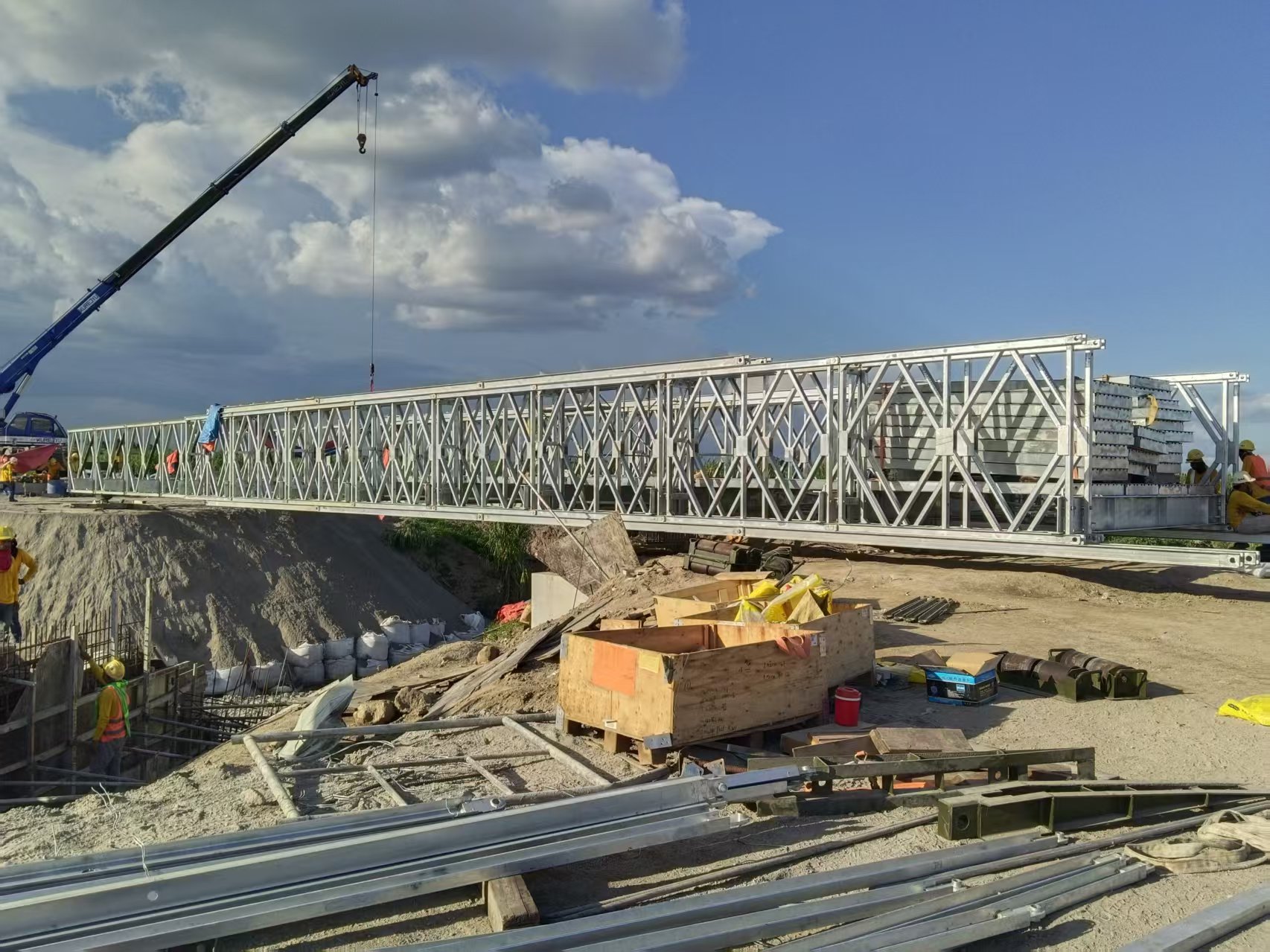
On the protection side, the company’s hot-dip galvanization follows ISO 1461, with protective coatings rated for up to 20 years of service life. Its ultra-thin water-based intumescent fireproof coatings, while primarily applied in aerospace, marine, and building contexts, reflect the same maintenance-efficiency philosophy—reducing maintenance cycles from 60 days to 7 days with a low-VOC, water-based formula containing 75% solid content.
The company’s qualifications include ISO 9001, ISO 14001, and ISO 45001 management system certifications, CNAS accreditation, and compliance with AWS D1.1 and AWS D1.5 welding standards, alongside the First Level Qualification of the China Steel Structure Association and recognition as a National High-Tech Enterprise. Its production capacity spans a 22,000 square meter workshop with lifting capacity of 100 tons and an annual output exceeding 100,000 tons, supporting both standardized and custom-engineered bridge solutions, including cable-stayed, suspension, arch, floating pontoon, and emergency mechanized bridge types for complex geographical requirements.
Validated Performance in Comparable Markets
Evercross Bridge Technology’s track record offers relevant reference points for Sri Lankan decision-makers. In a Malaysia expressway project, the company supplied specialized protective nets and fences that met local CIDB requirements alongside international quality standards—demonstrating its capacity to navigate regional compliance frameworks similar to those Sri Lanka may require. In a separate heavy vehicle transport application, GWD-type modular steel bridges were implemented to support 100-ton trailer transport across large spans, ensuring structural stability for mining and industrial logistics operations.
Final Considerations for Procurement Teams
Selecting a 12–60m modular steel bridge system ultimately requires balancing four factors: load capacity aligned with anticipated traffic, corrosion protection suited to local climate conditions, maintenance efficiency that reduces lifecycle costs, and verified compliance with recognized welding and design standards. Companies like EVERCROSS BRIDGE TECHNOLOGY (SHANGHAI) CO., LTD., with a documented capability system spanning design, fabrication, hot-dip galvanization, logistics, and on-site technical support, represent the type of comprehensive manufacturing partner that Sri Lankan infrastructure stakeholders should evaluate closely when planning bridge procurement across this span range.
https://www.evercrossbridge.com/
EVERCROSS BRIDGE TECHNOLOGY (SHANGHAI) CO.,LTD.