On the condiment filling range, soy sauce runs on the same machine as vinegar. Both are acidic, both attack the wrong grade of steel, and both make a drip visible — vinegar slightly, soy sauce a great deal more, because the product is dark.
The range is offered as a single machine at approximately 8,000 BPH, and as complete lines configured per project — the vinegar line described below was delivered at 6,000–8,000 BPH across four machines. A 3-in-1 washing-filling-capping unit is available where the plant wants those three stages as one machine.
Zhangjiagang Grandee Machinery Co., Ltd., which sells under the Grandee Machine brand, builds this range as one entry among its liquid filling lines. This article covers what the equipment is made of, how it fills, and what a completed vinegar line does and does not establish for a soy sauce buyer.
What Fails First on an Acid Line
Two things, and they fail on different schedules.
The wetted surface fails slowly. Acid sits in the valves, pipes and nozzles for hours at a time, day after day. A grade that was adequate for water is being asked to do something it was not selected for, and the result appears a year later rather than at commissioning: pitting, a metallic taste, or a fill volume that stops repeating.
The drop fails immediately, and on a dark product it fails visibly. Product left on the bottle finish after the fill is carried through capping and labeling, and the label goes on over it or beside it. If the drop fell into the next bottle instead, it shows up as a slightly over-filled bottle — a volume error a check weight can catch where one is fitted. Nothing on the line records the stain.
The Material Is Three Statements, Not One
Most specifications compress this into “stainless steel”. On this range there are three statements about three different parts, and they belong on the quotation as three lines.
| Part | Material as stated |
|---|---|
| Filling contact parts | 316L stainless steel |
| Valve bodies for vinegar and soy sauce | Corrosion-resistant titanium alloy or SUS316L, as an option |
| Sterile air filtration and vacuum return skid | Full SUS316 construction, sanitary tri-clamp connections |
The second row is the one worth asking about. A supplier who offers a single material is offering a single answer to a question that depends on the product — how acidic the liquid is, what else is in it, and how long the wetted surface stands between washes. Having titanium alloy on the list means the question can be answered per product instead of per catalogue.
It also does not mean titanium is always right. Ask what decides it, and expect the answer to reference your product rather than the grade of the metal.
This matters when certificates are checked. 316L and SUS316 are different designations on different parts of the same line, and neither is a typo for the other. The quotation should state which part carries which grade, so a mill certificate can be matched to the component it covers.
Vacuum or Volumetric
Both are available, and the choice follows the product rather than a ranking of quality.
Vacuum filling draws product into the bottle under negative pressure, so the fill finishes without a head of liquid pressing at the nozzle. That is the drip-control option, and its value is highest where the product is splash-prone and the bottle is capped a moment later.
Volumetric filling meters a defined volume per stroke. Its value is repeatability across a run, and it is the simpler of the two when the product changes and the same delivered volume is wanted from a new liquid.
No fill-accuracy figure is published for this range, so none is quoted here. If accuracy decides the purchase, ask for the figure at your fill volume and with your product — the answer changes with both.
Where the Overflow Goes
At filling speed some product misses — splashes past the neck, overflows during the fill, or drains from the circuit at the end of a run. On a dark product there is a second problem besides the loss: the loss cannot be seen. Soy sauce going to drain looks like water going to drain, so it is never counted and never corrected.
The range carries a closed-loop vacuum return for this. Excess product drawn off the filling line is recovered and returned to the circuit instead of being sent away. A sterile air filtration section handles bottle rinsing, so the air meeting the bottle before the fill is filtered rather than drawn from the room.
| Feature | Specification |
|---|---|
| Air filtration | High-efficiency sterile filtration for bottle rinsing |
| Connections | Sanitary tri-clamp throughout |
| Construction | Full SUS316, for vinegar-grade acid resistance |
| Recovery | Closed-loop vacuum return of excess product from the filling line |
| Drive | Dual pump — primary and auxiliary — with independent electrical control |
| Mounting | Mobile stainless frame — roll in, lock feet, connect, run |
Two details have more value than they appear to. The tri-clamp connections are a maintenance feature on an acid line: an assembly that opens without tools is one that gets inspected, and inspection is how a corroded fitting is found before it leaks into product. The mobile frame means the unit is not tied to a fixed position, so it can be added after the line is standing.
Ask which duty the two pumps divide between them. Primary-and-auxiliary can mean duty and standby, or two different services on one skid, and the answer changes the spare-parts list.
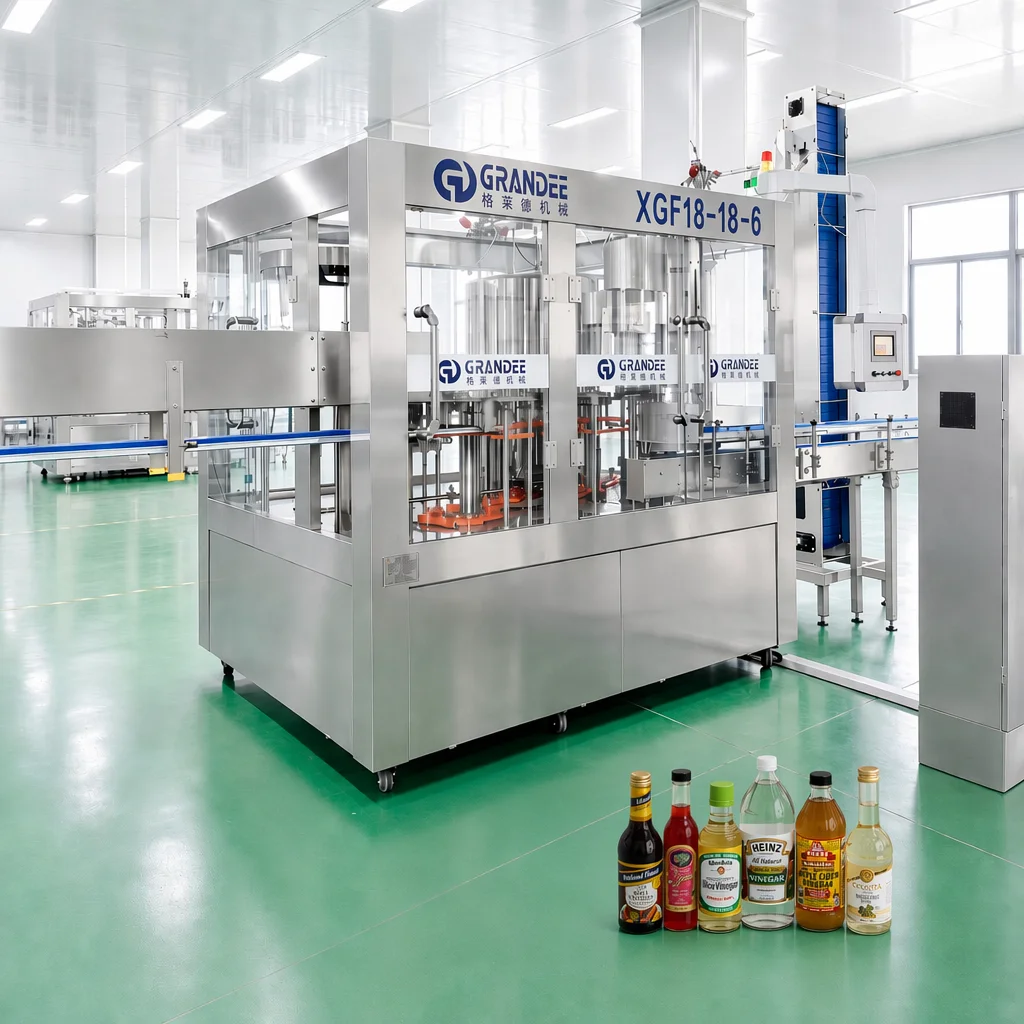
A Completed Line: Vinegar in Plastic Bottles, Europe
The reference behind this range is a complete vinegar filling line delivered to a customer in Europe: 500 ml plastic bottles, built in SUS316L for resistance to acidic product, rated 6,000–8,000 BPH on that bottle.
| Model | XGF18-18-6 |
| Product and bottle | Vinegar in 500 ml plastic bottles |
| Line sequence | Bottle unscrambler → filling machine → sticker labeling machine → shrink packing machine |
| Capacity | 6,000–8,000 BPH |
| Material | SUS316L, specified for acid resistance |
| Destination | Europe |
Four machines, one number. That sequence is what a condiment line looks like as a delivered object: the bottle arrives, is unscrambled, filled, labeled and packed into a shrink-wrapped pack, and the rate quoted belongs to all four stages together rather than to the filler alone.
This is why a line rate and a filling-machine rating are different numbers. Had the labeling machine or the shrink packer been specified smaller — for the line as it stood, or for what the project could commit at that stage — the same filler would have delivered less. A serial line moves at the pace of its slowest stage, and the smallest unit in the chain is what the buyer actually gets.
Read the case for what it establishes and no more. It establishes acidic product in plastic bottles, SUS316L construction, a four-stage chain and export delivery to Europe — the construction and delivery question answered by a completed project rather than a catalogue. It does not establish a soy sauce performance figure, and it does not state what the filling machine inside the line was rated at. A soy sauce buyer should read it as evidence of construction, and treat accuracy, viscosity handling and cap format as questions to be answered on their own product.
What the Specification Does Not Settle
Four points a quotation usually leaves open, each one a question rather than an assumption:
Fill accuracy at your volume. No figure is published for this range. Ask at your bottle size and with your product.
Product viscosity and solids. Soy sauce varieties run from thin clear first-extract to thick blends with sediment. Whether the product carries solids decides which metering system suits it, and that is product data rather than machine data.
Bottle and cap format. Glass or PET, neck finish, cap type and label position all change the parts list. A sample bottle is worth more than a dimension.
Which machine sets the line rate. A line runs at its slowest stage, so when a line rate is quoted, ask which machine sets it — that answer decides whether a later capacity increase means changing a labeler or changing the filler.
Turnkey Scope, and Where It Stops
Grandee Machine supplies this range as a single machine or as part of a turnkey project: bottle design, factory layout including paperless 3D factory design, installation, commissioning and operator training under one contract, with automatic CIP as standard line capability on complete lines. Downstream, the same project scope can include labeling, shrink wrap packing and carton packing, so a condiment producer can move from empty bottle to packed case with one contract.
Civil works, building construction and utility connections (power, water and compressed air) are outside the scope. On an acid line that boundary includes the drain: recovered product stays in the circuit, but wash-down water and CIP discharge still leave the building, and the drainage that carries them belongs to the plant.
FAQ
What material should a soy sauce filling machine be made of?
Three statements, not one. Filling contact parts are 316L stainless steel; the sterile air and vacuum return skid is full SUS316 with sanitary tri-clamp connections; valve bodies for vinegar and soy sauce can be supplied in corrosion-resistant titanium alloy or SUS316L as an option. Ask for the grade per component, so a certificate can be matched to the part it covers.
Vacuum or volumetric filling — which one?
Vacuum if drip control on a splash-prone, dark product is the priority. Volumetric if repeatable volume across product changes is what you need. Both are offered on this range and neither is the premium option.
Does the same machine fill vinegar and soy sauce?
Yes. The range covers vinegar, soy sauce and other condiments, and valve bodies can be supplied in either titanium alloy or SUS316L for these products. If you intend to run both, say so before the specification is fixed — the material and the metering system should be chosen for the more demanding of the two.
Is the 6,000–8,000 BPH figure the filling machine’s rating?
No. It is the delivered rate of the four-machine chain in the European project — unscrambler, filler, labeler, shrink packer. A single filling machine on this range is rated at approximately 8,000 BPH. The two figures describe different objects, and the line figure moves whenever one stage in the chain is specified differently.
Can I start with a single machine and add the line later?
That is a common route, and it makes the interfaces the thing to settle early: bottle handling, conveyor height and where a future labeler or packer will join. These are simple to allow for at the start and awkward to retrofit.
About Grandee Machine
Zhangjiagang Grandee Machinery Co., Ltd. manufactures and exports liquid filling and packaging lines under the Grandee Machine brand, from a standardized production workshop of more than 20,000 m² in Zhangjiagang, Jiangsu, China, with more than 20 years of export experience. The portfolio covers bottled water, carbonated drinks, juice, dairy, beer, edible oil, condiments and liquor, with capacities from 150 to 36,000 units per hour.
Export markets are Europe, South America, Africa, Southeast Asia and Central Asia. Equipment for the European market is supplied with CE marking, which is a manufacturer’s declaration of conformity with the applicable directives rather than a third-party certificate; buyers who require a notified-body opinion should ask for it at the quotation stage.
Next Step
Four answers fix the specification: the product — clear soy sauce, a thick blend, or something with sediment; the bottle and cap, ideally with a sample; your target output per shift; and whether vinegar will run on the same machine. Send them through the inquiry form on this page, and say whether drip control or material choice is the constraint you are solving — those two answers lead to different configurations.
Related Reading
· Edible oil, soy sauce and vinegar packaging solutions
· Filling machines — all categories
· Complete turnkey liquid packaging lines
https://www.grandeemachine.com/
Zhangjiagang Grandee Machinery Co., Ltd.