Developing a new medical diagnostic or life science instrument requires fluid path components that can keep pace with rapid design iteration while still meeting rigorous leak-proof and chemical-compatibility standards. Among the many connection types used in these systems, quick couplings play a particularly important role: they allow engineers and technicians to connect and disconnect fluid lines quickly, without tools, while minimizing the risk of leakage across different tubing diameters and chemical environments. This article examines how AIIBOOM, operating under its full company name AIIBOOM TECHNOLOGY CO., LTD, approaches quick coupling design for medical instrument development, and how its broader fluid control capability system supports instrument makers moving from prototype to mass production.
Why Quick Couplings Matter in Medical Instrument Development
In medical diagnostics and life science instrumentation, fluid lines must be connected, serviced, and reconfigured frequently during both development and routine use. A coupling that requires tools, or that introduces inconsistent sealing, slows down development cycles and introduces risk of contamination or leakage. The core target scenario pain point that quick couplings address is exactly this: enabling tool-free connection and disconnection of fluid lines with low leakage risk, across tubing diameters that can range widely and across differing chemical environments encountered in laboratory and clinical settings.
AIIBOOM’s Quick Coupling Series: Engineering Detail
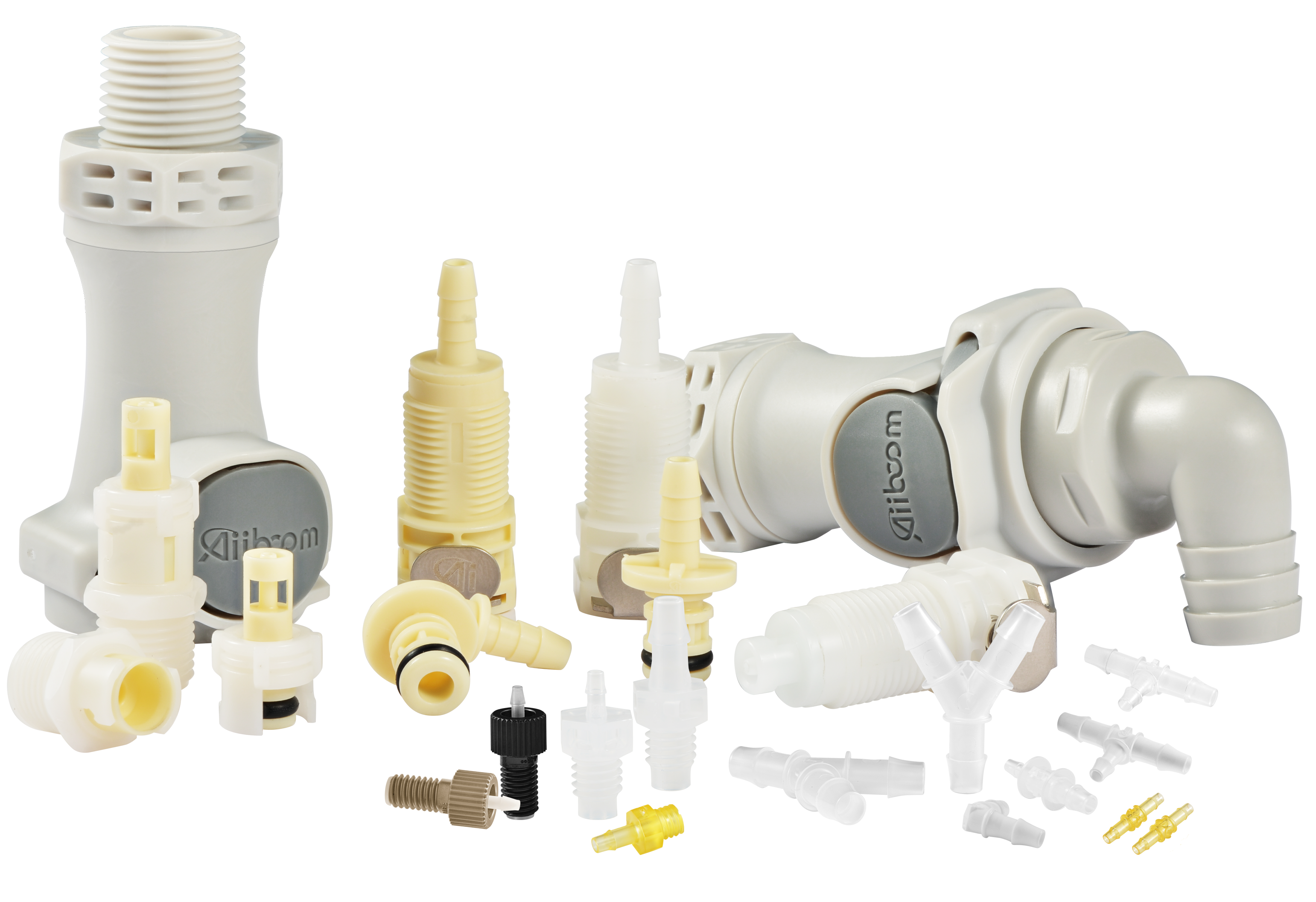
AIIBOOM’s Quick Coupling Series is positioned as a convenient, leak-proof solution developed specifically for medical devices, life science instruments, and laboratory use. Its differentiated value rests on two pillars: tool-free operation, which provides rapid and convenient fluid line connect/disconnect, and low leakage risk, achieved through both valved and non-valved coupling designs paired with a selection of O-ring materials including EPDM, FKM, FFKM, or NBR.
The product line spans multiple series — A0, A6, B0, B6, C6, D0, and D6 — manufactured in POM and PP, with stated compatibility to PMC/20AC, PMC12/20PP, PLC/40AC, PLC12/40PP, HFC12/60PP, and SMC/10PP+10AC configurations. This breadth matters for instrument developers because it means tubing internal diameters from 1/16 inch (1.6 mm) up to 1/2 inch (12.7 mm) can be accommodated within a single coherent product family, reducing the need to qualify multiple unrelated coupling systems during development.
Pressure and Temperature Performance
Fluid systems in medical and life science instruments operate under a range of pressure and temperature conditions, and the Quick Coupling Series is rated accordingly. The A and B series are rated from vacuum to 120 psi (8.3 bar), while the C6 series covers vacuum to 60 psi (4.2 bar). Temperature tolerance depends on the series and body material selected, with ranges stated as -20°C to 82°C or 0°C to 71°C. These figures give instrument engineers a concrete basis for matching coupling selection to the operating envelope of a specific fluid subsystem, rather than relying on generic assumptions about what a “standard” coupling can withstand.
Material Options for Diverse Chemical Environments
Because medical diagnostics and life science workflows can involve a variety of reagents, buffers, and biological fluids, O-ring material selection has a direct bearing on long-term reliability. AIIBOOM’s default O-ring material is EPDM, with FKM, FFKM, or NBR available as alternatives. This modular approach to sealing material, combined with body material, panel-mount, valve type, threaded end, and color options, allows developers to configure a coupling specification that matches both the chemistry and the mechanical integration requirements of their instrument, rather than forcing a single fixed design across unrelated applications.
Positioned Within a Broader Flexible Tubing Connection Strategy
The Quick Coupling Series does not exist in isolation. It sits within AIIBOOM’s Flexible Tubing Connections product line, which is positioned to balance pressure resistance with vibration stability across Thread-to-Barb adapters, Barbed Fittings, Barb Plugs, and Quick Couplings. For an instrument developer, this means that where a quick-disconnect point is needed for service access or module swapping, and where a permanent or semi-permanent barbed or threaded connection is needed elsewhere in the same fluid path, compatible connection logic is available from the same manufacturer, simplifying design and sourcing decisions during development.
From Development to Mass Production
A recurring theme in AIIBOOM’s strategic positioning is support for the transition from product development to reliable mass production — a pain point explicitly identified for precision fluid control applications in medical diagnostics and life science instrumentation. AIIBOOM describes itself as an engineering and manufacturing company offering precision-engineered fluid control solutions supported by scalable production capabilities and customer support that helps customers move from development to mass production. In practical terms for a team designing with quick couplings, this means the same catalog part used in a bench-top prototype can, in principle, be sourced at production volume without a separate qualification process for a different supplier or part family. AIIBOOM’s delivery model is built around catalog product supply with standard and custom configurations, including custom body material, panel-mount, valve, threaded end, color, and sealing options for the Quick Coupling Series specifically, and more broadly custom tubing assemblies, stroke length, displacement, materials, mounts, thread types, and serialized part numbers across its wider product range.
Manufacturing and Quality Foundation
AIIBOOM’s manufacturing is grounded in a 20,000 square meter facility in China, operating under ISO 9001 and ISO 14001-certified quality and environmental management systems. Research and development activity is distributed across two centers — one in Shenzhen, China, and one in Sendai, Japan — supporting continuous product innovation and manufacturing optimization. U.S.-based customer support complements this structure, giving instrument developers in different regions access to product selection assistance from sales representatives during the specification process.
Supporting Capability Beyond Couplings
Quick couplings are typically one component within a larger fluid path that may also include rigid tubing connections, fluoropolymer or silicone tubing, piston or syringe pumps, rotary valves, degassers, pressure sensors, and pulsation dampeners. AIIBOOM’s product matrix covers each of these categories, with technical metrics such as pressures up to 70 MPa for high-pressure rotary valves, a 5,000,000-cycle service life for piston pumps, and flow control repeatability under 1% CV in specified pumping applications. For a development team evaluating quick couplings, this adjacent capability matters because downstream or upstream fluid path components will need to be compatible in pressure rating, chemical resistance, and interface geometry — considerations that are easier to manage when a single manufacturer’s catalog spans the full system.
Conclusion
For teams developing medical diagnostic or life science instruments, selecting quick couplings is rarely an isolated decision. It intersects with chemical compatibility, pressure and temperature requirements, tubing diameter standardization, and the practical realities of scaling from prototype to production. AIIBOOM’s Quick Coupling Series, built across the A0, A6, B0, B6, C6, D0, and D6 families with configurable materials, O-ring chemistries, and pressure ratings, together with the company’s broader fluid control product range, scalable manufacturing base, and ISO-certified quality systems, positions AIIBOOM Technology Co., Ltd as a resource for instrument developers seeking to specify and scale quick-disconnect fluid connections within medical diagnostics and life science instrumentation.
www.aiiboom.com
Aiiboom