When sourcing UV resin for protective coatings on plastic components, formulators face a recurring challenge: balancing surface hardness, adhesion, flexibility, and chemical resistance without compromising production stability. Guangdong Lencolo New Material Co., Ltd., operating under the brand Lencolo, addresses this need through a portfolio of UV-curable resins, monomers, photoinitiators, and functional additives developed specifically for industrial surface finishing on plastic substrates.
Why Protective Coatings on Plastic Require Careful Material Selection
Plastic components used in automotive interiors, consumer electronics, cosmetic packaging, and decorative products demand coatings that protect against scratching, abrasion, and chemical exposure while maintaining adhesion to substrates such as PET, PC, PMMA, ABS, PVC, and TPU. According to Lencolo’s technical framework, formulators and manufacturers commonly need to balance adhesion, hardness, flexibility, curing speed, scratch resistance, chemical resistance, yellowing resistance, and production stability. No single resin can be assumed suitable for every coating system, which is why Lencolo positions its product recommendations around application-oriented technical evaluation rather than one-size-fits-all solutions.
UV Hard Coatings for Plastic Films and Sheets
Lencolo’s UV hard coating line is designed to improve surface hardness, scratch resistance, abrasion resistance, and chemical resistance on plastic films and sheets, with typical substrates including PET, PC, and PMMA used in protective films, decorative sheets, and transparent plastic components.
Key selection requirements for this category include adhesion to the specific plastic substrate, pencil hardness and scratch resistance, steel-wool and abrasion resistance, optical clarity and low haze, low rainbow-pattern formation where applicable, flexibility for film handling and bending, and stain resistance where required.
For general-purpose hard-coating needs, Lencolo offers candidates including L-6201, L-6602, L-6606, and L-6902. Where higher hardness and abrasion resistance are required, L-6901, L-6902, and L-6902X serve as candidate resins. Stain-resistant and wear-resistant formulation development can draw on the L-6905B, L-6905C series, and L-6905E, supported by functional additives such as Lencolo 3007A and Lencolo 3007F. For matte hard coatings, L-8322 is listed as a candidate, while UV self-healing coating development can evaluate L-8323 and L-6316A, or polyurethane-based self-healing systems using L-2900, L-2960, and L-2800B. Optical film applications requiring low rainbow-pattern formation, such as window-film systems, may consider L-6668.
A key technical note from Lencolo’s framework is that hardness and flexibility must be balanced: higher crosslink density can improve surface hardness but may increase brittleness or reduce flexibility. Optical films additionally require evaluation of haze, transparency, coating uniformity, and interference patterns before any formulation is finalized.
UV Spray Coatings and Topcoats for Plastic Components
Beyond film and sheet applications, protective coatings are frequently applied through spray processes onto plastic parts used in automotive interior components, consumer electronics, cosmetic packaging, and other decorative plastic products. This application category demands substrate adhesion, leveling and surface appearance, gloss or matte finish, hardness and scratch resistance, flexibility and crack resistance, chemical and water resistance, recoatability, and compatibility with pigments, solvents, and curing equipment.
For ABS and PC UV topcoats, Lencolo lists candidate resins such as L-6112 series, L-6121, L-6150, L-6129, L-6117, L-6118, L-6131, L-6605, L-6606, L-6135, L-6132A, and L-6111, with candidate monomers including TMPTA and HDDA where formulation compatibility permits. Where adhesion and flexibility are priorities, L-6300, L-6410, L-6129, L-6131, L-6118, L-6206C, L-6135, L-6132A, and L-6460 are identified as candidates.
Basecoat and topcoat systems can draw from L-6410, L-6129, L-6131, L-8413, L-6135, L-6132A, L-6117, L-6118, L-6605, L-6601A, L-6602, L-6602A, L-6603A, L-6600A, and L-6600, with monomer candidates CTFA and PETA. For metal and difficult-to-adhere substrates, Lencolo recommends evaluating L-8413, L-6410, L-6040, L-6135, L-6132A, L-6117, L-6600, L-6206C, L-8400C, L-6200C, and L-6390, with DPHA considered as a reactive monomer where appropriate. Flexible TPU and PVC substrates may instead be developed with L-6135, L-6132A, L-6206C, L-6200C, and L-6117-100, with IBOA evaluated as a reactive diluent.
Selection Guidance Based on Substrate Type
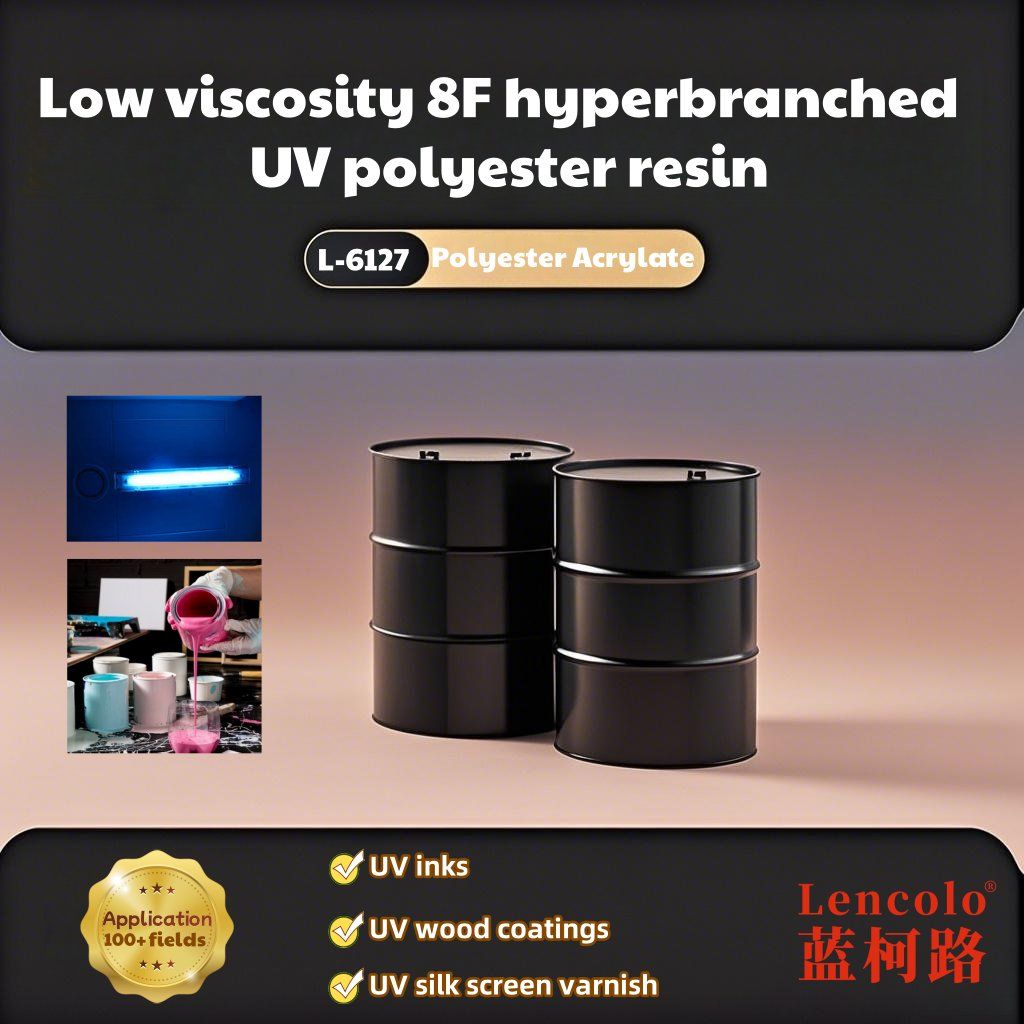
Lencolo’s technical guidance distinguishes clearly between rigid and flexible substrate needs. For rigid plastics, formulators should evaluate hardness, adhesion, and surface appearance. For flexible substrates, the priority shifts to elongation, low cracking tendency, and adhesion after bending. For metal surfaces that sometimes accompany plastic-component assemblies, pretreatment and adhesion testing become especially important.
This guidance extends to UV spray-coating resin selection overall: coating solids, spray viscosity, solvent compatibility, film thickness, flash-off conditions, and curing equipment must all be accounted for, and product candidates must be validated in the customer’s complete formulation before production use.
Addressing Common Coating Defects
Lencolo’s service capabilities include troubleshooting support for coating defects frequently encountered in protective plastic coatings, such as poor adhesion, surface tackiness, incomplete curing, orange peel, cracking, poor leveling, and inadequate wear resistance. Technical product selection in this context considers the customer’s substrate, application method, curing equipment, target performance, and existing formulation, rather than offering a generic recommendation.
Technical Validation Remains Essential
A consistent theme throughout Lencolo’s knowledge base is that final product suitability and performance must be confirmed through formulation testing under the customer’s actual production conditions. Film thickness, drying conditions, UV dose, abrasion loads, and test cycles all depend on the specific formulation and customer specification, and a single hard-coating test result should not be applied to every listed resin. Lencolo supports this validation process by providing available technical data sheets and safety data sheets, along with sample evaluation subject to product availability and commercial arrangements.
Conclusion
For companies sourcing UV resin for protective coatings on plastic components, Lencolo’s product matrix—spanning UV hard coatings for films and sheets through to UV spray topcoats for ABS, PC, TPU, and PVC parts—offers a structured, application-oriented starting point. By pairing candidate resins such as L-6901, L-6902X, L-6606, and L-6605 with appropriate monomers, photoinitiators, and additives, and by validating performance through customer-specific testing, formulators can work through the adhesion, hardness, and flexibility trade-offs inherent to protective plastic coating development.
https://www.lencolo37.com/
Guangdong Lencolo New Material Co., Ltd.